Mida.so vs VWO vs Optimizely vs Hotjar (2026): honest comparison
These four names cluster together in "A/B testing" searches, but only three of them actually run experiments. Hotjar shows up because it is often used in the same workflow, yet it does not test variants at all. Getting that distinction wrong leads teams to buy a heatmap tool when they needed an experimentation platform, or to over-buy Optimizely when Mida.so or VWO would have done the job for a fraction of the price. This guide separates what each tool really does, what it costs, how far its compliance goes, and where reviewers say it falls short.
| Metric | Mida.so | VWO | Optimizely | Hotjar |
|---|---|---|---|---|
| Category | Budget A/B testing + heatmaps | Experimentation + insights suite | Enterprise experimentation + DXP | Behavior analytics (not testing) |
| Best for | SMBs and Google Optimize refugees | Mid-market CRO teams | Large enterprises with RevOps/eng | Product/UX teams wanting the "why" |
| Server-side / feature flags | No | Yes | Yes (core strength) | No |
| Starting price | Free (100k MTU), then $299/mo annual | ~$314/mo (free tier ending) | Quote-only (~$36k/yr floor reported) | Free (200k sessions), then ~$49/mo |
| Verified compliance | Unverified | SOC 2 + ISO + HIPAA (first-party) | SOC 2 + ISO + FedRAMP/TISAX (first-party) | SOC 2 + ISO via Contentsquare + PII masking |
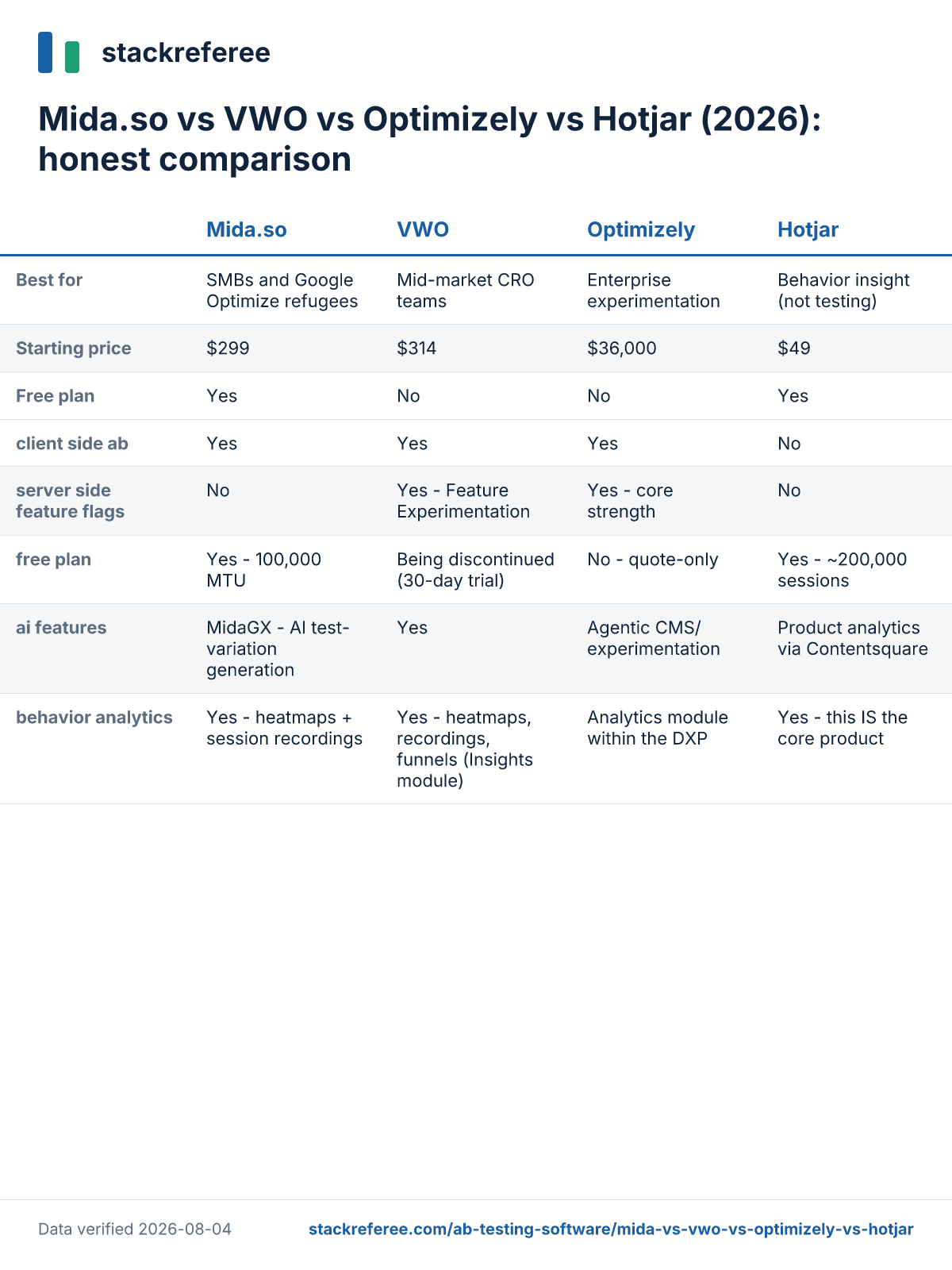
Two caveats frame the whole comparison. First, Hotjar being "missing" A/B testing is not a weakness; it is a different category, and it is included here because so many teams weigh it against testing tools. Read the notes as "what job does this do." Second, on data quality: G2 and TrustRadius blocked direct access during research, so their ratings are cited from search listings as directional, never as fact, and Optimizely and Hotjar render their live prices through JavaScript that could not be read, so their figures come from third-party sources and should be reconfirmed on the vendor's own page. Verbatim quotes below are only the ones read first-hand on Capterra. Prices were checked on August 4, 2026.
What is Mida.so
Mida.so is a budget-priced, AI-assisted A/B testing and heatmaps tool aimed at SMBs and solo operators, positioned explicitly as an affordable replacement for the retired Google Optimize and for pricier tools like VWO and Optimizely. Its core job is client-side visual A/B and split testing through a visual editor, with variants, goals and conversion tracking, plus heatmaps and session recordings and an AI feature that generates test variations from a prompt. It is the smallest and newest of the four, and it is not a server-side or feature-flag experimentation platform.
What is VWO
VWO is a full mid-market experimentation and behavior-insights suite. It runs client-side visual A/B, split-URL and multivariate tests, and it also offers server-side Feature Experimentation (feature flags), heatmaps, session recordings, funnels and personalization, sold as separate modules. Its typical user is a mid-market to lower-enterprise conversion-optimization team that wants testing and analytics under one roof. It is more capable than Mida.so and less heavy and expensive than Optimizely, occupying the practical middle of the market.
What is Optimizely
Optimizely is the enterprise experimentation platform, now embedded in a full digital experience platform. It offers client-side Web Experimentation and server-side Feature Experimentation alongside a CMS, content marketing, commerce, personalization and analytics. It is the only true enterprise, server-side-first experimentation vendor of the four, aimed at large organizations with dedicated experimentation and engineering teams. It publishes no prices, and its statistical engine and governance features are built for running large, high-stakes experimentation programs.
What is Hotjar
Hotjar is a behavior analytics tool, not an A/B testing platform. Its core job is heatmaps, session recordings, surveys and funnels, answering what users do and why rather than which variant performs better. It has no native server-side experimentation and no feature flags. Since the Contentsquare acquisition in 2025 its pricing page redirects to Contentsquare and the product is being folded into Contentsquare's packaging. Its user is an SMB-to-mid-market product, UX or marketing team doing qualitative research, and it belongs in this comparison as the "understand why" complement to a testing tool.
Mida.so: pros and cons
The cheapest real A/B testing option here. Mida.so's free plan covers 100,000 monthly tested users, and its paid Growth plan is $299/month billed annually with every feature unlocked, no per-feature gating. For a small team priced out of VWO or Optimizely, it is the clear value pick.
A genuine Google Optimize replacement, with AI test generation. Reviewers adopted it specifically to replace the retired Google Optimize. On Capterra, a CTO wrote that "Google Optimize used to be our go-to AB testing solution" and that Mida "is easy to use, quick to setup and provides all the reporting data you need." Its AI variation generator is a real differentiator at this price.
Reliability wobbles show up in reviews. The most substantive critique is dependability. A CIO on Capterra wrote that "when it works, it was good," but that "dependability, however, left things to be desired," noting the tool "would suddenly stop seeing our domains." For a testing tool, silent gaps in tracking matter, so validate it against your own traffic during a trial.
The newest and smallest vendor, with a thin track record. Mida.so has far fewer reviews than the others (only a couple on G2), which means less independent signal to lean on. It is also client-side visual testing only, so if you need server-side experiments or feature flags it is not the tool.
Compliance could not be verified. No first-party trust center or SOC 2, ISO or HIPAA confirmation was found during research. As a small vendor it may simply have no formal attestation, but that is a real gap next to the other three, and worth asking about directly if you handle sensitive data.
VWO: pros and cons
Testing and insights in one platform. VWO spans A/B and multivariate testing, feature flags, heatmaps, recordings and personalization, so a team can run experiments and understand behavior without stitching tools together. Its review base is large and positive, the biggest among the dedicated testing tools.
The strongest published compliance of the group for a mid-market buyer. VWO's trust center states SOC 2 Type II, multiple ISO 27000-series certifications, PCI DSS and compliance with GDPR, CCPA and HIPAA, with certificates downloadable. For a buyer who needs documented compliance without Optimizely's price tag, that is a strong position.
Modular pricing gets expensive as add-ons stack. The recurring critique is cost. On Capterra, a CEO listed "its high price relative to its features" and "occasional bugs in the editor" as the main drawbacks, and real-world contracts that bundle Insights and Personalization add-ons run well into five figures per year. Map exactly which modules you need before signing.
Prices are opaque and the free tier is going away. VWO's public pricing renders through JavaScript that could not be read during research, so the figures here come from third-party sources and should be reconfirmed. Multiple 2026 sources also report that the permanent free plan is being discontinued in favor of a 30-day trial, so do not count on a free tier.
Optimizely: pros and cons
The most powerful, enterprise-grade option. Optimizely offers true server-side experimentation and feature flags, deep integration with its digital experience platform, and a mature statistical engine with governance built for large programs. For an organization running experimentation at scale across engineering teams, it is the most capable tool here.
The broadest enterprise compliance. Its trust center states ISO 27001, ISO 27017, ISO 27018, SOC 2 Type 2, PCI DSS and TISAX, plus HIPAA, GDPR and CCPA, with FedRAMP also reported. Certificates are shared under NDA. For regulated or public-sector buyers, that stack is a genuine differentiator.
By far the most expensive, and the only fully opaque pricing. Optimizely publishes no prices; its page states that "every Optimizely plan is individually packaged." Third-party marketplaces report a floor around $36,000/year, common deals from the tens into the hundreds of thousands, and note that the license is often only about two-thirds of the true cost once implementation and staffing are added. All of these figures are market-reported estimates, not vendor-confirmed.
Complexity and cost drive churn to cheaper tools. Its reviews score lower than Hotjar's or VWO's, and the recurring themes are a steep learning curve, the need for engineering resources, and difficulty justifying the cost against competitors. These are paraphrased from aggregated review sources rather than quoted directly, because G2 and TrustRadius could not be accessed during research, so treat them as directional sentiment. The practical implication is clear: Optimizely earns its price only if you will use its depth.
Hotjar: pros and cons
The best-loved and largest review base of the four. Hotjar's qualitative insight is what users praise. On Capterra, a regional director wrote that "Hotjar has provided us with such incredible insights about how prospects and customers actually interact with our website." Its heatmaps, recordings and surveys are easy for non-technical teams and widely liked.
A generous free plan and solid privacy engineering. The free tier covers about 200,000 sessions, and because Hotjar records real sessions it ships genuine privacy controls: automatic in-browser suppression of digits and email addresses, keystroke suppression on input fields, and consent prompts, so sensitive data is masked before it reaches Hotjar's servers. That consent-and-masking burden is specific to recording tools and does not apply the same way to the testing tools here.
It is not an A/B testing tool. This is the point to be honest about: Hotjar has no server-side experimentation and no feature flags, and it does not run statistical A/B tests. It pairs with a testing tool rather than replacing one. If your actual need is to test variants and measure a winner, Hotjar alone will not do it.
Post-acquisition pricing is harder to follow, and prices are rising. Since the Contentsquare acquisition the single product has been split into separately billed lines, so heatmaps-plus-surveys means two subscriptions, and session-based pricing scales steeply. On Capterra, a marketing technologist wrote that "the cost is way too high to scale up for an enterprise company," and post-acquisition price increases are a repeated complaint. The live Contentsquare prices could not be read during research, so reconfirm them directly.
Use-case comparison
"I want to start A/B testing cheaply." Mida.so. A generous free tier, flat all-features pricing and a fast setup make it the value entry point, provided you validate its tracking reliability during a trial.
"I want testing plus heatmaps and feature flags in one suite." VWO. It is the mid-market all-rounder with the strongest review base among testing tools and broad compliance, as long as you budget for modular add-ons.
"I run experimentation at enterprise scale with engineers." Optimizely. True server-side experimentation, deep platform integration and the broadest compliance, if you can justify a five-figure-plus commitment and will use the depth.
"I want to understand why users behave the way they do." Hotjar. The best qualitative-insight tool here, run alongside a testing tool rather than instead of one.
Pricing
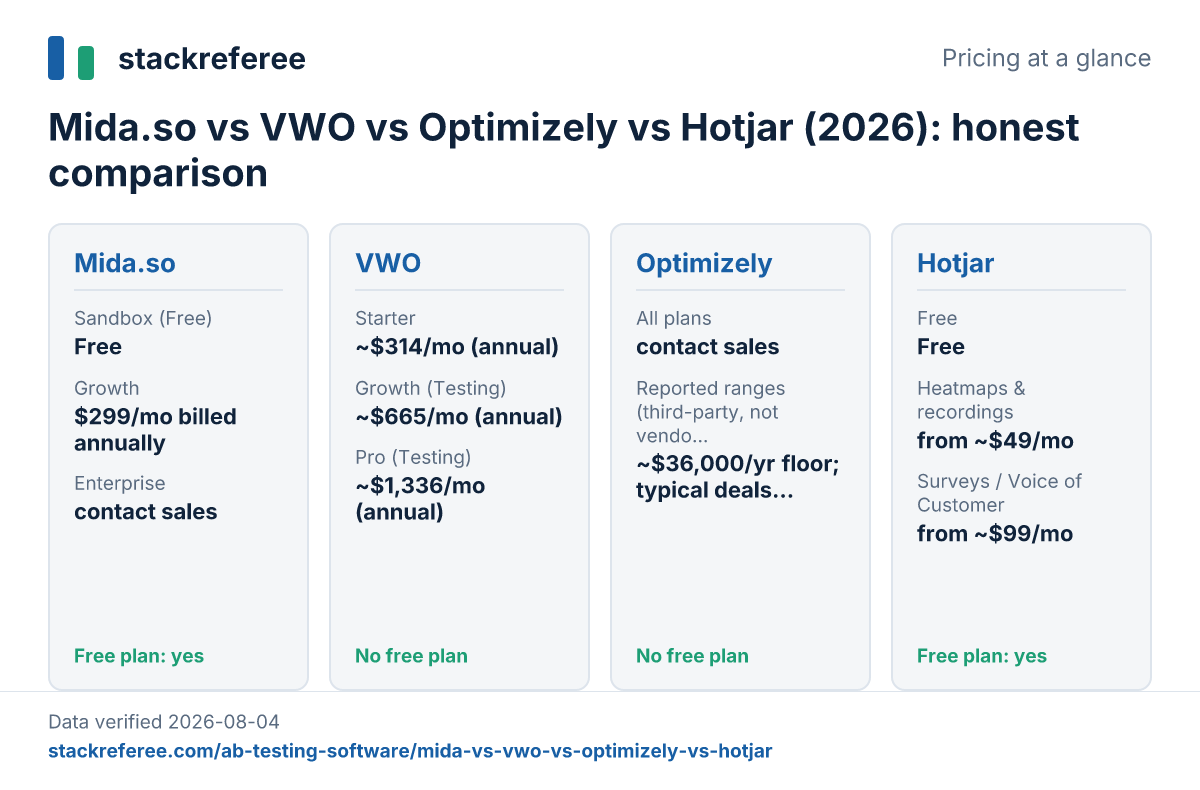
Every plan below was read from the vendor's own page on the verification date noted per tool, with two exceptions flagged inline where the live prices render through JavaScript that could not be read. The structural point matters more than any single number: Mida.so bills on monthly tested users with all features included, VWO bills per module and traffic, Optimizely is quote-only, and Hotjar bills on monthly sessions and now splits into separate product lines.
Mida.so pricing
- Sandbox (Free) — $0: 100,000 monthly tested users, 50,000 daily tracked events, 60-day retention, limited AI credits, 2 variants and goals, 2 active projects.
- Growth — $299/mo billed annually ($3,588/year): 100,000 monthly tested users, unlimited events and retention, unlimited AI credits, unlimited variants and goals, 5 active projects.
- Enterprise — custom: unlimited tested users and projects, dedicated support.
Pricing verified on mida.so/pricing, August 4, 2026. A separate one-time/lifetime deal page also exists. The monthly (non-annual) Growth rate is higher than the annual figure shown here.
VWO pricing
- Starter — around $314/mo billed annually for up to 10,000 monthly tested users (Testing only).
- Growth (Testing) — around $665/mo billed annually at 100,000 monthly tested users.
- Pro (Testing) — around $1,336/mo billed annually at 100,000 monthly tested users.
- Enterprise — quote-only. A permanent free plan is reportedly being discontinued in favor of a 30-day trial.
Pricing verified against vwo.com/pricing and third-party breakdowns, August 4, 2026. VWO's live pricing renders via JavaScript and could not be read directly; real contracts that bundle Insights and Personalization commonly run into five figures per year. Reconfirm on the vendor page.
Optimizely pricing
- All plans — contact sales. Optimizely publishes no prices and packages each product (experimentation, feature management, CMS, commerce, analytics) individually.
- Reported ranges (third-party, not vendor-confirmed) — a floor around $36,000/year, typical experimentation deals from roughly $40,000 into six figures, with implementation and staffing adding materially on top.
Pricing confirmed quote-only on optimizely.com/pricing, August 4, 2026. All dollar figures are market-reported estimates, not published by Optimizely.
Hotjar pricing
- Free — $0: about 200,000 sessions/mo, unlimited heatmaps, session replay, surveys, funnels and integrations, 1 project.
- Heatmaps and recordings — from about $49/mo (monthly) at roughly 7,000 sessions, scaling steeply to around $739/mo at 200,000 sessions.
- Surveys / voice of customer — billed separately, from about $99/mo, so heatmaps plus surveys is roughly $148/mo combined.
- Pro / Enterprise (product analytics) — custom-quoted.
Pricing verified via the hotjar.com/pricing redirect to contentsquare.com/pricing and third-party sources, August 4, 2026. The Contentsquare pricing table renders via JavaScript and did not expose numbers directly; reconfirm on Contentsquare.
What users say
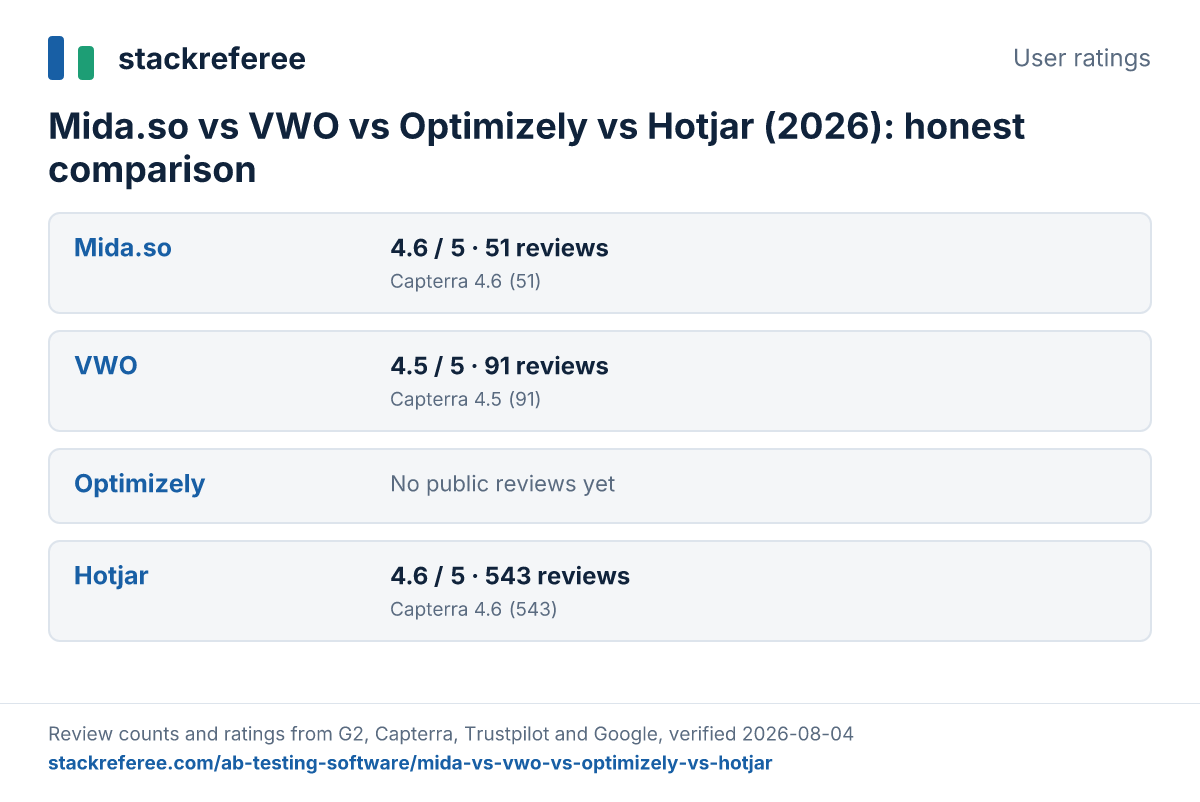
Ratings below come only from pages that could be verified first-hand. G2 and TrustRadius blocked direct access during research, so their numbers are cited from search listings as directional, and Optimizely has no verbatim quote here because its reviews could not be accessed directly.
- Mida.so — Capterra: 4.6 from 51 reviews, with value for money and ease of use rated highest. Reviewers praise it as a fast, cheap Google Optimize replacement; the recurring caution is reliability ("would suddenly stop seeing our domains").
- VWO — Capterra: 4.5 from 91 reviews, and a large positive G2 search listing (roughly 4.4 from around 900 reviews). Praised for combining testing with heatmaps and integrations; criticized for high price relative to features and occasional editor bugs.
- Optimizely — its G2 search listing shows roughly 4.2 from around 400 reviews for Web Experimentation, the lowest of the group and not verifiable on-page. Aggregated themes point to power offset by cost and complexity; no verbatim quote is stated here because the reviews could not be read directly.
- Hotjar — Capterra: 4.6 from 543 reviews, with the largest, most positive footprint of the four (its G2 and Trustpilot search listings are similarly high). Praised for qualitative insight; criticized for post-acquisition price increases and confusing tiers.
Verdict by use case
There is no single winner, because these tools are not all solving the same problem. Choose by the job in front of you.
For affordable A/B testing, choose Mida.so. It is the cheapest real testing tool here, with a generous free tier and flat pricing, offset by a thinner track record and reliability wobbles you should verify against your own traffic before committing.
For a mid-market testing-plus-insights suite, choose VWO. It combines experimentation, feature flags and behavior analytics with strong, documented compliance, as long as you budget for modular add-ons and reconfirm its opaque pricing.
For enterprise experimentation, choose Optimizely, accepting that it is the most expensive and fully quote-only, and that it earns its price only if you have the engineering resources and program maturity to use its server-side depth.
For understanding user behavior, choose Hotjar. It is the best qualitative-insight tool here, but it is behavior analytics, not experimentation, so run it alongside a testing tool rather than expecting it to test variants for you.
The honest shape of this market is a testing ladder plus one analytics tool: Mida.so, VWO and Optimizely ascend from SMB to enterprise on price and power, while Hotjar sits beside all of them answering "why." A common pairing is a testing tool for the experiment and Hotjar for the behavioral context behind the result. We take no vendor payment to rank these tools; read our editorial policy.
Recap table
| Mida.so | VWO | Optimizely | Hotjar | |
|---|---|---|---|---|
| Core job | Budget client-side A/B testing + heatmaps | Experimentation + insights suite | Enterprise experimentation + DXP | Behavior analytics (not testing) |
| Server-side / feature flags | No | Yes | Yes (core strength) | No |
| Client-side visual A/B | Yes | Yes | Yes | No |
| Starting price | Free (100k MTU), then $299/mo annual | ~$314/mo (free tier ending) | Quote-only (~$36k/yr floor reported) | Free (200k sessions), then ~$49/mo |
| Verified compliance | Unverified | SOC 2 + ISO + HIPAA (first-party) | SOC 2 + ISO + FedRAMP/TISAX (first-party) | SOC 2 + ISO via Contentsquare + PII masking |
| Verified reviews | Capterra 4.6 (51) | Capterra 4.5 (91) | G2 ~4.2 (~400), not on-page verified | Capterra 4.6 (543) |
| Biggest caveat | Reliability + thin track record | Modular price stacking | Cost + complexity, opaque pricing | Not a testing tool; price hikes post-acquisition |
Pricing and compliance details were verified against each vendor's own pages on August 4, 2026, except where noted that live prices render via JavaScript. G2 and TrustRadius ratings could not be verified on-page and are cited as directional only. Prices and plans change; reconfirm before purchasing.
Frequently asked questions
Are Mida.so, VWO, Optimizely and Hotjar all A/B testing tools?
No, and this is the most common mistake buyers make. Mida.so, VWO and Optimizely are A/B testing and experimentation tools. Hotjar is a behavior analytics tool: heatmaps, session recordings and surveys. It tells you what users do and why, not which variant wins, and it has no server-side experimentation or feature flags. Most teams run Hotjar alongside a testing tool, not instead of one.
Which is the cheapest way to start A/B testing?
Mida.so. It has a genuinely generous free plan (100,000 monthly tested users) and its paid Growth plan is $299/month billed annually with every feature included. VWO's entry Starter tier is roughly $314/month and its permanent free plan is being wound down, while Optimizely is quote-only and starts in the tens of thousands per year. Prices were read from each vendor's own page on August 4, 2026.
Which one runs server-side experiments and feature flags?
VWO and Optimizely. VWO offers Feature Experimentation alongside its visual testing, and Optimizely's server-side Feature Experimentation is a core strength. Mida.so is client-side visual testing only, and Hotjar does not run experiments at all. If you need feature flags and server-side rollouts, the choice is between VWO and Optimizely.
Why is Optimizely so much more expensive?
Optimizely is an enterprise experimentation platform embedded in a wider digital experience platform, sold to large organizations with dedicated experimentation and engineering teams. It publishes no prices; every plan is quote-only. Third-party marketplaces report a floor around $36,000/year and typical deals from the tens into the hundreds of thousands, and the license is often only part of the true cost once implementation and staffing are counted. Those figures are market-reported, not vendor-confirmed.
Did Hotjar's pricing change after the Contentsquare acquisition?
Yes. Since Contentsquare acquired Hotjar in 2025, hotjar.com/pricing now redirects to Contentsquare, and the single Hotjar product has been split into separately priced lines (heatmaps and recordings on one plan, surveys on another) billed by monthly sessions. The free plan is generous (about 200,000 sessions), but combining heatmaps and surveys means two bills, and post-acquisition price increases are a recurring complaint. Verify current numbers on Contentsquare directly.
Which has the strongest verified compliance?
Optimizely and VWO both publish broad, first-party certifications. Optimizely states ISO 27001, SOC 2 Type 2, PCI DSS and TISAX plus HIPAA, GDPR and CCPA. VWO states SOC 2 Type II, several ISO 27000-series certifications, PCI DSS and GDPR, CCPA and HIPAA. Hotjar's certifications run through the Contentsquare trust center. Mida.so's compliance could not be verified first-hand and should be treated as unconfirmed.
Comments
No comments yet.