Surge AI vs Qokedas vs Scale AI: 2026 Full Comparison
Picking a training-data vendor gets harder once you move past "which one has the most logos on its homepage." Two of these three companies won't tell you a price until you talk to sales, and the third doesn't have a product page to click through yet. This guide sticks to what each company has actually published, links every claim back to its source, and tells you plainly where the public record runs out. For more context on how this category is shaping up, see our AI Training Data Platforms comparisons hub.
| Surge AI | Qokedas | Scale AI | |
|---|---|---|---|
| Best for | Managed RLHF programs with domain-expert annotators | Early-stage teams working with instrument/physical-world signal | Enterprises needing a full pipeline plus certified compliance |
| Starting price | Not published; contact sales | Not published; contact founders | Free tier, then pay-as-you-go; Enterprise is contact sales |
| Free plan | None published | None published | Yes: first 1,000 labeling units + first 10,000 images free |
| Core differentiator | RLHF platform proven on Anthropic's LLM assistant | Converts instrument signal into RL environments | Only platform combining self-serve, enterprise GenAI, and RLHF |
| Compliance (GDPR / SOC 2) | Unknown / Unknown | Unknown / Unknown | Unknown / SOC 2 Type II confirmed (plus ISO 27001, FedRAMP High, DoD IL4) |
| SSO/SAML | Unknown | Unknown | Unknown |
What is Surge AI
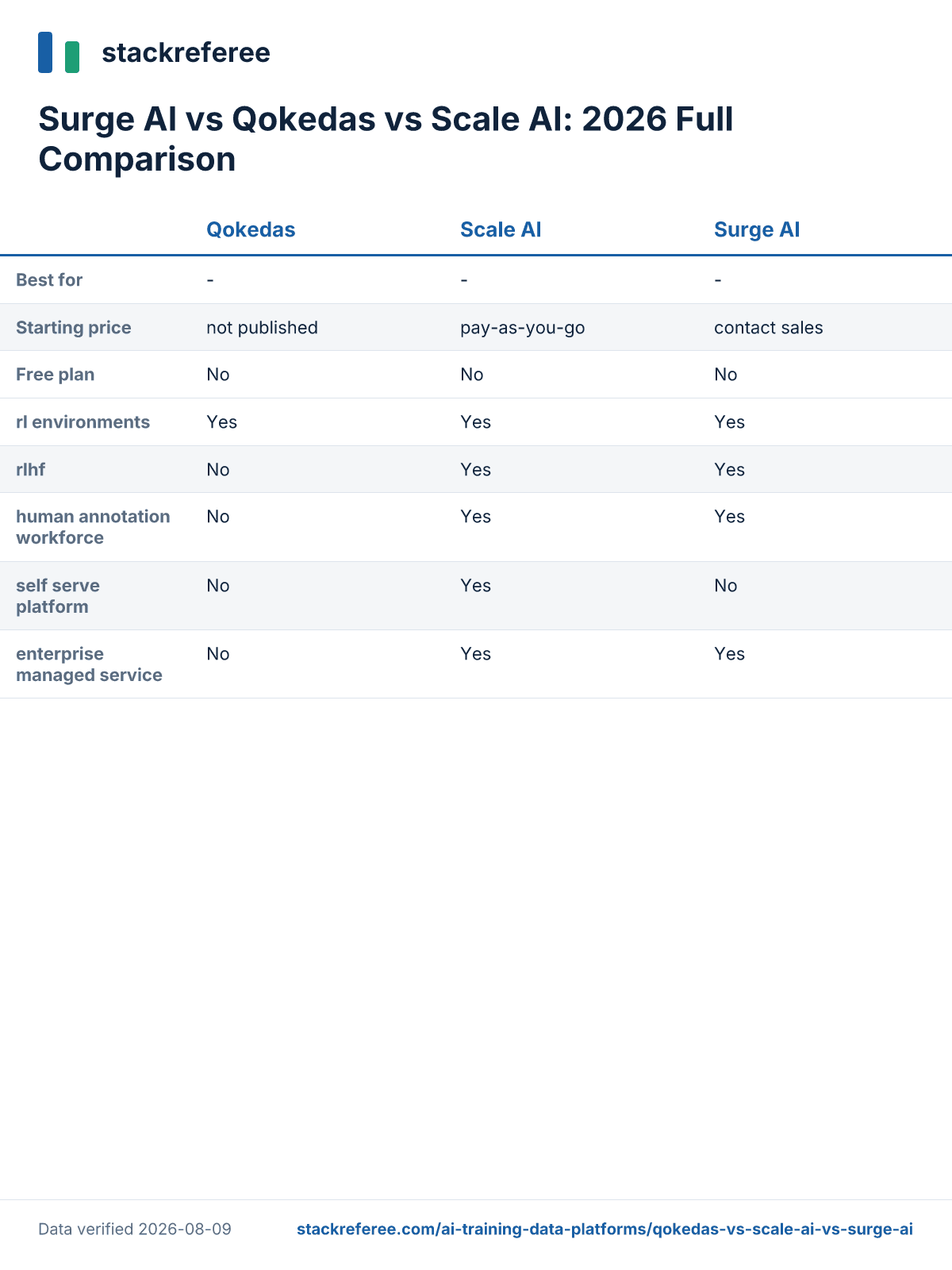
Surge AI is a data-labeling and RLHF company whose products page lists human annotation workforce, domain-expert annotators, RL environments, and enterprise-managed service delivery. It supports multimodal data and multiple languages, according to its own feature listing. The clearest public evidence of scale comes from Surge AI's own blog: Anthropic used Surge AI's RLHF platform to train its LLM assistant with human feedback. Surge AI does not publish a self-serve signup or an API, so every engagement runs through a managed, sales-led process. That positions it toward teams that want a vetted human-feedback pipeline handled for them rather than a platform they configure themselves. There is no public pricing page, and no first-party security or trust page could be located on surgehq.ai as of this review.
What is Qokedas
Qokedas is a pre-launch startup from Y Combinator's Fall 2026 batch, described on its YC page as "teaching models to decode the physical world." The company has 3 employees and, as of August 2026, no public product page, pricing page, or compliance documentation. Its feature listing confirms RL environments and multimodal data support, both consistent with a stated focus on converting instrument and physical-world signal into training environments rather than general-purpose text or image annotation. Qokedas has no reviews on any platform checked for this comparison. Prospective customers reach the team directly at wilhelm@qokedas.com rather than through a self-serve product. Treat every Qokedas claim here as provisional; a 3-person, pre-launch company's public footprint can change quickly.
What is Scale AI
Scale AI runs a Self-Serve Data Engine alongside an Enterprise offering that bundles its Data Engine with a GenAI Platform. Its feature listing is the most complete of the three: self-serve platform, enterprise-managed service, RLHF, human annotation workforce, domain-expert annotators, RL environments, multimodal data, model evaluation and benchmarking, API access, and multilingual support all confirm true. Scale AI's security page confirms SOC 2 Type II, ISO 27001:2022, FedRAMP High, and DoD IL4, a compliance set none of the other two tools in this comparison currently confirm. A customer case study with TIME appears on scale.com/customers, and an August 2026 blog post titled "Scale's next era: building for 2026" signals continued investment in its enterprise data engine and GenAI platform. Pricing beyond the published free tier is not public.
Surge AI: pros and cons
Pro: RLHF pedigree backed by a named customer
Anthropic used Surge AI's RLHF platform to train its LLM assistant with human feedback, according to Surge AI's own blog post on the partnership. That's a concrete, sourced case study rather than a generic claim, and it's rare among vendors in this category to have a named, verifiable production use case for RLHF specifically.
Pro: Domain-expert annotators as a confirmed capability
Surge AI's feature listing confirms domain-expert annotators, distinct from generalist crowdworkers. For specialized data, medical, legal, or technical content, that matters more than raw annotator headcount, since accuracy depends on subject-matter familiarity rather than volume alone.
Pro: Multilingual and multimodal coverage plus managed delivery
Surge AI confirms multilingual support, multimodal data, human annotation workforce, and enterprise-managed service. Combined, these suit organizations that want a vendor to run the annotation program end to end across languages and data types, rather than configuring a self-serve tool themselves.
Con: No self-serve platform
Self-serve platform is confirmed false in Surge AI's feature listing. Every engagement requires a sales conversation before you can start, which slows down small pilots and makes it harder to test the platform without committing to a larger scoped project first.
Con: No API access
Surge AI's feature listing confirms no API access. Teams that want to pipe labeling jobs directly into an ML pipeline programmatically will need to work around this with manual handoffs, unlike platforms in this comparison that expose an API.
Con: Pricing is completely opaque
No public pricing page exists on surgehq.ai. Third-party estimates exist but aren't sourced from Surge AI itself, so this comparison excludes them. Budget for a sales cycle before you know whether Surge AI fits your project's cost envelope.
Qokedas: pros and cons
Pro: A specific, stated niche
Qokedas describes its focus as converting instrument and physical-world signal into RL environments, per its YC company page. That's a narrower, clearer positioning than a generalist annotation vendor, useful if your training data genuinely comes from sensors or instruments rather than text or images.
Pro: Multimodal data confirmed
Qokedas' feature listing confirms multimodal data support, consistent with a physical-signal focus. If your project spans multiple data types tied to instrument output, this at least indicates the company built with that scope in mind from the start.
Pro: Direct access to the founding team
As a 3-person, pre-launch YC (Fall 2026) company, Qokedas doesn't have an account-management layer between you and the people building the product. Early customers can reach the founders directly at wilhelm@qokedas.com to shape what gets built.
Con: No published pricing
Qokedas has no pricing page. The only path to a quote is emailing the founders directly, which means you can't budget or compare costs against Surge AI or Scale AI without first starting a conversation.
Con: No confirmed compliance posture
GDPR, SOC 2, and SSO/SAML are all unknown for Qokedas, since no security or trust page could be found. For any project involving regulated or sensitive data, this is a real gap to resolve before committing, not an assumption to make in Qokedas' favor.
Con: No independent reviews or customer references
No reviews exist for Qokedas on any review platform checked, and no customer case studies are public. Buyers have no third-party performance evidence to lean on yet, unlike Surge AI's Anthropic case study or Scale AI's TIME case study.
Scale AI: pros and cons
Pro: Government-grade compliance confirmed
Scale AI's security page confirms SOC 2 Type II, ISO 27001:2022, FedRAMP High, and DoD IL4. Neither Surge AI nor Qokedas confirms any of these certifications publicly, which makes Scale AI the clearer choice for regulated or government-adjacent workloads today.
Pro: The most complete feature matrix of the three
Scale AI is the only platform in this comparison confirming all ten capabilities checked: self-serve platform, enterprise-managed service, RLHF, human annotation workforce, domain-expert annotators, RL environments, multimodal data, model evaluation and benchmarking, API access, and multilingual support.
Pro: A genuine free entry point
The first 1,000 labeling units for bring-your-own-workforce annotation and the first 10,000 images for data management are free before any paid commitment starts. That lets you test the self-serve product with real data before a sales conversation is required.
Con: No published rate card beyond the free tier
Once you exceed the free thresholds, Scale AI doesn't publish a per-unit or per-seat price. You either move to usage-based billing with an undisclosed rate or book an Enterprise demo, so cost planning still requires a conversation with sales.
Con: GDPR status isn't explicitly confirmed
Scale AI's public security page doesn't state GDPR compliance outright, and the full Trust Center certificate list sits behind a login that couldn't be accessed for this review. If GDPR is a hard requirement, confirm it directly with Scale AI's sales team.
Con: Verified reviews are thin
Capterra's Scale listing shows 0 reviews and Product Hunt's shows 0 reviews; GetApp UK's rating badge reflects 0 users despite the visual template score. For a company of Scale AI's size, independent review-platform validation is surprisingly sparse in the public record.
Use-case comparison
Regulated or government-adjacent workloads. If your project needs documented compliance you can point to in a vendor-risk review, Scale AI is the only one of the three confirming SOC 2 Type II, ISO 27001:2022, FedRAMP High, and DoD IL4 on a first-party security page. Neither Surge AI nor Qokedas confirms comparable certifications publicly as of this review.
Managed RLHF programs with subject-matter depth. If you want a vendor to run human-feedback labeling with domain-expert annotators rather than configuring a self-serve tool, Surge AI's confirmed track record with Anthropic's LLM assistant is the strongest sourced evidence in this comparison. Scale AI also confirms RLHF and domain experts, so it's worth comparing if you also want self-serve flexibility alongside the managed option.
Physical-world or instrument-signal training data at an early stage. If your data genuinely comes from sensors or instruments and you're comfortable working with a very early-stage vendor, Qokedas' stated focus is the narrowest fit among the three. Confirm compliance, pricing, and delivery timelines directly with the founders before committing, since none of that is public yet.
Pricing
Surge AI pricing
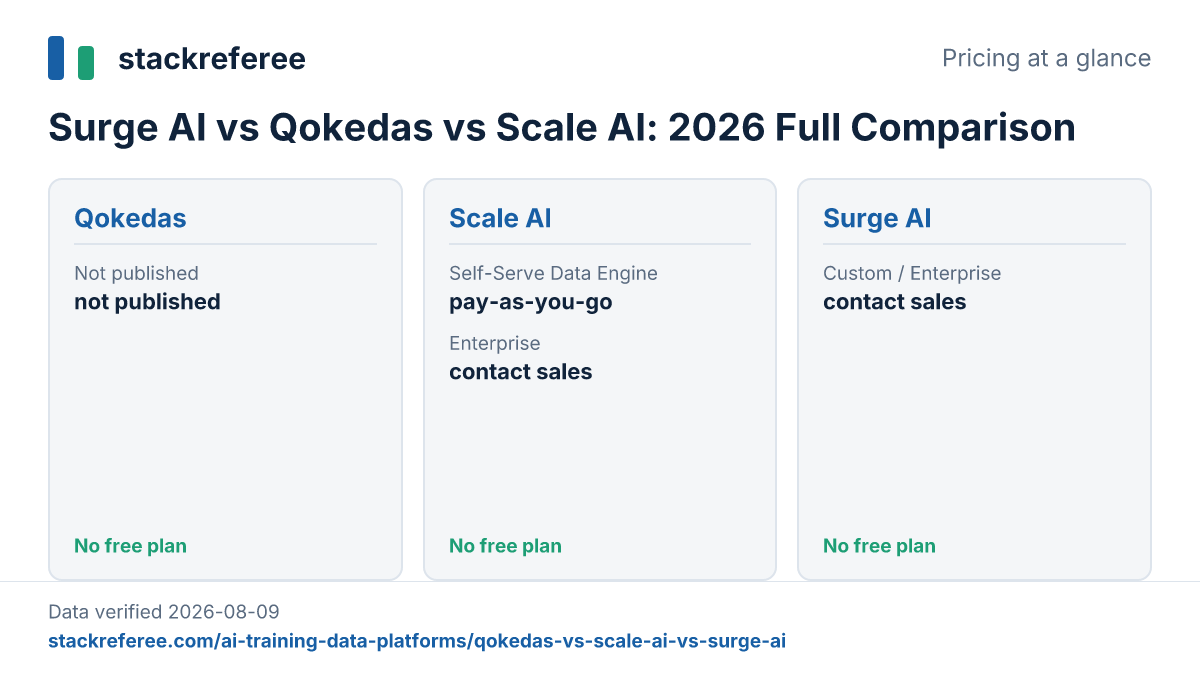
Surge AI publishes no pricing page. Every plan is Custom / Enterprise, quoted through a sales conversation regardless of project size. Third-party sources describe a flat per-label fee model, but Surge AI does not confirm this itself, so it is not treated as verified pricing here.
Pricing verified on August 9, 2026.
Qokedas pricing
Qokedas has not published a pricing page or plan structure. As a pre-launch YC (Fall 2026) company, quotes come directly from the founders at wilhelm@qokedas.com. There is no self-serve tier to test before that conversation.
Pricing verified on August 9, 2026.
Scale AI pricing
Scale AI's Self-Serve Data Engine is pay-as-you-go, with the first 1,000 labeling units (bring-your-own-workforce annotation) free, and the first 10,000 images free to upload and curate for data management. No published per-unit rate applies beyond those free thresholds. The Enterprise plan bundles the Data Engine with the GenAI Platform, adding enterprise SLAs and dedicated customer ops, and requires booking a demo rather than a public price list.
Pricing verified on August 9, 2026.
What users say
Independent, verbatim review-platform quotes aren't available for any of the three tools in this comparison, and it's worth explaining why rather than skipping the section.
Surge AI: G2's seller page indicates "Read 0 Reviews," and no Capterra listing could be found for Surge AI at all. The only sourced customer evidence is Surge AI's own blog post describing Anthropic's use of its RLHF platform, a vendor-published case study rather than an independent review, so this comparison doesn't present it as a testimonial quote.
Qokedas: No reviews exist on any platform checked. That's expected for a 3-person, pre-launch company, but it also means there's no third-party sentiment to report either way.
Scale AI: Capterra shows 0 reviews and Product Hunt shows 0 reviews for Scale's listing; GetApp UK shows a template rating badge tied to 0 actual users. G2's seller page title indicates "Read 1 Reviews," but the underlying content couldn't be directly verified, so it's excluded rather than reported as an unconfirmed score. Scale AI's own customer-story page features a case study with TIME, again a vendor-selected reference rather than an independent review.
The pattern across all three is consistent with enterprise, sales-led go-to-market motions rather than self-serve, review-driven ones: none of them has built up the kind of public review volume you'd see from a bottom-up SaaS product. If independent sentiment matters to your decision, ask each vendor for reference customers directly rather than relying on review sites.
Verdict per use case
Choose Surge AI if you need a managed RLHF program with domain-expert annotators and you're comfortable with a sales-led engagement instead of a self-serve start. Its Anthropic case study is the clearest sourced evidence of production-scale RLHF work among the three.
Choose Qokedas if your training data comes from physical instruments or sensors, you're an early adopter willing to shape the product with a 3-person founding team, and you can tolerate the absence of public pricing, compliance documentation, or reviews for now.
Choose Scale AI if you need certified compliance (SOC 2 Type II, ISO 27001:2022, FedRAMP High, DoD IL4), want the option to start self-serve with a free tier before talking to sales, or need API access and model evaluation tooling alongside annotation. It's the most fully documented of the three across features and security.
Recap table
| Surge AI | Qokedas | Scale AI | |
|---|---|---|---|
| Price | Custom/Enterprise, contact sales, no public rate | Not published, contact founders directly | Free tier (1,000 labeling units / 10,000 images), then pay-as-you-go or Enterprise contact sales |
| Best for | Managed RLHF with domain-expert annotators | Early-stage instrument/physical-signal RL data | Enterprises needing compliance plus a full data pipeline |
| Core differentiator | Proven RLHF platform (Anthropic case study) | Converts instrument signal into RL environments | SOC 2, ISO 27001, FedRAMP High, DoD IL4 confirmed |
If you're also weighing infrastructure decisions further down the training stack, our guides on serverless GPU platforms and data center AI chips cover the compute side of the same pipeline. And if you want to understand how we evaluate vendors like these three, read our editorial policy.
Frequently Asked Questions
Is Qokedas a real company or still in development? Qokedas is a pre-launch startup from Y Combinator's Fall 2026 batch, with 3 employees and no public product or pricing page as of August 2026. Its stated focus is converting instrument and physical-world signal into RL environments. Reach the founders directly at wilhelm@qokedas.com to discuss access, since there is no self-serve signup yet.
How much does Scale AI cost? Scale AI's Self-Serve Data Engine is pay-as-you-go, with the first 1,000 labeling units and first 10,000 images free. Beyond that, no per-unit rate is published. The Enterprise plan, which bundles the Data Engine with the GenAI Platform and dedicated customer ops, requires a sales conversation. Pricing verified on August 9, 2026.
Does Surge AI publish pricing? No. Surge AI has no public pricing page on surgehq.ai. Every plan is custom and quoted through a sales conversation, whether you need a small annotation batch or a large managed RLHF program. Budget for a discovery call before you can compare costs against Scale AI's published free-tier thresholds.
Is Scale AI SOC 2 compliant? Yes. Scale AI confirms SOC 2 Type II, ISO 27001:2022, FedRAMP High, and DoD IL4 on its security page. GDPR status is not explicitly stated on the public security page, and the full Trust Center certificate list sits behind a login, so treat GDPR as unconfirmed rather than absent.
Does Surge AI offer an API? No public API access is confirmed for Surge AI in its feature listing. It also lacks a self-serve platform, so teams work through account managers rather than programmatic integration. If API-driven pipeline integration matters to your workflow, Scale AI is the platform in this comparison that confirms API access.
Which of these platforms has a free plan? Only Scale AI publishes a free tier: the first 1,000 labeling units for bring-your-own-workforce annotation and the first 10,000 images for data management and curation. Surge AI and Qokedas both require a direct sales or founder conversation, with no published free allowance for either.
Who has used Surge AI for RLHF training? Anthropic used Surge AI's RLHF platform to train its LLM assistant with human feedback, according to a case study published on Surge AI's own blog. That is the clearest public evidence of Surge AI's RLHF capability at production scale among the sources reviewed for this comparison.
What is the best alternative to Scale AI for RL environments? Surge AI confirms RL environments, RLHF, and domain-expert annotators, making it a managed-service alternative for teams that don't need Scale AI's self-serve platform or API. Qokedas also lists RL environments as a capability, but as a pre-launch startup it has no public pricing or compliance information yet.
Frequently asked questions
Is Qokedas a real company or still in development?
Qokedas is a pre-launch startup from Y Combinator's Fall 2026 batch, with 3 employees and no public product or pricing page as of August 2026. Its stated focus is converting instrument and physical-world signal into RL environments. Reach the founders directly at wilhelm@qokedas.com to discuss access, since there is no self-serve signup yet.
How much does Scale AI cost?
Scale AI's Self-Serve Data Engine is pay-as-you-go, with the first 1,000 labeling units and first 10,000 images free. Beyond that, no per-unit rate is published. The Enterprise plan, which bundles the Data Engine with the GenAI Platform and dedicated customer ops, requires a sales conversation. Pricing verified on August 9, 2026.
Does Surge AI publish pricing?
No. Surge AI has no public pricing page on surgehq.ai. Every plan is custom and quoted through a sales conversation, whether you need a small annotation batch or a large managed RLHF program. Budget for a discovery call before you can compare costs against Scale AI's published free-tier thresholds.
Is Scale AI SOC 2 compliant?
Yes. Scale AI confirms SOC 2 Type II, ISO 27001:2022, FedRAMP High, and DoD IL4 on its security page. GDPR status is not explicitly stated on the public security page, and the full Trust Center certificate list sits behind a login, so treat GDPR as unconfirmed rather than absent.
Does Surge AI offer an API?
No public API access is confirmed for Surge AI in its feature listing. It also lacks a self-serve platform, so teams work through account managers rather than programmatic integration. If API-driven pipeline integration matters to your workflow, Scale AI is the platform in this comparison that confirms API access.
Which of these platforms has a free plan?
Only Scale AI publishes a free tier: the first 1,000 labeling units for bring-your-own-workforce annotation and the first 10,000 images for data management and curation. Surge AI and Qokedas both require a direct sales or founder conversation, with no published free allowance for either.
Who has used Surge AI for RLHF training?
Anthropic used Surge AI's RLHF platform to train its LLM assistant with human feedback, according to a case study published on Surge AI's own blog. That is the clearest public evidence of Surge AI's RLHF capability at production scale among the sources reviewed for this comparison.
What is the best alternative to Scale AI for RL environments?
Surge AI confirms RL environments, RLHF, and domain-expert annotators, making it a managed-service alternative for teams that don't need Scale AI's self-serve platform or API. Qokedas also lists RL environments as a capability, but as a pre-launch startup it has no public pricing or compliance information yet.
Comments
No comments yet.