lemlist vs Instantly vs Apollo vs HeyReach vs Clay (2026): honest comparison
Comparing lemlist, Instantly, Apollo, HeyReach and Clay head-to-head is tempting because they all show up in the same "cold outreach" searches. But treating them as five versions of the same product leads to buying the wrong tool for the job. A LinkedIn agency does not need Clay's waterfall enrichment on day one, and a founder who wants to send 50 personalized emails a week does not need Apollo's entire contact database. This guide breaks down what each one actually is, what it costs, where reviewers say it falls short, and which combinations make sense.
| Metric | lemlist | Instantly | Apollo | HeyReach | Clay |
|---|---|---|---|---|---|
| Category | Cold email + light multichannel | Cold email at scale | Contact DB + outreach | LinkedIn automation | Data enrichment/orchestration |
| Best for | Deliverability-first email in one seat | High-volume sending across many inboxes | All-in-one database and sequencing | Agencies running many LinkedIn accounts | Building higher-quality lists to feed senders |
| Starting paid price | $69/mo ($55 annual), per workspace | $94/mo ($85 annual), per workspace | $59/mo ($49 annual), per user | $79/mo ($63 annual) | $185/mo ($167 annual), per workspace |
| Free plan | No (14-day trial) | No (14-day trial) | Yes ($0) | No (free trial) | Yes ($0) |
| Verified compliance | SOC 2 (via vendor case study); SSO on Enterprise | Not verified on own site | SOC 2 + ISO 27001 + GDPR (first-party) | SOC 2 self-claimed on blog | SOC 2 Type 2 (first-party); SSO on Enterprise |
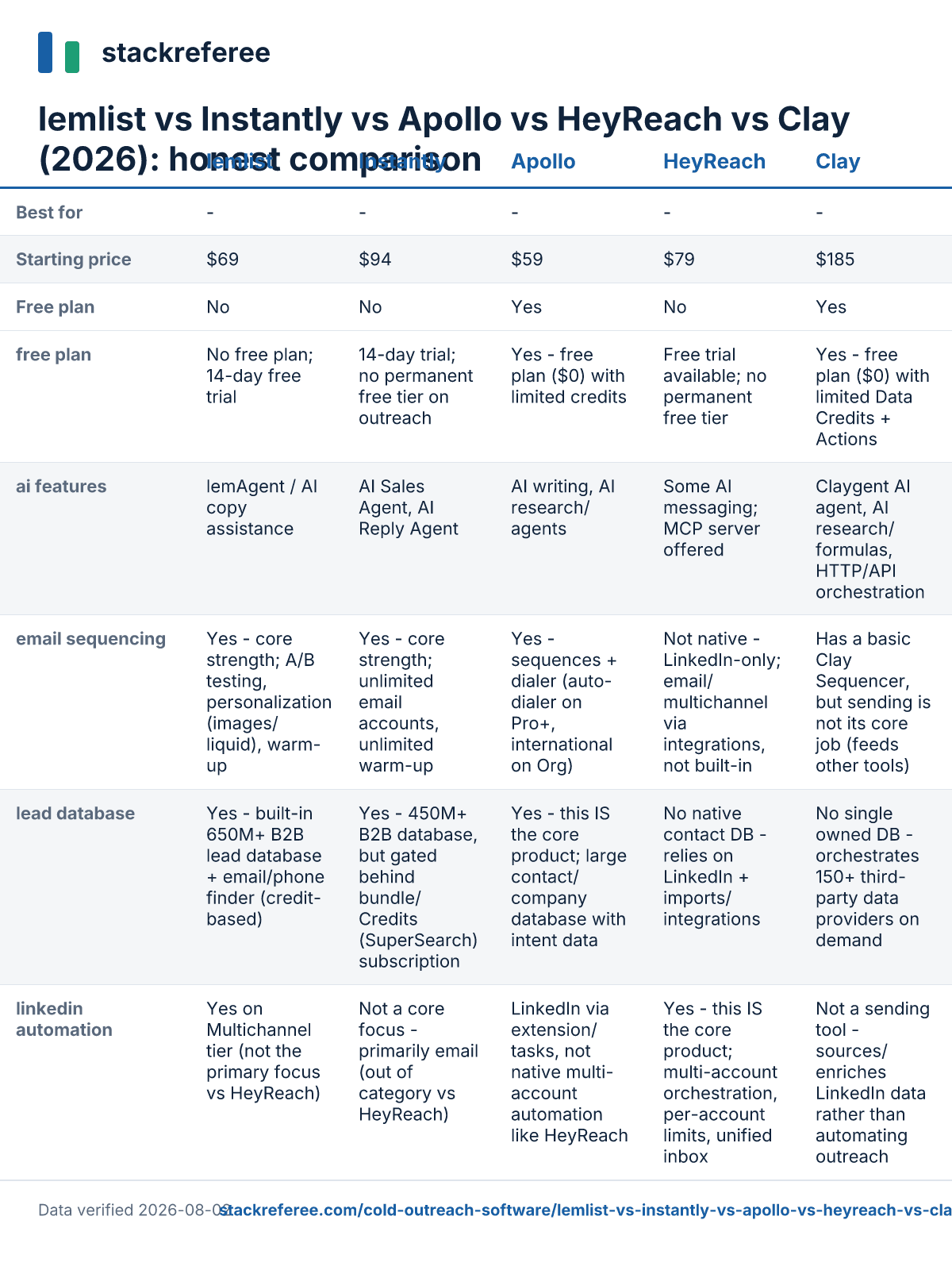
Before the details, one caveat that applies to the entire comparison: these tools sit in different categories, so a capability being "absent" usually means it is out of scope, not that the vendor failed to build it. HeyReach has no email sequencing because it is a LinkedIn tool by design. Clay does not send at scale because it is a data layer, not a sender. Read the feature notes below as "what job does this do," not "which one has more checkboxes." A second caveat: every G2 and Trustpilot page for all five tools blocked direct access during research, so no G2 or Trustpilot ratings are stated as fact here. Only first-hand-verified numbers (mostly Capterra, plus Product Hunt for Clay) are cited, and prices were read from each vendor's own pricing page on August 2, 2026.
What is lemlist
lemlist is a cold-email sequencing tool with light multichannel steps layered on top. Its core job is personalizing and sending cold-email campaigns with built-in deliverability tooling: warm-up, a deliverability hub, A/B testing and personalization (including images and dynamic variables). It also ships a built-in B2B lead database of 650M+ contacts with a credit-based email and phone finder, plus an AI assistant (lemAgent) for copy. On the higher Multichannel tier, lemlist adds LinkedIn automation, an in-app dialer and SMS, so a single rep can run email, LinkedIn and calls from one seat. It is a European (French) tool that positions itself on deliverability plus multichannel in one place.
What is Instantly
Instantly is built for sending cold email at scale. Its signature capabilities are unlimited email accounts and unlimited warm-up, so teams can spread volume across many inboxes, plus a unified inbox called Unibox to manage the replies. It bundles access to a 450M+ B2B lead database, but that data sits behind its bundle plans and a separate SuperSearch credits subscription rather than being included flat. Instantly has restructured into "bundle" plans (Starter, Scale, Agency, Enterprise) and additionally sells its Outreach product and lead-database Credits as standalone subscriptions. It leans hard into deliverability, though as noted later some reviewers report that its warm-up score does not always match real inbox placement.
What is Apollo
Apollo is a B2B contact database first, with a sales-engagement layer built around it. Unlike the pure senders, the database is the core product: a large contact and company dataset with intent signals, from which you build lists and then run email sequences and calls without leaving the platform. It includes a dialer (auto-dialer on the Professional tier and up, with international dialing on Organization), enrichment and CRM sync, and AI writing and research features. Apollo is the most "all-in-one" of the five for a single team that wants to find contacts and reach them in one tool. Its trade-offs, covered below, center on data freshness and how the data is sourced.
What is HeyReach
HeyReach is dedicated LinkedIn outreach automation, built agency-first. Its core job is running and rotating LinkedIn outreach across many sender accounts safely at scale, with per-account limits, a unified inbox, and API and webhook access. It has no native contact database and no built-in email sequencing; it is LinkedIn-only by design and connects to email or multichannel workflows through integrations rather than owning them. That narrow scope is deliberate. The important caveat, which is inherent to this whole category rather than specific to HeyReach, is that automating LinkedIn actions runs against LinkedIn's User Agreement and carries account-restriction risk no matter which tool you use.
What is Clay
Clay is a different animal from the other four: it is a data-enrichment and orchestration layer, not a sender. Its flagship capability is "waterfall" enrichment, where it aggregates data from 150+ third-party providers on demand, so if one provider lacks an email or phone number, it falls through to the next. On top of that sit an AI research agent (Claygent), formulas, and HTTP/API orchestration to build and clean go-to-market data. Clay has a basic sequencer, but sending is not its job; it builds and enriches the list you then push into a tool like lemlist, Instantly or Apollo. In March 2026 Clay overhauled its pricing into a dual credit system (Data Credits plus Actions), which is worth understanding before you buy.
lemlist: pros and cons
Deliverability tooling is built in. Warm-up and a dedicated deliverability hub ship with the product, alongside A/B testing and rich personalization. For teams whose main pain is landing in the inbox rather than the spam folder, that focus is the point of the tool.
Per-workspace entry pricing. The Email plan is $69/mo ($55/mo annual) priced per workspace with unlimited users, not per seat. A small team can share one workspace without every rep adding to the bill, which is unusual among these tools.
Multichannel in one seat. The Multichannel plan adds LinkedIn automation, an in-app dialer and SMS. Reviewers specifically call out the combined workflow: one Capterra reviewer noted it is "easy to create campaigns with both email and LinkedIn automations in a simple workflow."
Support gets mixed marks. One Capterra founder wrote that lemlist's "support is not technical and only relays what their technical people tell them, so you can never get a straight answer on anything." If your team expects hands-on troubleshooting, weigh that.
Compliance is only partly verifiable. lemlist's SOC 2 Type 2 completion shows up in a third-party vendor case study rather than a first-party trust page, and a first-party GDPR statement was not directly confirmed. SSO/SAML is listed on the Enterprise plan. Ask for documentation during procurement.
Instantly: pros and cons
Built for volume. Unlimited email accounts and unlimited warm-up are the headline features, which is why high-volume senders gravitate to it. Reviewers on Software Finder credit it with boosting "deliverability and open rates" and making it "easy to manage multiple inboxes."
Bundle pricing can get complicated. The core plans are per-workspace bundles (Starter $94/mo, Scale $194/mo, Agency $555/mo), but Outreach and the SuperSearch lead Credits are also sold as separate standalone subscriptions. One reviewer complained bluntly: "I had to pay three times before I could even use the platform." Map out exactly which pieces you need.
Deliverability claims deserve scrutiny. The tool leans on warm-up as a selling point, but reviewers have reported that the warm-up score does not always match real inbox placement, and that done-for-you domains can arrive with poor reputation. Deliverability is never fully outsourced.
Compliance could not be verified. Instantly's own security page returned an error during research, and the only compliance badges found came from a third-party aggregator (including implausible ones). Treat Instantly's SOC 2, GDPR and ISO claims as unverified until it shows you first-party documentation.
Thin verified review footprint. Instantly has no Capterra listing with reviews, and its G2 and Trustpilot pages could not be accessed, so no star rating or review count is quoted here as fact. The quotes above come from Software Finder, a smaller review source.
Apollo: pros and cons
Database and outreach in one tool. Because the contact database is the core product, you can find decision-makers and sequence them without stitching two tools together. A Capterra reviewer said it "made prospecting much less time-consuming because I could easily search for the right companies and decision-makers."
Strongest first-party compliance of the five. Apollo states SOC 2 and ISO 27001 (certified by A-LIGN) and GDPR compliance on its own security page and trust center. For buyers who need documented compliance rather than a self-claim, that matters.
Data freshness and credit burn are the common critiques. One Capterra reviewer noted "some contact information is outdated and credit can run out quickly with heavy usage." Because the database is scraped and contributed, accuracy varies by segment, and heavy users hit credit limits.
Support complaints show up too. A COO wrote, bluntly, "Worst support ever. It's a shame to call this experience 'support'." As always with a single review, weigh it against your own trial, but it is a recurring theme.
Data-sourcing caveats for EU buyers. Apollo builds its database from scraped and contributed data and acts as a data controller, which raises opt-out and GDPR subject-rights questions; it also had a historical data exposure in 2018. Factor that into any EU-facing rollout.
Real per-seat cost climbs. The Free and Basic ($59/mo per user) tiers are cheap, but the auto-dialer starts on Professional ($99/mo) and the Organization tier ($149/mo per user) carries a 3-seat minimum, so a small team's entry point is closer to $357/mo annually than the sticker price.
HeyReach: pros and cons
Purpose-built for multi-account LinkedIn. Rotating outreach across many LinkedIn sender accounts with per-account safety limits is exactly what HeyReach is for, and agencies are the target user. A Capterra reviewer in staffing said it "allowed us to scale our LinkedIn outreach effortlessly" and called it "miles ahead of other tools we've tried."
Agency-friendly tiers and tooling. Beyond the Growth plan, the Agency ($999/mo) and Unlimited ($2,999/mo) tiers add whitelabel branding, more enrichment credits and managed onboarding, with a fully managed Done For You option on top. Unified inbox, API and webhooks come standard.
LinkedIn ToS risk is inherent. This is the headline caveat: automating LinkedIn actions runs against LinkedIn's User Agreement and carries account-restriction or ban risk regardless of how carefully a tool manages limits. That risk belongs to the category, not to HeyReach specifically, but it is real and you are accepting it when you adopt any LinkedIn automation.
Compliance is self-claimed and review volume is thin. HeyReach's SOC 2 Type II appears only as a claim on its own blog, with no accessible trust center to verify it. And its verified review footprint is small: the Capterra page carried just two reviews (both 5-star) at the time of research, and G2 and Trustpilot could not be accessed, so treat the rating as directional, not statistically meaningful.
No email or database of its own. If you also need cold email or contact data, you will pair HeyReach with another tool. That is by design, but it means HeyReach is rarely a complete outbound stack on its own.
Clay: pros and cons
Waterfall enrichment is the flagship. Pulling from 150+ providers and falling through until it finds a valid email or phone number produces higher match rates than any single database. Combined with Claygent (its AI research agent), Clay can build and clean lists that other tools then send. One Product Hunt reviewer put it vividly: "This is Excel in God Mode."
It multiplies the tools you already have. Because Clay feeds senders rather than replacing them, teams report it lifting the performance of their existing outreach. A founder reviewer claimed "if you are doing cold outreach, Clay will 3x the conversion," and praised its education resources.
Steep learning curve. The power comes with complexity. A reviewer cautioned that "the tool might be looking a bit complex at first, so not that straightforward to know its capabilities." Budget ramp-up time, and lean on Clay's tutorials and cohorts.
Credit model rewards planning. After the March 2026 pricing overhaul, Clay runs on Data Credits plus Actions, and failed enrichment lookups still consume credits. One reviewer wished he could simply buy more credits rather than jump tiers. Model your volume before committing.
Solid first-party SOC 2, thinner elsewhere. Clay confirms SOC 2 Type 2 on its own blog (dated September 2024) and lists SSO and RBAC on its Enterprise plan. GDPR and ISO 27001 were not stated first-party, and because Clay resells data from 150+ providers, you should check each provider's terms for your use case.
Use-case comparison
"I want to send personalized cold email from one seat." lemlist. Deliverability tooling is built in, the Email plan is per workspace, and you can add LinkedIn and calls on the Multichannel tier without a second tool.
"I want to send high volume across many inboxes." Instantly. Unlimited inboxes and warm-up are its reason to exist, just budget for the bundle-plus-credits structure and verify deliverability yourself.
"I want to find contacts and email them in one platform." Apollo. It is the only one of the five where the contact database and the sending engine are the same product, and its compliance is the best documented.
"I run LinkedIn outreach for multiple clients." HeyReach. Multi-account orchestration is its whole point, provided you accept LinkedIn's ToS risk.
"My lists are low quality and I want to fix that before sending." Clay. It is the enrichment layer that improves the data the other four rely on, then hands off to a sender.
Pricing
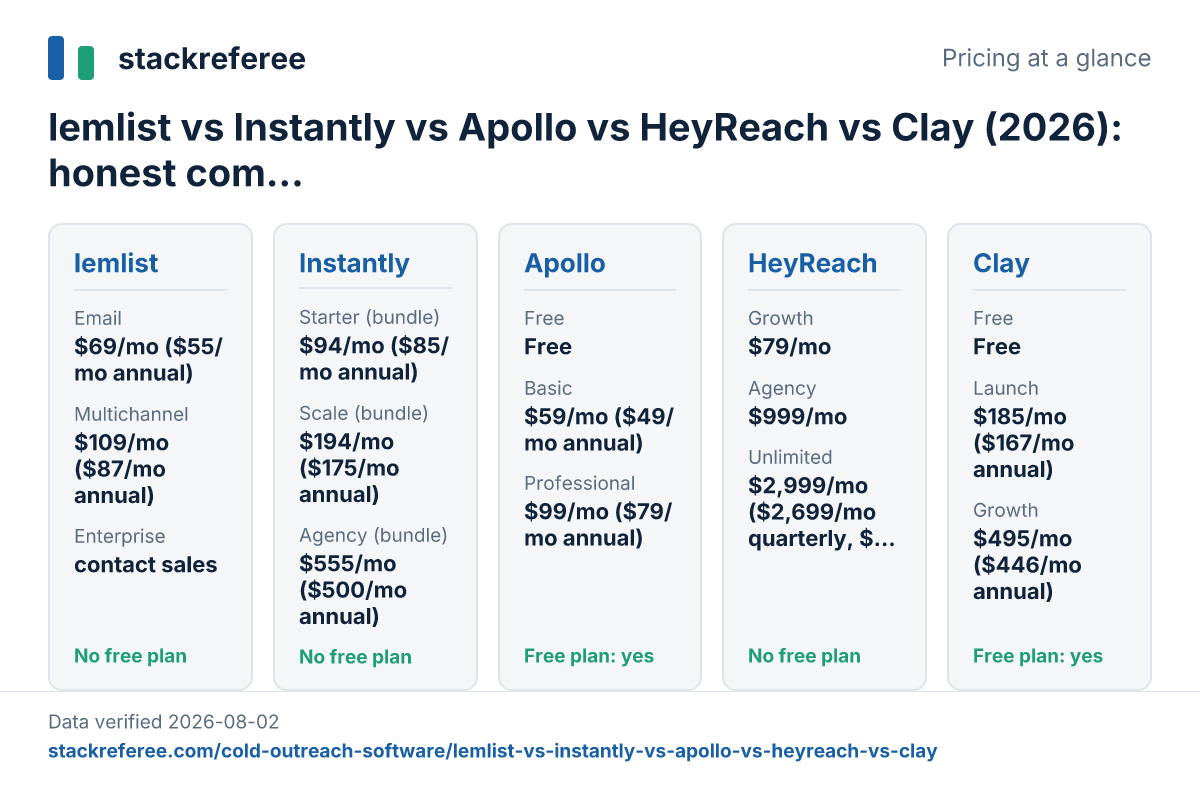
Every plan below was read from the vendor's own pricing page and is current as of the verification date noted per tool. Several vendors gate their lead databases behind credits, and two (Apollo, Clay) have genuine free tiers, so compare on the specific plan you will actually use, not the headline number.
lemlist pricing
- Email — $69/mo ($55/mo annual), per workspace (unlimited users): 50,000 emails/mo, unlimited contacts, the 650M+ lead database, credit-based email and phone finder, warm-up/deliverability hub and lemAgent AI.
- Multichannel — $109/mo ($87/mo annual), per user: everything in Email plus LinkedIn automation, in-app dialer, SMS, up to 5 senders per user and a unified inbox.
- Enterprise — contact sales (5+ seats): adds SSO/SAML, custom roles, a dedicated account manager and 1:1 onboarding.
Pricing verified on lemlist.com/pricing, August 2, 2026.
Instantly pricing
- Starter (bundle) — $94/mo ($85/mo annual): 5,000 emails/mo, 1,000 uploaded contacts, 1,500 credits/mo, 450M+ database access and unlimited email accounts plus warm-up.
- Scale (bundle) — $194/mo ($175/mo annual): 100,000 emails/mo, 25,000 contacts, Unibox unified inbox and advanced deliverability.
- Agency (bundle) — $555/mo ($500/mo annual): 500,000 emails/mo, 100,000 contacts and dedicated server/IP management.
- Enterprise — contact sales. Plus standalone Outreach and Credits subscriptions from around $47/mo, sold separately.
Pricing verified on instantly.ai/pricing, August 2, 2026. Standalone tier prices were inconsistent during capture; confirm current figures with Instantly.
Apollo pricing
- Free — $0/user/mo: limited credits, basic sequencing and search.
- Basic — $59/mo ($49/mo annual) per user: more credits, CRM sync, basic sequencing.
- Professional — $99/mo ($79/mo annual) per user: first tier with the (US) auto-dialer and advanced sequencing/analytics.
- Organization — $149/mo ($119/mo annual) per user, 3-seat minimum (about $357/mo annual entry): international dialer and advanced security controls.
Pricing verified against apollo.io/pricing and corroborating third-party breakdowns, August 2, 2026. Apollo's live pricing table did not render during capture, so verify current numbers directly.
HeyReach pricing
- Growth — $79/mo ($71/mo quarterly, $63/mo annual): unlimited campaigns, all LinkedIn automation, unified inbox, API/webhooks and enrichment credits.
- Agency — $999/mo ($799/mo annual): more senders, whitelabel branding, more enrichment credits and done-for-you onboarding.
- Unlimited — $2,999/mo ($2,399/mo annual): unlimited LinkedIn sender accounts, migration services and priority support.
- Done For You — contact sales: fully managed service.
Pricing verified on heyreach.io/pricing, August 2, 2026. Included-sender counts per tier were ambiguous during capture; confirm allocation with HeyReach.
Clay pricing
- Free — $0/mo: about 100 Data Credits plus 500 Actions/mo, unlimited seats and tables, multi-provider waterfalls and Claygent.
- Launch — $185/mo ($167/mo annual), per workspace (unlimited users): roughly 2,500–3,000 Data Credits plus 15,000 Actions/mo, phone enrichment and job-change signals.
- Growth — $495/mo ($446/mo annual): 6,000 Data Credits plus 40,000 Actions/mo, CRM auto-sync, HTTP API and web-intent signals.
- Enterprise — contact sales: SSO, RBAC, data-warehouse sync and a dedicated strategist. Third parties cite roughly $30k/yr entry, which is not confirmed on Clay's own page.
Pricing verified against clay.com/pricing, August 2, 2026. Clay overhauled pricing in March 2026 and credit allotments varied by source, so figures are volatile; confirm before buying.
What users say
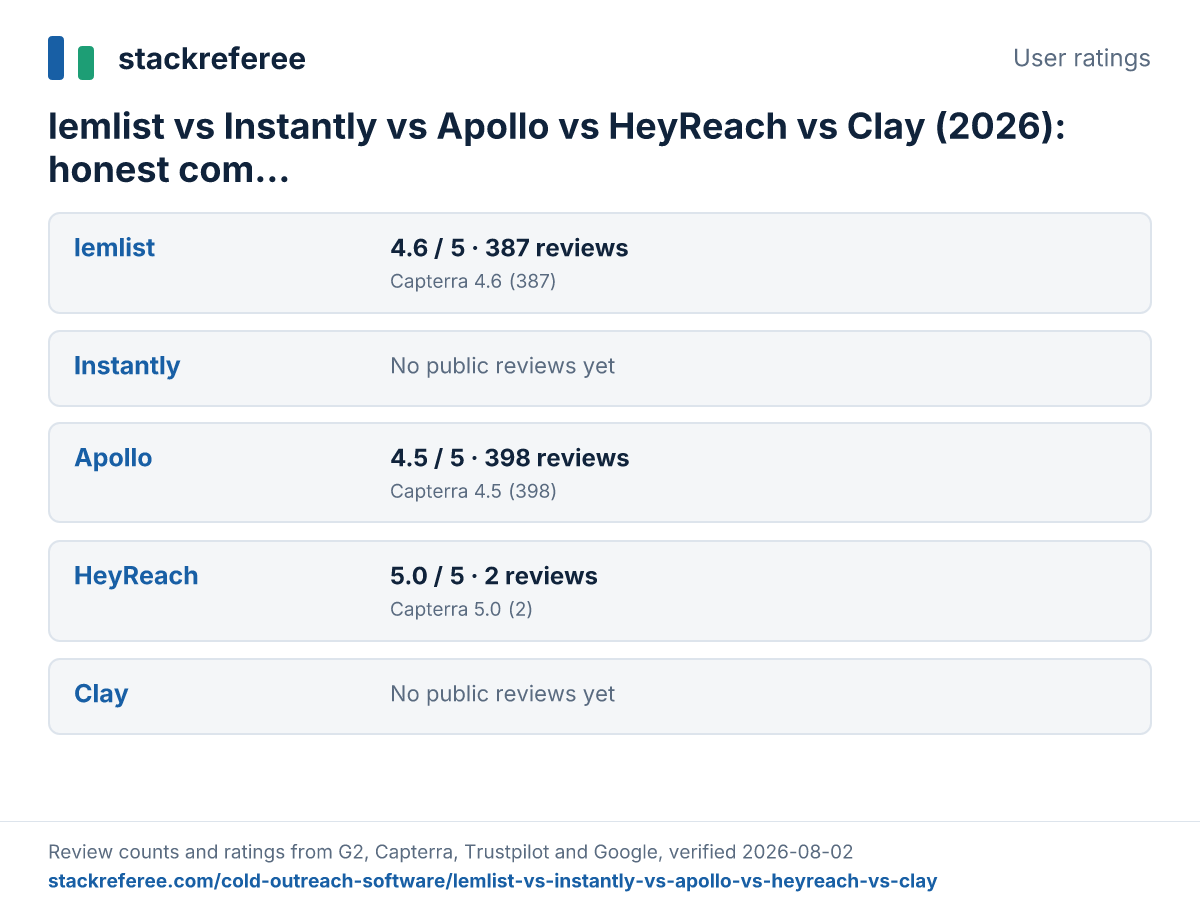
Ratings below come only from pages that could be verified first-hand. Every G2 and Trustpilot page was inaccessible during research, so those platforms are omitted rather than estimated.
- lemlist — Capterra: 4.6 from 387 reviews. Reviewers praise it as "really central to our outbound efforts" and easy for combined email-plus-LinkedIn workflows; the recurring gripe is non-technical support.
- Apollo — Capterra: 4.5 from 398 reviews. Praised for fast prospecting; criticized for outdated contacts, fast credit burn and weak support.
- HeyReach — Capterra: 5.0 from just 2 reviews. Positive but far too small a sample to lean on; treat as directional only.
- Instantly — no verifiable rating on Capterra, G2 or Trustpilot. Quotes here come from Software Finder, where reviewers highlight deliverability gains but also fragmented billing and weak support.
- Clay — no usable listing on Capterra, G2 or Trustpilot (its Capterra entry is a different product entirely). Quotes come from its verified Product Hunt page (4.8 from 39 reviews), where enthusiasm is high but the learning curve is the common caution.
Verdict by use case
There is no single winner here, because these tools are not solving the same problem. Choose by the job in front of you.
For deliverability-first cold email in one seat, choose lemlist. Built-in warm-up, per-workspace entry pricing and optional multichannel make it the most self-contained email tool of the group, with the caveat that support can be hit or miss.
For high-volume sending across many inboxes, choose Instantly, but go in with eyes open: map the bundle-plus-credits pricing, verify deliverability yourself rather than trusting the warm-up score, and ask for first-party compliance documentation, which could not be verified independently.
For a single tool that both finds and emails contacts, choose Apollo. It has the best-documented compliance of the five (SOC 2, ISO 27001 and GDPR, first-party), balanced against data-freshness complaints and the GDPR considerations that come with a scraped, controller-model database.
For multi-account LinkedIn outreach, choose HeyReach, accepting that all LinkedIn automation carries account-ban risk under LinkedIn's ToS, that its SOC 2 is self-claimed, and that its verified review volume is thin.
For better data before you send, choose Clay. It is the enrichment engine that lifts the other four rather than competing with them, with a real learning curve and a credit model that rewards planning. Its SOC 2 Type 2 is confirmed first-party.
If you are building a stack rather than buying one tool, a common shape is Clay for list-building and enrichment, then lemlist or Instantly for email and HeyReach for LinkedIn, with Apollo as the all-in-one alternative when you would rather have the database and sender in a single platform.
Recap table
| lemlist | Instantly | Apollo | HeyReach | Clay | |
|---|---|---|---|---|---|
| Core job | Deliverability-first email + light multichannel | High-volume email across many inboxes | Contact database + outreach | Multi-account LinkedIn automation | Waterfall data enrichment/orchestration |
| Starting paid price | $69/mo ($55 annual), per workspace | $94/mo ($85 annual), per workspace | $59/mo ($49 annual), per user | $79/mo ($63 annual) | $185/mo ($167 annual), per workspace |
| Free plan | No (trial) | No (trial) | Yes ($0) | No (trial) | Yes ($0) |
| Built-in lead data | Yes (650M+) | Yes (450M+, gated) | Yes (core product) | No | No (orchestrates 150+ providers) |
| Verified compliance | SOC 2 (indirect); SSO on Enterprise | Not verified first-party | SOC 2 + ISO 27001 + GDPR (first-party) | SOC 2 self-claimed | SOC 2 Type 2 (first-party); SSO on Enterprise |
| Verified reviews | Capterra 4.6 (387) | None verifiable | Capterra 4.5 (398) | Capterra 5.0 (2) | Product Hunt 4.8 (39) |
| Biggest caveat | Support quality | Bundle pricing + unverified compliance | Data freshness + GDPR controller model | LinkedIn ToS/ban risk | Learning curve + credit model |
Pricing and compliance details were verified against each vendor's own pages on August 2, 2026. Prices and plans change; reconfirm before purchasing.
Frequently asked questions
Are lemlist, Instantly, Apollo, HeyReach and Clay competitors?
Only partly. lemlist and Instantly are cold-email senders, Apollo is a B2B contact database with built-in outreach, HeyReach is LinkedIn-only automation, and Clay is a data-enrichment and orchestration layer. They overlap around outbound but solve different core jobs, so many teams run two or three of them together rather than picking one.
Which is the cheapest to start with?
Apollo and Clay both have a genuinely free plan ($0 with limited credits). Among paid entry tiers, lemlist's Email plan at $69/mo ($55/mo annual) is priced per workspace with unlimited users, HeyReach's Growth plan is $79/mo ($63/mo annual), Instantly's Starter bundle is $94/mo ($85/mo annual), and Clay's Launch plan is $185/mo ($167/mo annual). Prices verified on the vendors' own pricing pages on August 2, 2026.
Which tool is best for LinkedIn outreach?
HeyReach is the only one of the five built specifically for multi-account LinkedIn automation. lemlist adds LinkedIn steps on its Multichannel tier, and Apollo offers LinkedIn tasks via an extension, but neither is designed to safely rotate outreach across many LinkedIn sender accounts the way HeyReach is. Note that automating LinkedIn runs against LinkedIn's User Agreement and carries account-restriction risk regardless of the tool.
Do I still need Clay if I have Apollo?
They do different jobs. Apollo is a single contact database plus a sending engine. Clay does not own one database or send at scale; it orchestrates enrichment across 150+ third-party providers (running waterfalls and AI research) to build higher-quality lists that you then push into a sender like lemlist, Instantly or Apollo. Many teams use Clay to build the list and another tool to send it.
Which of these has the strongest verified compliance?
Apollo is the only one of the five that states SOC 2, ISO 27001 and GDPR compliance on its own security page (certified by A-LIGN). Clay confirms SOC 2 Type 2 on its own blog. lemlist's SOC 2 appears in a vendor case study rather than a first-party page, HeyReach's SOC 2 is a self-claim on its blog, and Instantly's compliance could not be verified on its own site at all. See the pricing and verdict sections for detail.
Is Instantly's pricing really per workspace?
Instantly's core plans are bundle plans priced per workspace (Starter $94/mo, Scale $194/mo, Agency $555/mo), each with unlimited email accounts and warm-up. On top of that, Instantly sells its Outreach product and its SuperSearch lead-database Credits as separate standalone subscriptions starting around $47/mo, so the total depends on how many pieces you buy.
Does lemlist charge per user?
It depends on the plan. lemlist's entry Email plan is priced per workspace with unlimited users at $69/mo ($55/mo annual). The Multichannel plan, which adds LinkedIn automation, an in-app dialer and SMS, switches to $109/mo per user. SSO/SAML and custom roles sit on the quote-based Enterprise plan (5+ seats).
Why are there no G2 or Trustpilot ratings in this comparison?
During research for this article, every G2 and Trustpilot page for all five tools returned an access error and could not be read directly, so no G2 or Trustpilot numbers are quoted as fact. The review counts cited here come only from pages that could be verified first-hand, mainly Capterra (and Product Hunt for Clay).
Comments
No comments yet.