CCC ONE vs Mitchell vs Qapter: the 2026 shop guide
In short: Mitchell pairs cloud estimating with OEM repair procedures and photo-based AI estimating. Qapter (Solera's Audatex line) is the AI photo-to-estimate specialist with the longest global history. CCC ONE is the ecosystem play - estimating, shop management and insurer connections in one platform, with the strongest review score of the three. Rote, a YC Winter 2027 startup in private beta, doesn't write estimates at all: it fights the denials that come back. None of the four publishes usable pricing.
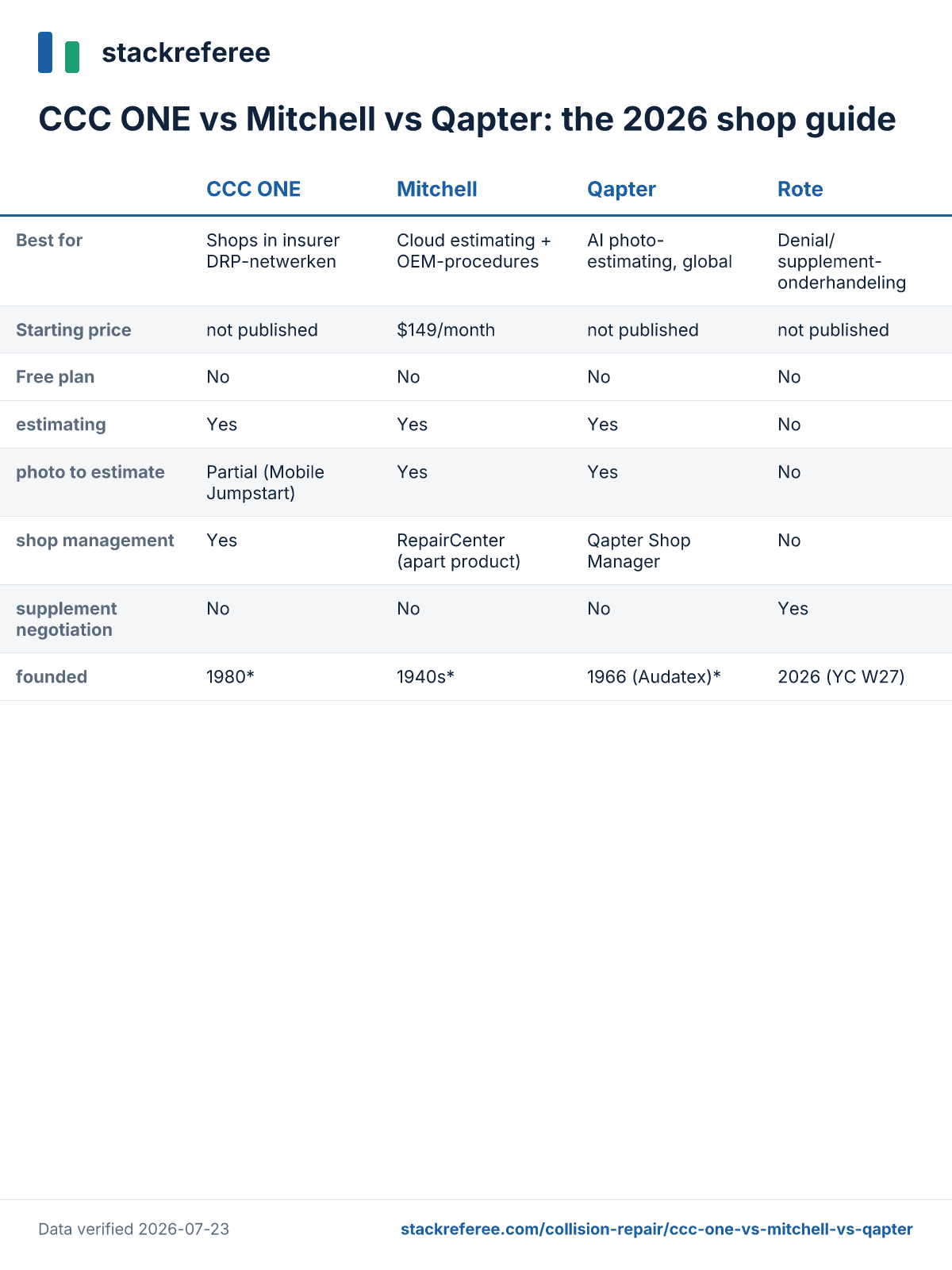
Comparison at a glance
| Mitchell | Qapter | CCC ONE | Rote | |
|---|---|---|---|---|
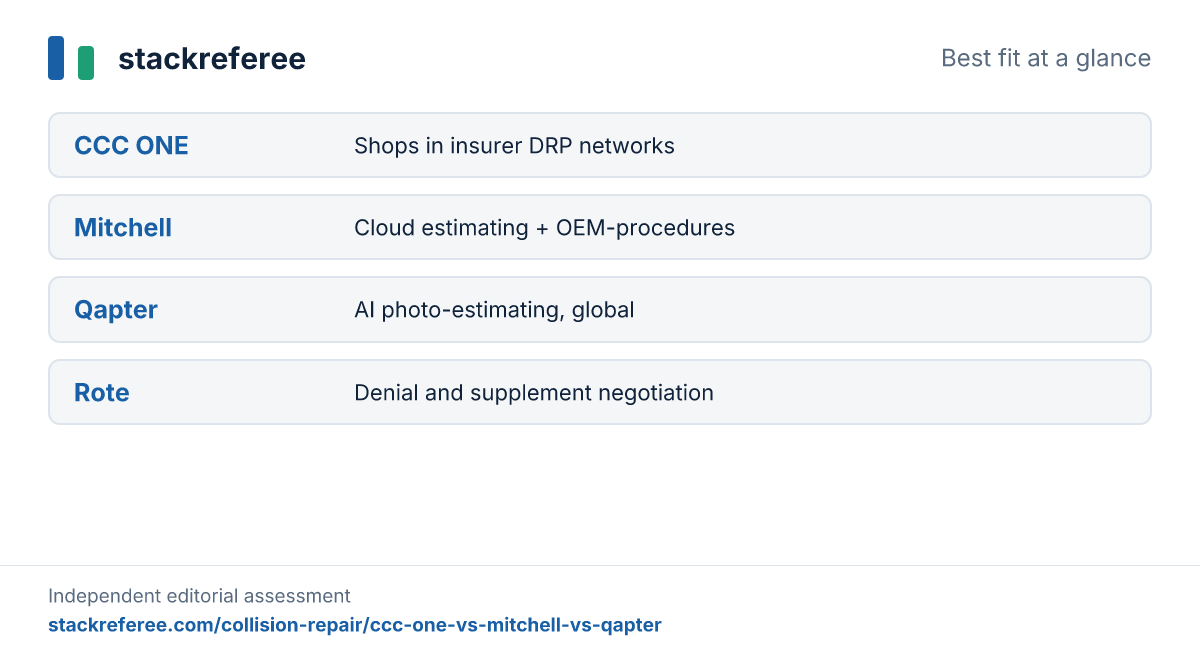
| Best for | Cloud estimating + OEM procedures | AI photo-estimating, global reach | Shops in insurer DRP networks | Denial and supplement negotiation |
| Writes estimates | Yes | Yes | Yes | No - works on denials after the estimate |
| Photo-to-estimate | Yes (Intelligent Estimating) | Yes (Visual Intelligence) | Partial (Mobile Jumpstart) | No |
| Shop management | RepairCenter (separate product) | Qapter Shop Manager | Built into the platform | No |
| Public pricing | No | No | No | No (private beta) |
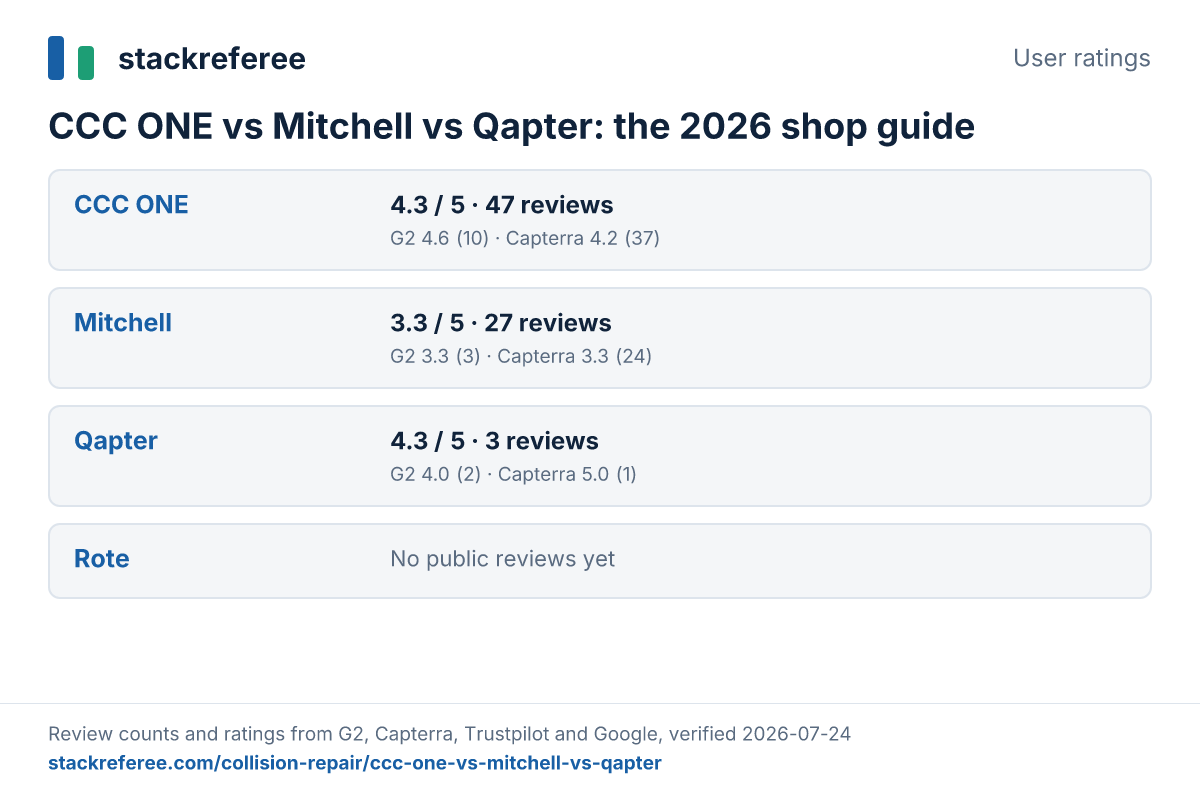
| Capterra score | 3.3/5 (RepairCenter, 24 reviews) | 5.0/5 (1 review); Audatex listing 3.0/5 | 4.3/5 (44 reviews) | No reviews yet |
| Roots | 1940s auto-part catalogues* | Audatex, 1966* | Founded 1980* | 2026, YC W27 |
*Founding details come from third-party sources or corporate history pages, not always from the vendors' own product sites - see the verification notes throughout this article.
Collision estimating is an unusual software category: three companies dominate it, all three sell through sales calls rather than price lists, and reviews skew toward frustration with lock-in rather than missing features. This comparison sticks to what we could verify on vendor sites and review platforms on July 23, 2026, with a verification date on every pricing section. Where something couldn't be verified, we say so - that policy is documented on our editorial policy page.
What is Mitchell?
Mitchell is the collision estimating and repair-technology arm of Enlyte, the company formed around the Mitchell, Genex, Coventry and Apricus brands. Enlyte's own About page traces the business back to car-part catalogues in the 1940s - the exact founding year often cited elsewhere isn't stated on its site. Today the flagship estimating product is Mitchell Cloud Estimating, aimed at collision repairers, independent appraisers and insurers, with extensions for trucks (TruckMax) and EVs.
Two things stand out in Mitchell's current positioning. First, Mitchell Intelligent Estimating uses artificial intelligence plus decades of industry data to produce collision estimates from images and vehicle information - photo-to-estimate is a shipping feature, not a roadmap item. Second, Mitchell bundles repair intelligence around the estimate: TechAdvisor for OEM repair procedures, Estimate Advisor, VIN scanning and Predictive ADAS identification through Mitchell Diagnostics. Enterprise deals with Caliber Collision and Classic Collision are announced on its site.
What is Qapter?
Qapter is Solera's brand for AI-driven estimating, built on the Audatex product line that started in Minden, Germany in 1966 and came under Solera after its 2006 acquisition of ADP's Claims Services Group - corporate history that comes from SEC filing summaries rather than qapter.com itself. In the US, shops still encounter the estimating product under the Audatex name, while Qapter markets the AI layer: photo-based damage capture, automated line-by-line estimates, and Intelligent Triage for total-loss detection.
Solera describes Qapter as a globally available, modular, AI-powered suite - a vendor claim, like its stated training data of billions of damage images and hundreds of millions of historical claims. The verifiable substance: VIN decoding, weekly OE price updates, 3D graphics with 360-degree rotation, a parts search and an insurance compliance module all appear on the collision estimating product page. Vehicle coverage reaches back to 1970 models, per the same page. A separate Qapter Shop Manager product handles shop workflows.
What is CCC ONE?
CCC Intelligent Solutions is the biggest name in US collision software. The company is publicly listed (NASDAQ: CCCS) and was founded in 1980 according to financial data providers - its own About page doesn't state these facts, which tells you something about how CCC communicates. Its platform brands have evolved too: the homepage now leads with "CCC IX Cloud", while the estimating product for repairers is still sold as CCC ONE.
CCC ONE's pitch is integration. Estimating, parts ordering, customer contact and insurance claim submission live in one program, connected to Direct Repair Programs that CCC says give shops access to hundreds of insurers, plus thousands of parts suppliers. The company also claims relationships with 12 of the top 15 OEMs and processes tens of millions of claims a year - all vendor claims we could not independently verify. What users confirm in reviews is the practical effect: one program for the whole workflow, at a price small shops feel.
What is Rote?
Rote is the odd one out, deliberately. It's a Y Combinator Winter 2027 startup - the only company in that batch - founded in 2026 in San Francisco by Aditya Mittal and Gabriel Castillo, both ex-Apple engineers with Cornell CS degrees, per the YC profile. Rote does not write estimates. Its site describes an AI tool that turns insurer denials into supplement arguments backed by P-page citations and precedent from the Database Enhancement Gateway (DEG). YC's profile frames it more broadly as handling the negotiation lifecycle between shops and insurers to recover money from denied claims.
Honest limitations: the product is in private beta, the site is largely unreadable to automated verification (only its metadata could be checked), there are no user reviews anywhere we looked, and no pricing exists publicly. We include Rote because it targets a pain point every reviewer of the big three circles around - the fight with insurers after the estimate - not because it can replace an estimating platform today. It can't, and its own positioning doesn't claim to.
Pros and cons
Mitchell
Pros
- Photo-to-estimate is live. Mitchell Intelligent Estimating produces collision estimates from images and vehicle information, combined with its cloud estimating workflow - one of two platforms here with full photo-based estimating shipping today.
- OEM repair data travels with the estimate. TechAdvisor integrates OEM repair procedures, and Mitchell Diagnostics adds Predictive ADAS identification - relevant as ADAS calibrations become routine on modern vehicles.
- Diagnostic accuracy earns praise. "Mitchell Repair Center does an excellent job at providing accurate diagnostic information to technicians," per a general manager on Capterra, with support quality praised in other reviews.
Cons
- RepairCenter reviews are the weakest of the three. At 3.3/5 across 24 Capterra reviews, Mitchell's shop-management product scores well below CCC ONE's 4.3/5 - and no separate review page exists for Cloud Estimating, so buyers can't isolate its reputation.
- Stability complaints are serious. A collision center director reports the program closing mid-estimate with all work lost. For a tool used dozens of times a day, that's a costly failure mode.
- Licensing and integration friction. A 2026 review states the software runs on only one computer and calls the integrations weak - friction CCC's all-platform approach is built to avoid.
Qapter
Pros
- The deepest AI estimating claims in the category. Sub-second image processing, automated line-by-line estimates and total-loss triage - vendor claims, but backed by a product line insurers deploy at scale internationally.
- Genuinely global footprint. Audatex has operated since 1966, covers vehicles back to 1970, and Solera sells to insurers and body shops worldwide - useful for MSOs with international owners or insurer relationships.
- Digital claims workflow praised by network users. "It makes submitting repair estimates easier. An interactive tool between car repairers, the network company and the insurers," per a regional network analyst on Capterra.
Cons
- Almost no US review footprint. One Capterra review for Qapter and six for Audatex is a remarkably thin public record for a 60-year-old product line - you'll be relying on references, not reviews.
- Service complaints on the Audatex listing are harsh. "Terrible service...worst company for payments," writes one shop owner. The listing sits at 3.0/5.
- Usability criticism from the same listing. "The format is awkward... not very user friendly," per another reviewer - dated feedback (2016), but consistent with the low score.
CCC ONE
Pros
- One program for the whole job. "You can do everything in one program from writing the estimate, ordering parts, contacting the customer, submitting claims to insurance," per an operations manager on Capterra - the single most repeated praise in its reviews.
- Insurer and vendor connectivity. Direct Repair Programs, CCC Open Shop for assignments, thousands of parts suppliers and QuickBooks integration (per user reviews) make CCC ONE the default for DRP-heavy shops.
- The strongest review score of the established three. 4.3/5 across 44 Capterra reviews, with owners crediting it for saving "countless labor hours."
Cons
- Cost pressure on small shops. "It can get expensive for small businesses. It also lags a lot and tends to move slow," per a January 2026 review - price and performance named in one breath.
- Contract lock-in complaints. "This company uses one-sided contracts to lock customers into agreements where rates increase," warns a shop owner. Read terms before signing.
- Vehicle database lag. A manager reports current-year and next-year vehicles regularly missing from the system - a recurring annoyance when new models hit the shop.
Rote
Pros
- Attacks the money you've already lost. Denied supplements are pure margin leakage; a tool that argues them back with P-page citations and DEG precedent targets revenue the big three leave on the table.
- Cited argumentation, not templates. Per its site, arguments come backed by P-page citations and DEG precedent - the reference material estimators already use to fight denials manually.
- Focused founding team with relevant pedigree. Two ex-Apple engineers, backed by Y Combinator as the sole Winter 2027 company - early, but a credible signal of technical seriousness.
Cons
- Unproven, with zero public track record. No reviews, no case studies, no verifiable customers - everything known about the product comes from its own metadata and YC profile.
- Private beta with no pricing. You can't buy it today; you can only join a waitlist. Budgeting for it is impossible until pricing exists.
- Not a platform. Rote handles denials and supplements. You still need CCC, Mitchell or Qapter/Audatex to write the estimate - it adds a tool, it doesn't consolidate one.
Which tool fits which shop?
Independent shop in insurer DRP networks. CCC ONE is the pragmatic default: reviewers confirm the end-to-end workflow works, and DRP connectivity is its core strength. Budget for it deliberately - the recurring criticism is cost, and one reviewer's warning about contract terms is worth taking literally.
Shop prioritizing OEM-correct repairs and ADAS. Mitchell's TechAdvisor and Predictive ADAS identification bundle repair-procedure data into the estimating workflow. Weigh that against the stability and licensing complaints on the RepairCenter side, and ask for Cloud Estimating references specifically - its reviews can't be separated from RepairCenter's.
Insurer-connected MSO or international operation. Qapter/Audatex has the global insurer network and the most aggressive AI estimating stack. The thin, mixed US review record means you should demand a pilot and references from comparable operations.
Any shop bleeding money on denied supplements. Watch Rote. Don't replace anything with it - it doesn't estimate - but if the private beta opens and pricing appears, the pitch addresses a cost every shop recognizes.
Pricing
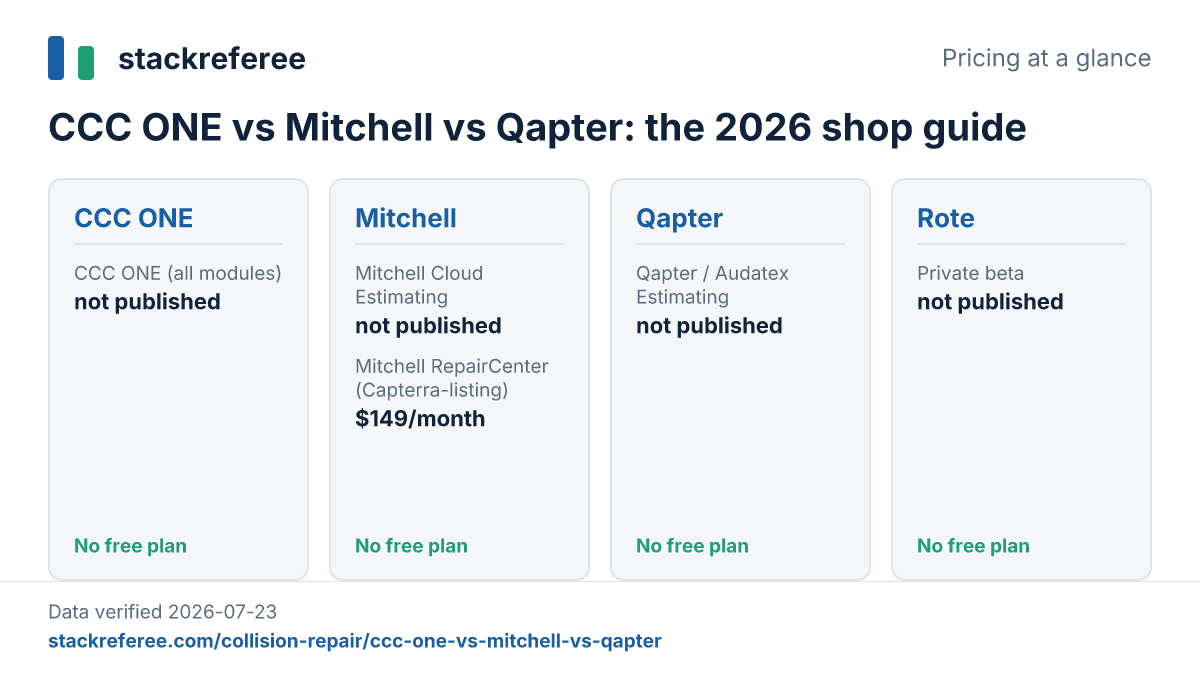
The pattern across all three established vendors is identical: no price list, only contact forms. That's worth pausing on - pricing opacity shifts negotiating power to the vendor, and reviewers of both CCC and Audatex specifically complain about billing and contract practices. Here is exactly what each vendor publishes, as of our verification date.
Mitchell pricing
Mitchell publishes no pricing for Cloud Estimating on mitchell.com - only contact CTAs. The sole public number is on Capterra's Mitchell RepairCenter listing: a $149/month flat-rate starting price. That figure is third-party, unconfirmed by Mitchell, and covers the shop-management product rather than estimating. Treat it as a floor for a conversation, not a quote. Pricing verified on July 23, 2026.
Qapter pricing
No pricing page exists on qapter.com. The collision estimating page's CTA is to call 866-348-8058 or fill out a form. Capterra lists it as "contact vendor for pricing" with no free trial or free version. Pricing verified on July 23, 2026.
CCC ONE pricing
CCC publishes no pricing anywhere on cccis.com - the estimating product page offers only contact CTAs. The only public signal is directional: a reviewer notes it "can get expensive for small businesses." No verified dollar figure exists. Pricing verified on July 23, 2026.
Rote pricing
Rote is in private beta; its site metadata invites you to join the beta and no pricing page with content exists. Pricing verified on July 23, 2026.
What users say
We only publish quotes we could trace to a real review page, with at least one critical quote per two positive ones per tool. All quotes below come from Capterra; G2 blocked automated verification during our research, and Rote has no reviews anywhere yet. One caveat applies to Mitchell: all its Capterra reviews sit on the RepairCenter listing, the shop-management product - no separate review page exists for Cloud Estimating.
Mitchell
"Mitchell Repair Center does an excellent job at providing accurate diagnostic information to technicians." - Kyle K., General Manager, via Capterra
"All together a great product, works without fail. Updated regularly, great technical support team." - Brooke H., Customer Service Rep, via Capterra
"In the middle of building an estimate, the program will close, and everything you've been working on is deleted/gone." - Alex S., Collision Center Director, via Capterra
"The software can only be used on 1 computer. Integrations are a joke at best" - Caleb F., Owner, via Capterra
Qapter
"You can do retrospective checks and save time, space and costs." - Turan A., IT Admin, via Capterra
"It makes submitting repair estimates easier. An interactive tool between car repairers, the network company and the insurers" - Ajoke H., Regional Network Analyst, via Capterra
"Terrible service...worst company for payments. They will not process your payments on time" - Tracy G., Owner, via Capterra
"The format is awkward... not very user friendly" - David K., via Capterra
CCC ONE
"I like that you can do everything in one program from writing the estimate, ordering parts, contacting the customer, submitting claims to insurance." - Audra R., Assistant Operations Manager, via Capterra
"The most widely used and most common software in this industry...saves me countless labor hours." - Rob O., Owner, via Capterra
"It can get expensive for small businesses. It also lags a lot and tends to move slow."
- Brazola M., Receptionist, via Capterra
"This company uses one-sided contracts to lock customers into agreements where rates increase." - Jason K., Owner, via Capterra
Read the criticism as a set and a theme emerges: nobody says these platforms can't do the job. The complaints are about the terms of doing it - price, contracts, stability, billing. In a category with three entrenched vendors and no published pricing, that's exactly the pattern you'd expect, and exactly why contract review matters more here than feature checklists.
The estimating data moat, honestly assessed
Why do three companies own this category? The estimating databases underneath - labor times, parts prices, repair procedures - took decades to build. CCC points to its claims volume and historical data, Solera to its billions of damage images, Mitchell to its decades of industry data. All are vendor claims we can't audit, but the structural point stands: a new entrant can't credibly rebuild P-pages and OE pricing from scratch, which is why no startup in years has attacked estimating head-on.
That's what makes Rote's angle notable. It doesn't challenge the databases - it uses them. P-pages and DEG precedent are the estimator's existing reference material; Rote's bet is that AI can wield them faster in supplement disputes than a busy estimator can. Whether it works in production is unproven, but the strategy of building on top of the moat rather than against it is the first genuinely new approach this category has seen in a while.
Verdict: choose by your constraint, not by features
All three established platforms write estimates competently - their feature lists converge more every year. Choose by your binding constraint instead. If your revenue runs through DRP relationships, CCC ONE's insurer connectivity is the constraint-solver, and you accept the cost and contract vigilance that comes with it. If OEM-correct procedures and ADAS workflows dominate your day, Mitchell puts that data closest to the estimate. If you operate internationally or insurer-side, Qapter/Audatex is built for your structure, thin US reviews notwithstanding. And if denied supplements are your quiet profit leak, keep an eye on Rote - it's the only tool here aimed at that specific wound, just not one you can buy yet.
Recap
| Mitchell | Qapter | CCC ONE | Rote | |
|---|---|---|---|---|
| Pricing | Not published | Not published | Not published | Private beta |
| Target buyer | OEM/ADAS-focused shops | Global MSOs, insurers | DRP-network shops | Shops fighting denials |
| Key differentiator | OEM procedures + photo AI | AI photo-to-estimate at global scale | End-to-end platform + insurer network | AI supplement arguments |
Browse more collision repair comparisons, read our editorial policy - vendors never buy rankings or scores here - or report a correction if you spot something off. Pricing and features change; our verification dates tell you exactly when we last checked.
Frequently asked questions
What is the best estimating software for a collision repair shop?
There is no single best option. CCC ONE combines estimating and shop management in one platform tied into a large insurer ecosystem. Mitchell Cloud Estimating is cloud-based and pairs with OEM repair procedures via TechAdvisor. Qapter (Audatex) leads on AI photo-to-estimate workflows. Which fits depends on your insurer relationships, your workflow and your tolerance for contract lock-in - none of the three publishes pricing.
Is CCC ONE better than Mitchell?
They solve overlapping but different jobs. Reviewers praise CCC ONE for handling estimates, parts ordering and insurance claims in one program, while criticism targets cost and performance. Mitchell splits estimating (Cloud Estimating) from shop management (RepairCenter), and its RepairCenter reviews are mixed at 3.3/5 on Capterra versus 4.3/5 for CCC ONE. Neither publishes prices, so a real comparison requires quotes.
How much does CCC ONE cost?
CCC does not publish pricing anywhere on cccis.com - the estimating page only offers contact CTAs. A Capterra reviewer from January 2026 notes it "can get expensive for small businesses", but no verified dollar figure exists publicly. You will need to request a quote, and reviewers advise reading contract terms carefully before signing.
What is the difference between Qapter and Audatex?
Qapter is Solera's current brand for its AI estimating suite; Audatex is the long-running estimating product line underneath it, dating back to 1966. In the US, estimating still runs under the Audatex name while qapter.com markets the AI photo-estimating layer. Reviews are split across both Capterra listings, which is worth knowing when you research the product.
What does Rote do for auto body shops?
Rote is a YC Winter 2027 startup building an AI tool that turns insurer denials into supplement arguments backed by P-page citations and DEG precedent, per its site. It is not an estimating platform - it works on the negotiation that happens after your estimating system produces the sheet. The product is in private beta with no published pricing.
Is there a cheap alternative to CCC ONE?
Not a verified one among the three established platforms - CCC, Mitchell and Solera all hide pricing behind sales calls. The only public number we found is a $149/month starting price for Mitchell RepairCenter on its Capterra listing, which is a third-party figure for the shop-management product, not for estimating. Treat any dollar figure you see online with skepticism until the vendor confirms it.
Comments
No comments yet.