TrustAI vs Vanta vs Drata vs Secureframe: 2026 guide
In short: Vanta has the broadest verified framework coverage and the longest track record of the four. Secureframe is the most transparent about its platform, with 300+ documented integrations and a public AI feature set. Drata pitches an agent-driven "trust management" approach with a documented Trust Center. TrustAI is the specialist: a YC Summer 2026 startup focused purely on risk-testing ERP AI agents. None of the four publishes pricing.
Comparison at a glance
| Vanta | Drata | Secureframe | TrustAI | |
|---|---|---|---|---|
| Best for | Broad framework coverage | Agent-driven trust management | Integration-heavy stacks | ERP AI-agent risk |
| Public pricing | No - 4 tiers, quote only | No - contact sales | No - 3 tiers, quote only | No - book a demo |
| Frameworks (verified on vendor site) | SOC 2, ISO 27001, GDPR, HIPAA, HITRUST, ISO 42001, CMMC, FedRAMP, EU AI Act, more | SOC 2, ISO 27001, ISO 42001, GDPR, HIPAA, PCI DSS, more | SOC 2, ISO 27001, HIPAA, PCI DSS, CCPA, GDPR, CMMC 2.0 | Maps findings to SOX, ITGC, ISO 27001, GxP, EU AI Act |
| Documented integrations | Not publicly verified | "Hundreds" (no count) | 300+ | ERP MCP Hub (SAP) |
| Trust center | Marketed, details unverified | Yes, documented | Yes, documented | No |
| Founded | 2018 | 2020* | 2020* | 2026 (YC S26) |
*Founding years for Drata and Secureframe come from third-party sources, not their own sites.
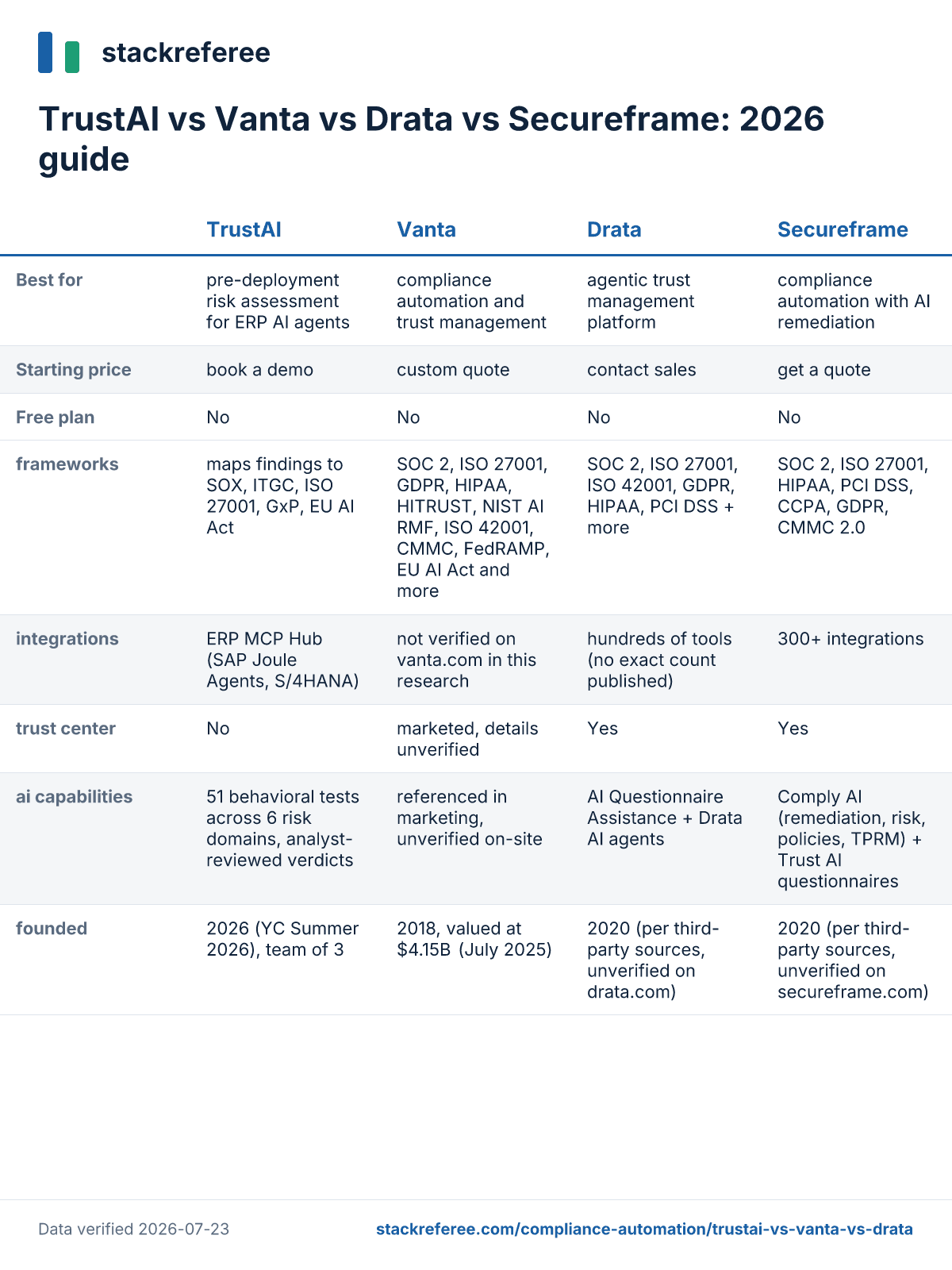
The compliance automation market has an unusual feature: every serious vendor hides its prices. That makes independent comparison harder and vendor claims easier to inflate. This article sticks to what we could verify on the vendors' own websites and on review platforms, with a verification date on every pricing section. Where we couldn't verify something, we say so instead of guessing - see our editorial policy for how that works.
What is Vanta?
Vanta was founded in 2018 and is the oldest platform in this comparison. Its About page lists backers including Sequoia Capital, Y Combinator, J.P. Morgan and Goldman Sachs. In July 2025, Forbes reported a $150M Series D at a $4.15 billion valuation - the largest publicly reported valuation among these four vendors.
The product pitch is compliance automation plus trust management. Vanta's own framework collection is the broadest we verified in this comparison: SOC 2, ISO 27001, GDPR, HIPAA, HITRUST, NIST AI RMF, ISO 42001, CMMC, CJIS, NIS2, DORA, FedRAMP, the EU AI Act and several more, plus support for custom frameworks. If you expect to stack multiple frameworks over the next few years, that breadth is the headline argument for Vanta.
What is Drata?
Drata describes itself as an "Agentic Trust Management Platform" - the framing is that AI agents, not just checklists, do the compliance work. Its platform page names SOC 2, ISO 27001, ISO 42001, GDPR, HIPAA and PCI DSS as supported frameworks, with a "+ More" label for others. Third-party reporting places its founding in 2020 in San Diego, though Drata's own site doesn't confirm those details.
Two AI features are documented by name: AI Questionnaire Assistance, which drafts responses from your approved trust content, and Drata AI, described as native AI features and agents for governance, risk and compliance work. Drata also documents a Trust Center product: a self-serve destination where prospects, customers and auditors can review your security posture and request documents.
What is Secureframe?
Secureframe is the most publicly documented platform of the four. Its integrations page headline reads "Explore our 300+ integrations" - the only concrete integration count any of these vendors publishes - naming AWS, Azure, Google Cloud, GitHub, Okta, Jamf and Slack among them. Its compliance frameworks page lists CMMC 2.0, SOC 2, ISO 27001, HIPAA, PCI DSS, CCPA and GDPR.
The AI suite is unusually specific for this category. Comply AI covers remediation (auto-generated infrastructure-as-code fixes), risk scoring, policy generation, third-party risk management and control mapping. Trust AI automates security questionnaires. Secureframe also documents AI Evidence Validation, which flags missing documents, outdated timestamps and mismatched evidence before audits. Like Drata, it offers a documented trust center product with self-serve document requests and admin approval workflows.
What is TrustAI?
TrustAI is the wildcard: a Y Combinator Summer 2026 startup, founded in 2026 by two MIT students, with a team of three. Its product is pre-deployment risk assessment for ERP AI agents - think SAP Joule Agents running inside S/4HANA environments. The platform connects to agents through an "ERP MCP Hub", maps what each agent can reach and affect, and runs a battery of behavioral tests (the site cites 51) across six risk domains, from hallucination and grounding to security and data privacy.
Findings come back as analyst-reviewed verdicts mapped to SOX, ITGC, ISO 27001, GxP and the EU AI Act. That is a genuinely different job than what Vanta, Drata and Secureframe do: TrustAI governs the AI agents you deploy, rather than automating your company's own certification work. One caution: the YC directory profile still describes an earlier automation product, which suggests a recent pivot, and the test counts and accuracy figures are the company's own claims. Early-stage software deserves early-stage scrutiny.
Pros and cons
Vanta
Pros
- Broadest verified framework coverage. The framework list on Vanta's own site is the longest in this comparison, including newer frameworks like the EU AI Act, NIS2, DORA and ISO 42001 alongside the SOC 2/ISO 27001 staples.
- Longest track record and deepest funding. Founded in 2018 and valued at $4.15 billion as of July 2025 per Forbes - relevant if vendor longevity matters for a multi-year compliance investment.
- Four differentiated plan tiers. Essentials through Enterprise gives smaller companies a named entry point rather than a single enterprise motion.
Cons
- Nothing has a price. All four tiers are quote-only, so budgeting requires a sales conversation - and comparing offers requires running parallel sales processes.
- Key product details aren't publicly documented. We could not verify an integrations count, Trust Center specifics or concrete AI capabilities on vanta.com; several product pages were unreachable during research.
- No verifiable public reviews. G2, Capterra and TrustRadius all blocked access during our research, and we exclude quotes we can't verify - so buyer due diligence takes more work.
Drata
Pros
- Documented AI direction. AI Questionnaire Assistance and Drata AI are named, described features on the platform page - not just marketing adjectives.
- Documented Trust Center. The self-serve security-posture portal, with document request and approval workflows, is verifiable on Drata's own product page.
- ISO 42001 support. Alongside SOC 2, ISO 27001, GDPR, HIPAA and PCI DSS, Drata lists the AI management standard that will matter to teams shipping AI features.
Cons
- Reviewers flag the UX. "The UX can be clunky. Too many clicks to get where you need to go," writes a Chief of Staff on Capterra.
- No HITRUST out of the box, according to an IT manager reviewing on Capterra - a gap if you sell into US healthcare. We could not verify this against Drata's own site.
- Zero pricing transparency. No tiers, no amounts - every question goes through sales.
Secureframe
Pros
- 300+ documented integrations. The only vendor here that publishes a number, which makes coverage of your stack checkable before you ever talk to sales.
- The most specific public AI feature set. Comply AI for remediation, risk, policies and vendor risk, plus Trust AI questionnaires and AI Evidence Validation - each described on its own feature page.
- Clear plan structure. Fundamentals, Complete and Defense (CMMC-focused) signal who each plan is for, including a dedicated tier for defense contractors.
Cons
- Integration setup can get hairy. "Things can get more confusing and arcane, requiring support to fix or clear things up," reports an IT support reviewer on Capterra.
- Maturity questions at equal cost. "Same price as competitors despite being less mature," notes a CTO on Capterra - pointed feedback given nobody publishes prices.
- Quote-based pricing. Three named tiers, but no amounts on any of them.
TrustAI
Pros
- Purpose-built for a new problem. Pre-deployment risk testing of ERP AI agents is a job the three incumbents don't document, and agent governance demand is growing fast.
- Framework-mapped output. Verdicts map to SOX, ITGC, ISO 27001, GxP and the EU AI Act - language your auditors and risk teams already speak.
- Human review in the loop. Findings are analyst-reviewed rather than raw model output, per the company's own description.
Cons
- Very early stage. Founded 2026, three people, no public customers, no testimonials, no trust center - every claim rests on the vendor's word for now.
- Positioning is still settling. The YC profile describes a different, earlier product than the live site, and the pivot isn't dated anywhere public.
- Unverified self-claims. The "51 tests" and "95% confidence interval" figures are the company's own numbers with no independent verification available.
Which tool fits which team?
| Your situation | Strongest fit (based on verified facts) |
|---|---|
| First SOC 2, small startup | Secureframe or Vanta - both name entry tiers; check integration coverage first |
| Stacking many frameworks (EU AI Act, NIS2, FedRAMP…) | Vanta - broadest verified framework list |
| Heavy, unusual tool stack | Secureframe - 300+ published integrations to check against |
| Betting on AI-driven GRC workflows | Drata or Secureframe - both document named AI features |
| Deploying SAP/ERP AI agents | TrustAI - the only one built for agent risk testing |
A note on that last row: TrustAI complements rather than replaces the other three. A company running SAP Joule Agents could plausibly need a compliance platform for its certifications and TrustAI for its agents.
Pricing
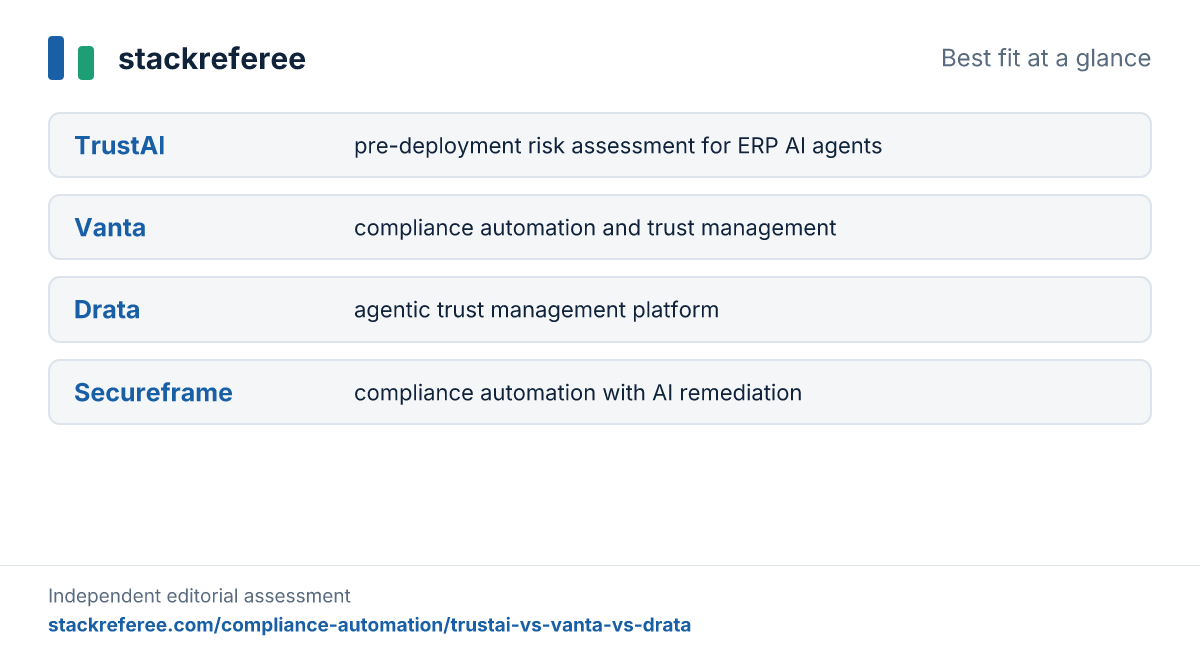
The uncomfortable truth of this category: no vendor in this comparison publishes a single price. Here's exactly what each one does say.
Vanta pricing
Four tiers - Essentials, Plus, Professional (marked "Most popular") and Enterprise - each with a qualitative description and a demo request instead of an amount.
Pricing verified on July 23, 2026.
Drata pricing
No public pricing page content at all: drata.com/pricing resolves to the product homepage with Contact Sales and Get a Demo calls to action.
Pricing verified on July 23, 2026.
Secureframe pricing
Three named tiers - Fundamentals, Complete and Defense - each with a "Get a quote" button and no amounts.
Pricing verified on July 23, 2026.
TrustAI pricing
No published pricing; the site's call to action is "Book a Demo".
Pricing verified on July 23, 2026.
Third-party aggregators circulate figures like "$7,500 per year starting price" for several of these tools. We could not verify any of them against the vendors and recommend treating such numbers as negotiating folklore, not facts. Get quotes from at least two vendors - the lack of price transparency works in your favor once vendors know they're competing.
What users say
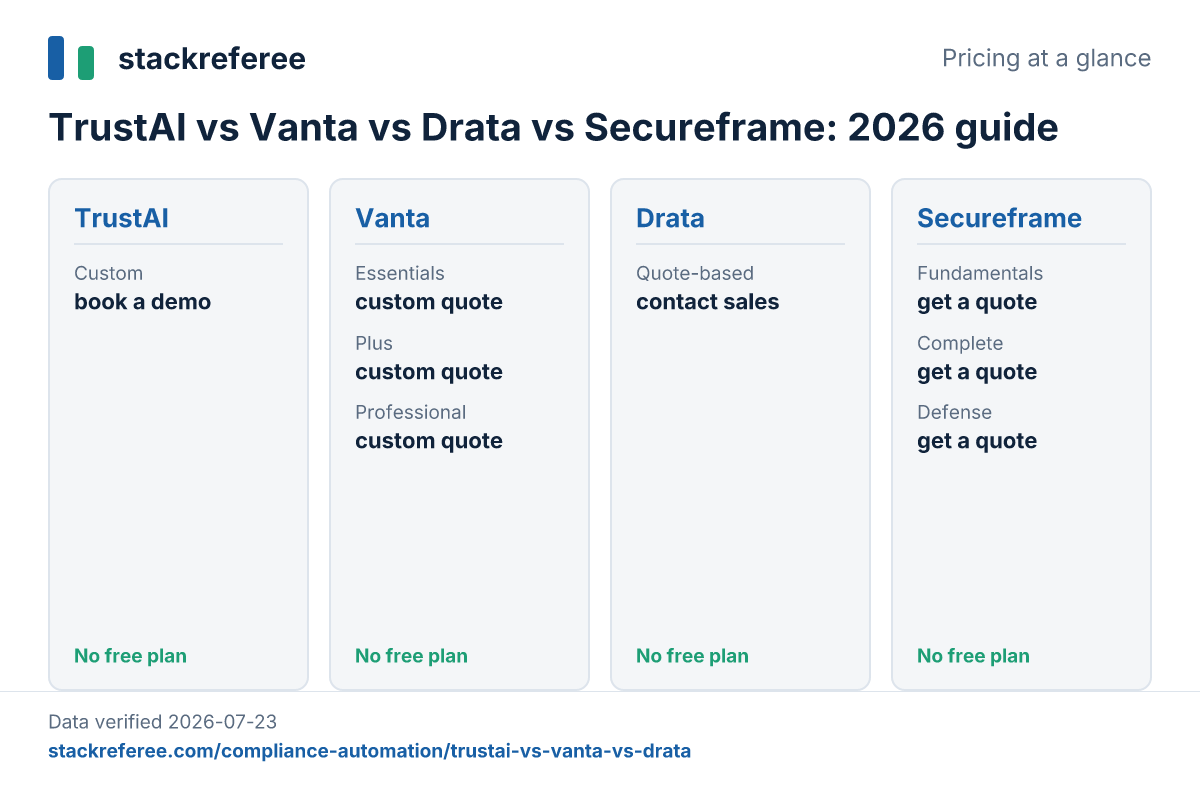
We only publish quotes we could trace to a real review page, and at least one critical quote for every two positive ones. For this article that produced verified quotes for Drata and Secureframe. For Vanta, the major review platforms blocked automated verification during our research, and for TrustAI no user reviews exist yet - rather than paraphrase search snippets, we're stating that plainly.
Drata
"We receive great support from our account rep and customer support is always helpful." - Matt S., IT Manager, via Capterra
"The UX can be clunky. Too many clicks to get where you need to go." - Abigail A., Chief of Staff, via Capterra
"They do not offer a HITRUST framework out of the box." - Matt S., IT Manager, via Capterra
Secureframe
"Straight foward UI interface to ensure you meet your SOC 2 (and other) compliance needs and requirements" - Travis C., CTO, E-Learning, via Capterra
"When getting into integrations things can get more confusing and arcane, requiring support to fix or clear things up." - Chad I., IT Support, Law Practice, via Capterra
"Same price as competitors despite being less mature" - Travis C., CTO, E-Learning, listed under Cons, via Capterra
The pattern in the criticism is worth noting: neither platform gets dinged for missing the core job. The complaints target friction - clicks, integration setup, value for (undisclosed) money. That's consistent with a maturing category where the basics work.
AI capabilities, compared honestly
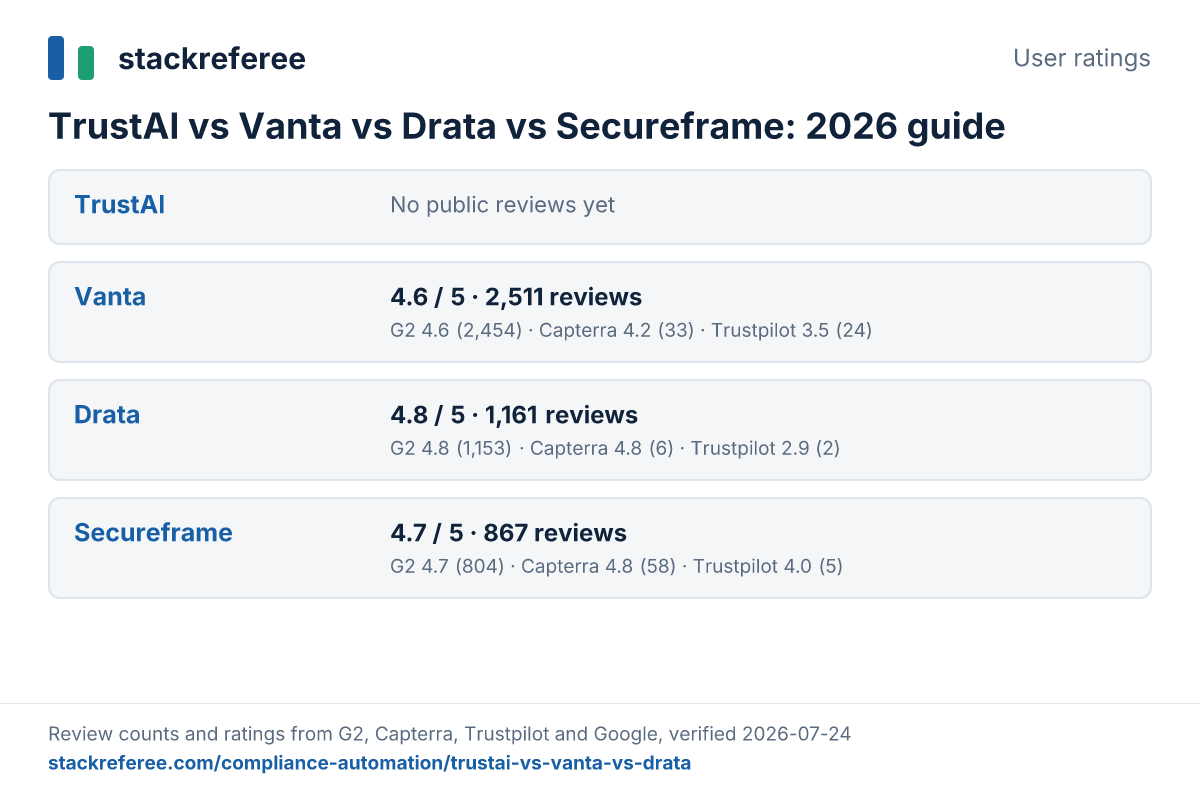
Every vendor in this category now markets AI. The useful question is what's actually documented, feature by feature, on the vendors' own sites - because that's what you can hold them to in a sales conversation.
Secureframe documents the most. Its AI pages describe five Comply AI functions by name: remediation with auto-generated infrastructure-as-code fixes, inherent and residual risk scoring with treatment plans, generative policy creation, third-party risk extraction from vendor documents such as SOC 2 reports, and control mapping. On top of that sit Trust AI for security questionnaires and AI Evidence Validation, which flags missing documents, outdated timestamps and mismatched evidence before an audit. Whether each feature performs as described is something a trial should test - but the claims are specific enough to test.
Drata documents a direction plus two features. AI Questionnaire Assistance drafts responses from your approved trust content, and Drata AI is described as native AI features and agents across the platform. The "Agentic Trust Management Platform" framing is bolder than the documented feature list - in a demo, ask which agent behaviors exist today versus on the roadmap.
Vanta's AI story could not be verified on its site. AI capabilities are referenced in marketing, but the relevant product pages were unreachable during our research, so we can't tell you what Vanta's AI concretely does. Ask for a feature-by-feature walkthrough in writing.
TrustAI is AI risk tooling rather than AI-assisted compliance. Its six test domains - correctness and control, hallucination and grounding, robustness at scale, security and adversarial behavior, data privacy, and efficiency - target the agent you deploy, not your certification workload. If your board is asking "what could our SAP agents actually do wrong?", this is the only tool of the four whose documentation answers that question directly.
Framework coverage in depth
Framework lists are where these platforms differ most visibly, so here is exactly what each vendor's own site claims.
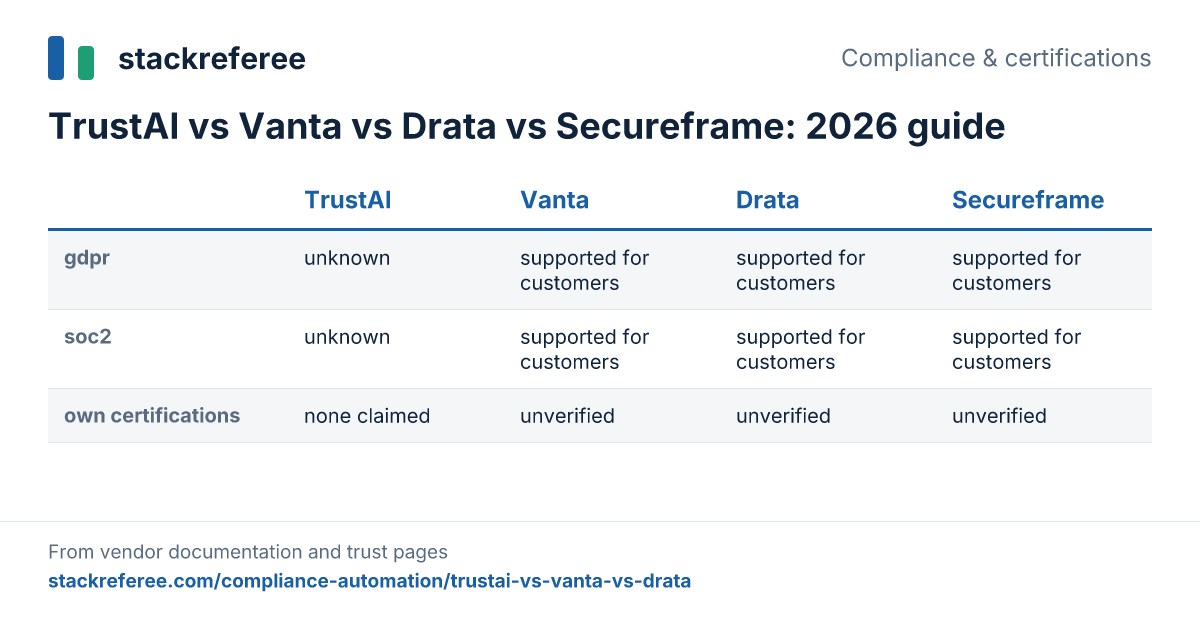
Vanta's verified list is the longest: SOC 2, ISO 27001, GDPR, HIPAA, HITRUST, NIST AI RMF, ISO 42001, CMMC, CJIS, NIS2, DORA, CPS 234, the EU AI Act, Essential Eight, Cyber Essentials, FedRAMP and more, plus custom frameworks. Two things stand out. First, HITRUST - which a Capterra reviewer says Drata lacks out of the box - appears on Vanta's list. Second, the European regulatory wave (NIS2, DORA, EU AI Act) is explicitly covered, which matters if you sell into the EU.
Drata's platform page names six frameworks - SOC 2, ISO 27001, ISO 42001, GDPR, HIPAA, PCI DSS
- with a "+ More" label. The presence of ISO 42001, the AI management system standard, is notable; the absence of an enumerated full list means you should request one.
Secureframe's compliance page lists seven: CMMC 2.0, SOC 2, ISO 27001, HIPAA, PCI DSS, CCPA and GDPR. The CMMC 2.0 lead position and the dedicated Defense plan tier signal a deliberate play for the US defense supply chain - if that's you, start your evaluation here.
TrustAI doesn't certify you against frameworks at all. It maps agent-risk findings to SOX, ITGC, ISO 27001, GxP and the EU AI Act so that audit and risk teams can slot agent testing into their existing control language. Judge it as evidence tooling, not as a compliance automation platform.
The pricing-opacity problem
It's worth dwelling on what four quote-only pricing pages mean for you as a buyer, because it shapes evaluation strategy more than any feature difference.
You cannot budget this purchase from public information. You cannot compare vendors without entering four parallel sales processes. And every "Vanta costs about $X" figure you find on the internet comes from aggregators reselling anonymous data points we could not verify - one Capterra reviewer's "same price as competitors despite being less mature" comment about Secureframe is as close to public price signal as this market gets.
Our practical advice from the research: request quotes from at least two vendors in the same week, name the competitor in both conversations, and get multi-year price protection in writing. Opaque pricing cuts both ways - vendors who won't publish prices will also move them under competitive pressure.
Verdict: choose by your actual job
- Choose Vanta if framework breadth is your bottleneck. Nobody else in this comparison verifiably supports as many frameworks, including the newer European ones, and the company's scale reduces vendor risk on a multi-year contract.
- Choose Drata if you buy the agentic-GRC thesis and want a documented trust center now. Budget demo time to judge the UX complaints for yourself.
- Choose Secureframe if you want to verify fit before talking to sales. The published integration count and named AI features make it the easiest platform to evaluate on paper - then stress-test the integration setup during a trial.
- Choose TrustAI if your actual problem is ERP AI agents, not certifications. It's the only tool here built for that job - just size the early-stage risk honestly, and expect to run it alongside a compliance platform rather than instead of one.
There is no overall winner, and given four quote-based pricing models, the cheapest option is unknowable from the outside. Shortlist two, request quotes the same week, and make the vendors compete.
Recap
| Vanta | Drata | Secureframe | TrustAI | |
|---|---|---|---|---|
| Pricing | Quote (4 tiers) | Quote (contact sales) | Quote (3 tiers) | Quote (demo) |
| Target buyer | Multi-framework companies | AI-forward GRC teams | Integration-heavy stacks | ERP AI-agent operators |
| Key differentiator | Framework breadth | Agentic trust platform | 300+ documented integrations | Agent risk testing |
Browse more compliance automation comparisons, read our editorial policy - vendors never buy rankings here - or report a correction if you spot something off. Pricing and features change; our verification dates tell you exactly when we last checked.
Frequently asked questions
What is the best alternative to Vanta?
Drata and Secureframe are the closest established alternatives to Vanta, covering similar frameworks like SOC 2, ISO 27001, GDPR and HIPAA. Secureframe documents 300+ integrations and a detailed AI feature set publicly. Drata positions itself as an agentic trust management platform. Which fits best depends on your framework needs - none of the three publishes pricing, so you'll need quotes from each.
Is Drata cheaper than Vanta?
Neither company publishes pricing. Vanta lists four plan tiers (Essentials, Plus, Professional, Enterprise) without amounts, and Drata routes all pricing questions to its sales team. Third-party estimates circulate online, but we could not verify them against either vendor, so treat any specific figure you see elsewhere with caution.
Does Vanta publish its pricing?
No. As of July 23, 2026, vanta.com/pricing shows four plan tiers with qualitative descriptions and a request-a-demo call to action, but no dollar amounts. Drata, Secureframe and TrustAI don't publish pricing either - quote-based sales is the norm in this category.
What is TrustAI?
TrustAI is a Y Combinator Summer 2026 startup that runs pre-deployment risk assessments for ERP AI agents, such as SAP Joule Agents. It tests agents across six risk domains and maps findings to frameworks like SOX, ITGC, ISO 27001, GxP and the EU AI Act. It's early-stage: founded in 2026 with a team of three.
Which tool is better for SOC 2: Drata or Secureframe?
Both list SOC 2 as a core supported framework on their own sites. Secureframe publicly documents 300+ integrations and its Comply AI remediation features; Drata documents its Trust Center and AI questionnaire assistance. Reviewer feedback cuts both ways - one Capterra reviewer calls Drata's UX clunky, another finds Secureframe's integrations confusing - so run a trial of each against your own stack.
Do these platforms support the EU AI Act?
Vanta lists the EU AI Act among its supported frameworks, and TrustAI maps its agent-risk findings to the EU AI Act. Drata and Secureframe list AI-related frameworks like ISO 42001 (Drata) but we could not verify explicit EU AI Act support on their sites as of July 2026.
Is TrustAI a replacement for Vanta or Drata?
Not today. Vanta, Drata and Secureframe automate compliance across broad frameworks for your whole company. TrustAI addresses a narrower, newer problem: testing and governing ERP AI agents before deployment. For most teams it would complement a compliance platform rather than replace one.
Comments
No comments yet.