Skydio vs DroneDeploy vs Degla Inc: 2026 Comparison
In short: Skydio is the public-safety pick - autonomous drones, docks and fleet software with SOC 2, ISO 27001 and CJIS on its trust page, sold only through sales calls. DroneDeploy is the mapping pick, from $1,908/year self-service to quote-only enterprise plans, with the strongest verified compliance set of the three. Degla Inc, a two-person YC Fall 2026 startup, promises a natural-language autonomy layer but is early access: no pricing, no reviews, no certifications yet. No tool wins outright.
Comparison at a glance
| Skydio | DroneDeploy | Degla Inc | |
|---|---|---|---|
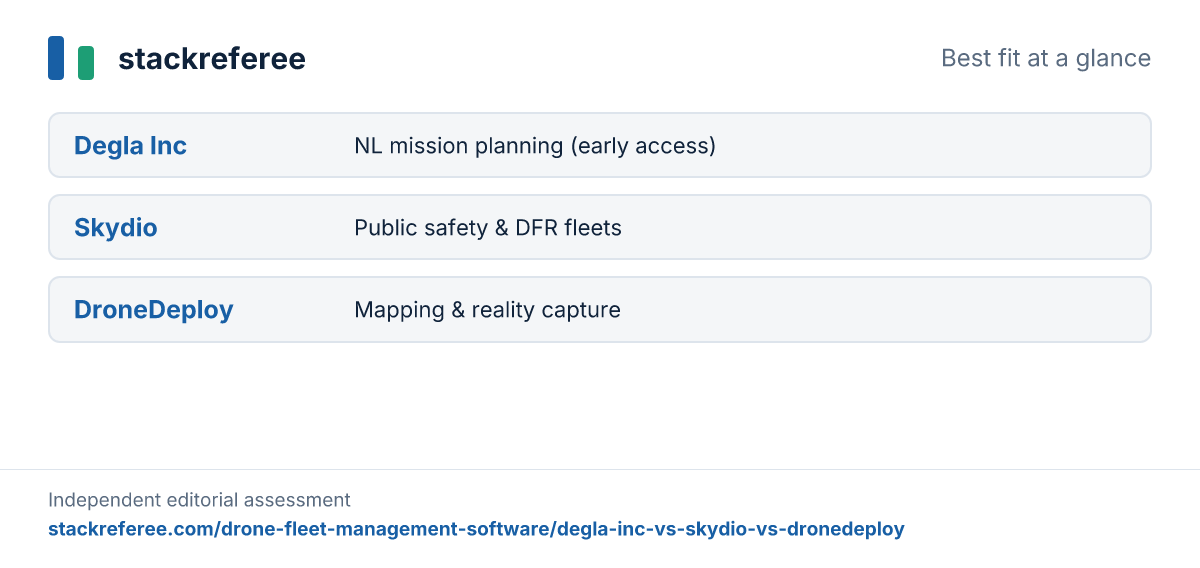
| Best for | Public safety & DFR fleets | Mapping & reality capture | Natural-language autonomy (early access) |
| Public pricing | No - contact sales | Partial - from $1,908/year | No - early access |
| Autonomy & obstacle avoidance | Yes, core strength | Not its focus | Claimed, unverified |
| Mapping / photogrammetry | Yes | Yes, core strength | Claimed on site |
| Dock ("drone-in-a-box") | Yes, own docks | Yes, DJI Dock integration | Not verified |
| SOC 2 / ISO 27001 | Yes / Yes (trust page) | Yes / Yes (docs) | Unknown |
| GDPR | Not confirmed | Yes (docs) | Unknown |
| Public reviews | Very few (1 G2, 3 Trustpilot) | Substantial (Capterra) | None yet |
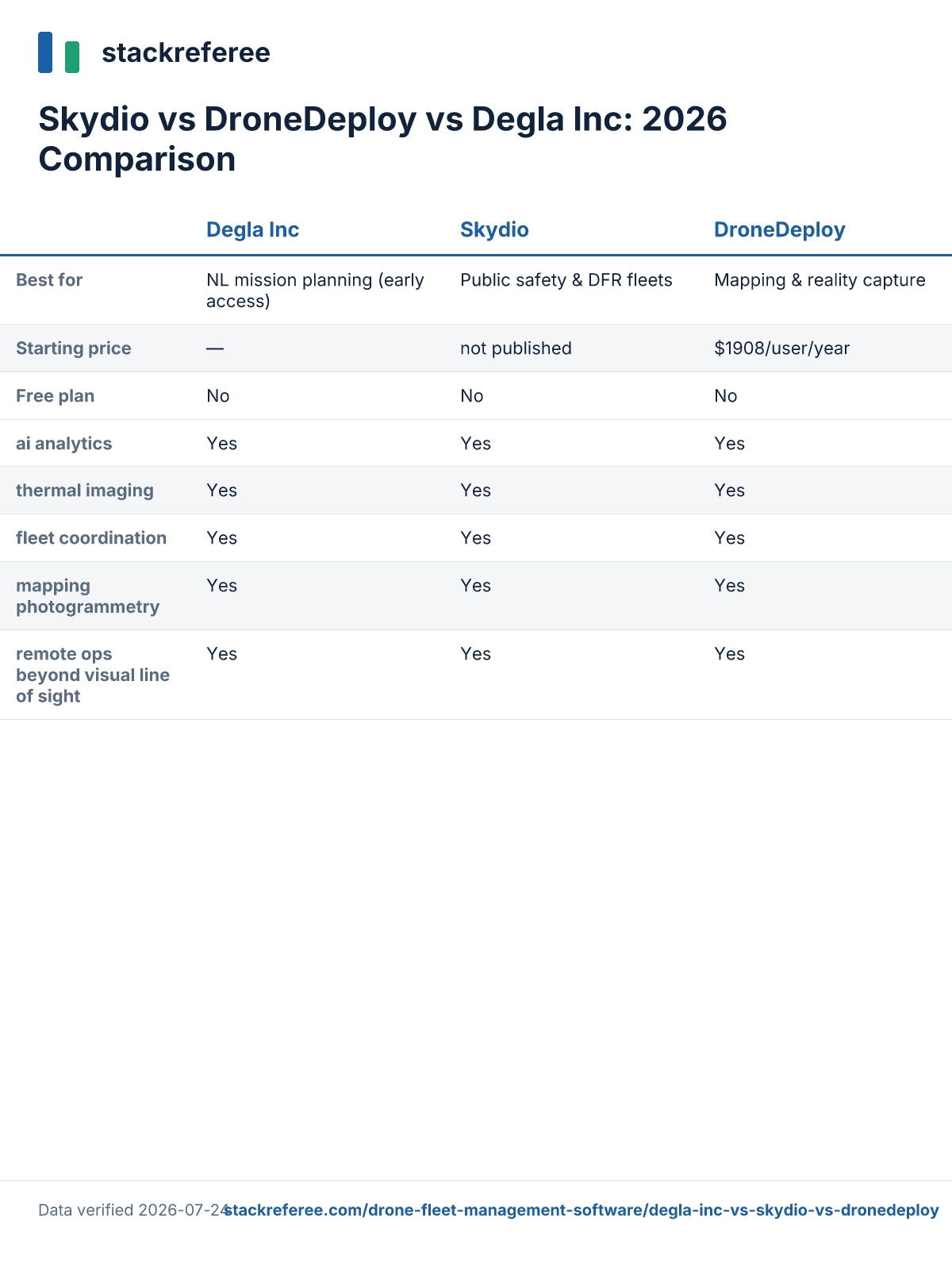
This is an unusual three-way comparison: two mature enterprise platforms with different centers of gravity, plus a startup so new it has no reviews at all. We flag that maturity gap explicitly throughout instead of pretending the three are peers. Everything below was verified on vendor sites, documentation, changelogs and review platforms on July 24, 2026; what we could not verify, we say so, per our editorial policy.
What is Skydio?
Skydio builds autonomous drones - the X10 is the current flagship - and the software stack to run fleets of them: Fleet Manager, Remote Ops for beyond-visual-line-of-sight operations, and DFR Command for drone-as-first-responder programs. The hardware and software are designed as one system, including the Dock for X10 that lets drones launch, land and charge unattended. Its cloud software adds live streaming, AI-assisted analytics, thermal imaging and 3D scanning.
Two verifiable signals stand out. First, the software ships continuously - public release notes show firmware updates as recently as July 2026. Second, the Security Trust Center claims SOC 2, ISO 27001:2022 and CJIS compliance, with data hosted on AWS in the United States. That combination - autonomy plus a public-safety-grade compliance story - explains Skydio's pull with police and government fleets. What you won't find is a price: every product routes to a sales conversation.
What is DroneDeploy?
DroneDeploy approaches the category from the data side. Its platform turns drone imagery - and increasingly ground and indoor 360 capture - into maps, models and inspection deliverables for construction, agriculture and energy. It is hardware-agnostic, automating DJI Dock 2 deployments rather than selling its own aircraft, and it publishes quarterly release notes showing an active development cadence into 2026.
DroneDeploy also has the most transparent compliance posture in this comparison: its documentation confirms SOC 2 Type 2 (with a published audit announcement), ISO 27001, GDPR support and SSO/SAML. Pricing is partially public - a rarity here - with two self-service plans and a wall of quote-only enterprise tiers behind them. Its Capterra review base is the largest of the three tools, which gives the user quotes below more weight than the thin samples available for Skydio.
What is Degla Inc?
Degla Inc is a Y Combinator Fall 2026 company from Boston, founded in 2026 with a team of two, describing itself as a fully autonomous intelligence layer in the sky. Its site positions the product around natural-language mission planning - telling a fleet what to do in plain English - plus autonomous flight, fleet coordination, mapping, thermal and public-safety response. That feature list would place it squarely against both incumbents.
Every claim in that paragraph comes from Degla's own marketing site and YC profile, because nothing else exists yet: no reviews on any platform we checked, no public changelog, no pricing, no published compliance information. That's normal for a company this young, and we treat it accordingly - Degla appears in this comparison as the early-stage variable worth watching, not as a buyable peer of Skydio or DroneDeploy today. It is in early access; you can register interest on its site.
Pros and cons
Skydio
Pros
- Autonomy is the product, not a feature. Obstacle avoidance and autonomous flight are the core of the X10 platform, paired with docks for unattended operations - the strongest verified autonomy story in this comparison.
- Built for public safety and DFR. DFR Command and Remote Ops target drone-as-first- responder programs specifically, an area neither competitor verifiably serves.
- Public-sector-grade compliance claims. SOC 2, ISO 27001:2022 and CJIS on its trust page - CJIS being the one that matters for US law-enforcement data.
Cons
- No pricing transparency at all. Every product is a sales conversation, and cost depends on fleet and dock configuration - budgeting requires vendor engagement.
- A troubling review, in a tiny sample. A Trustpilot business customer reports a dock solution that never worked properly, unfixed, unreplaced and unrefunded. One review proves little, but it's detailed and recent.
- GDPR is not confirmed. The trust page doesn't mention it and data resides in the US
- a real consideration for European fleets.
DroneDeploy
Pros
- The mapping specialist. Photogrammetry, thermal, ground and indoor 360 capture, and DJI Dock 2 automation - reviewers on Capterra call the flight planning and map sharing its standout strengths.
- Partial public pricing. Two plans you can actually budget without a call: $4,188/ year for an individual pilot, $1,908/year for agriculture. Neither competitor offers that.
- The most complete verified compliance set. SOC 2 Type 2, ISO 27001, GDPR and SSO/SAML, all confirmed in its own documentation.
Cons
- A severe reliability complaint exists. One reviewer reports the software failing twice and costing him two drones - a one-star outlier, but a costly failure mode worth asking about.
- Sharing is gated by subscriptions. A reviewer notes clients can view maps but can't use basic tools without their own subscription - friction if deliverables go to external customers.
- Team pricing disappears behind quotes. The moment you need more than one seat, you're in contact-sales territory like everyone else.
Degla Inc
Pros
- A genuinely different interface promise. Natural-language mission planning is a capability neither incumbent verifiably offers - if it ships as described, it lowers the skill barrier for fleet operations.
- Broad claimed scope from day one. Autonomy, fleet coordination, mapping, thermal and DFR response are all on the site - an ambitious surface for a young team.
- YC backing and momentum. Fall 2026 batch, Boston-based - early, but a real signal that the ambition has institutional support.
Cons
- Nothing is independently verified. Every capability claim traces to Degla's own site; there are no reviews, case studies or changelogs to check them against.
- No pricing, no buying path. Early access means you can register interest, not procure - impossible to evaluate commercially today.
- No published compliance story. GDPR, SOC 2 and SSO status are unknown - a blocker for exactly the public-safety and enterprise buyers its feature list targets.
Which tool fits which fleet?
Police, fire and DFR programs. Skydio is built for you, and CJIS plus US data residency fit the constraint set. Go in with eyes open on pricing and ask directly about dock deployment references - the harshest review we found was about exactly that.
Construction, agriculture, energy and surveying. DroneDeploy is the specialist, and the only option here you can partially budget without a sales call. If your deliverables go to external clients, test the sharing workflow before committing - it's the most repeated friction point in reviews.
European fleets with GDPR requirements. DroneDeploy is the only one of the three with GDPR confirmed in its documentation. Skydio doesn't confirm it and hosts data in the US; Degla publishes nothing yet.
Teams betting on autonomy's next interface. Watch Degla. Natural-language mission planning is a real differentiator if it materializes - but treat it as a pilot-program candidate for next year, not a procurement option today.
Pricing
Skydio pricing
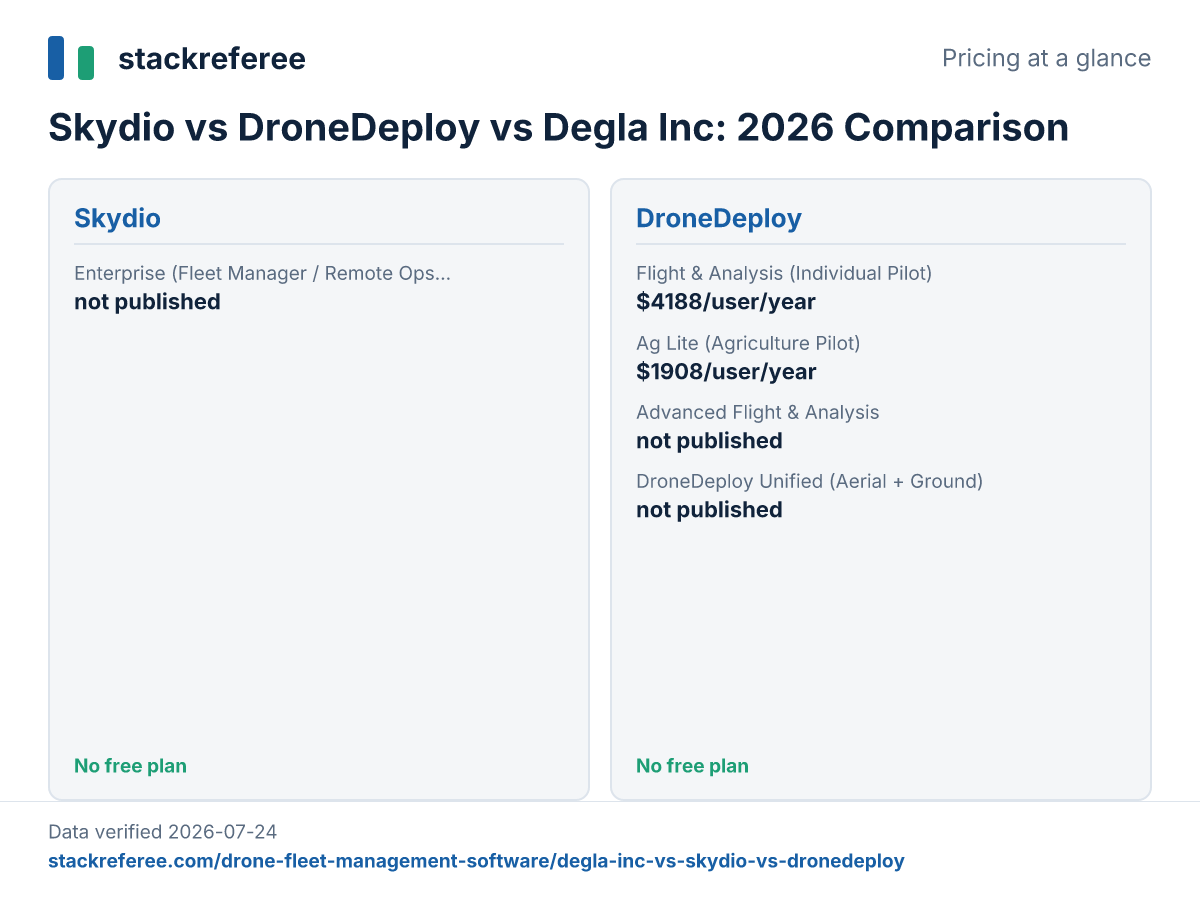
Skydio publishes no pricing for Fleet Manager, Remote Ops or DFR Command - the site routes every product to a sales contact, and cost depends on fleet and dock configuration. A $2,999/year figure for 3D Scan software appears on third-party aggregators but not on skydio.com, so we don't treat it as verified. Pricing verified on July 24, 2026.
DroneDeploy pricing
Two plans are public and self-service: Flight & Analysis for an individual pilot at $4,188/year and Ag Lite for agriculture at $1,908/year, both billed annually. Advanced Flight & Analysis, Unified (aerial plus ground), Aerial Pro and the Ground plans are all quote-only. In practice: one pilot can budget from the price list; a team cannot. Pricing verified on July 24, 2026.
Degla Inc pricing
No pricing exists. The product is in early access via its website; there are no published plans or amounts. Pricing verified on July 24, 2026.
What users say
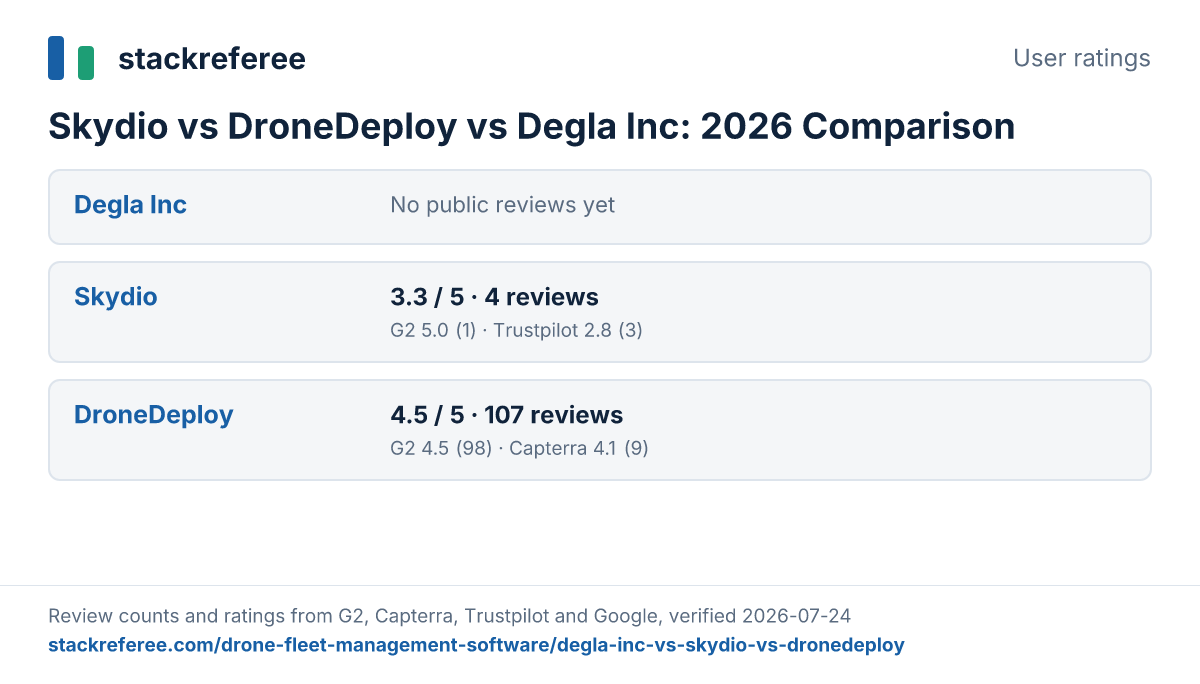
Review coverage is lopsided here, and we present it that way rather than flattening it: DroneDeploy has a substantial Capterra base, Skydio's public footprint is strikingly thin - one G2 review and a handful on Trustpilot - and Degla has no reviews at all, which we verified across G2, Capterra, Trustpilot, GetApp and Product Hunt. We publish at least one critical quote per two positive ones per tool wherever quotes exist.
Skydio
"Best Drone On The Market - Hands Down" - G2 reviewer (5.0 stars), via G2
"They sold us a drone and dock solution that never worked properly, they never fixed or replaced it, and refused to refund the cost when we were forced to go with another solution." - business customer, via Trustpilot
Both come from very small samples - treat them as data points, not verdicts.
DroneDeploy
"They have made this software incredibly easy to use." - Steven K., Pilot, Airlines/Aviation, via Capterra
"The convenience of creating flight plans, sharing maps, and visualizing different deliverables make this flight software the best in the game." - Jp J., Pilot Success Manager, via Capterra
"The Software has fail twice causing the lost of 2 of my drones." - Fernando G., CEO, Security/Investigations, via Capterra
"It is very hard to share with customers. they can pull up map but can not use the simple tools unless they are subscribers." - Capterra reviewer, via Capterra
Degla Inc
No user reviews exist anywhere we could verify - expected for an early-access product from a 2026-founded team. We state that plainly rather than quoting marketing copy.
Docks and unattended operations, compared
"Drone-in-a-box" - a dock that launches, lands and charges aircraft without a human on site - is quickly becoming the dividing line between drone programs that scale and ones that stay pilot-bound. The three tools approach it very differently. Skydio sells the whole stack: its Dock for X10 is its own hardware, designed around its own aircraft and software, which keeps integration risk low but locks you into one vendor for everything. DroneDeploy takes the opposite route: it doesn't build aircraft or docks at all, but automates DJI Dock 2 deployments through its software - attractive if you already fly DJI, though it ties that workflow to a second vendor's hardware roadmap. For Degla, dock support is simply not verifiable today; its site doesn't document it, so we leave it as unknown rather than assuming either way.
The same split shapes remote operations. Skydio's Remote Ops product is explicitly built for beyond-visual-line-of-sight work, and DroneDeploy's platform supports remote operations across its capture fleet. Both therefore claim the operational model regulators are gradually opening up. Which one fits depends on the question from the sections above: are you flying to respond, or flying to measure?
Release cadence as a buying signal
One practical way to judge software maturity without a demo: read the vendor's public release notes. Skydio publishes detailed firmware updates for the X10 - the most recent we verified is from July 16, 2026 - showing an active, hardware-coupled release rhythm. DroneDeploy ships quarterly platform releases plus interim notes, with its April 2026 quarterly release publicly documented. Both leave a verifiable paper trail of shipping.
Degla has no public changelog at all. For an early-access startup that's expected, but it matters for buyers: you cannot independently confirm what the product does this month versus what the website promises. Until that changes, any Degla evaluation depends entirely on what the founders show you directly - which is precisely why we recommend containing it to a low-stakes pilot.
The maturity gap, honestly assessed
The most important fact in this comparison isn't a feature - it's that these three companies are at completely different life stages. Skydio and DroneDeploy ship public release notes monthly to quarterly, hold third-party security attestations and carry years of production usage. Degla has a marketing site, a YC profile and a two-person team. That doesn't make Degla's approach wrong; category-defining products start exactly this way. But it defines what you can responsibly do with each today: deploy the incumbents in production, and evaluate Degla in a contained pilot where a failed mission costs you nothing. Revisit that judgment when Degla publishes pricing, compliance information and its first verifiable customer stories.
Verdict: choose by your mission profile
If your fleet exists to respond - police, fire, security - Skydio's autonomy, docks and CJIS posture make it the default, priced only through sales conversations. If your fleet exists to measure - sites, crops, assets - DroneDeploy's capture-to-deliverable pipeline and partially public pricing make it the pragmatic pick, especially for GDPR-bound organizations. And if your roadmap bets on operators directing fleets in plain language, put Degla on a watchlist with a re-evaluation date, because today it's a promise with institutional backing, not a product with a track record.
Recap
| Skydio | DroneDeploy | Degla Inc | |
|---|---|---|---|
| Pricing | Not published | From $1,908/year; teams quote-only | Early access, none |
| Target buyer | Public safety & DFR fleets | Mapping-driven operations | Autonomy early adopters |
| Key differentiator | Autonomous drones + docks + CJIS | Reality capture across air and ground | Natural-language mission planning (claimed) |
Browse more drone fleet management comparisons, read our editorial policy - vendors never buy rankings or scores here - or report a correction if you spot something off. Pricing and features change; our verification dates tell you exactly when we last checked.
Frequently asked questions
What is the best drone fleet management software?
It depends on the job. Skydio pairs its own autonomous drones and docks with fleet software aimed at public safety and drone-as-first-responder programs, backed by SOC 2, ISO 27001 and CJIS claims. DroneDeploy leads on mapping and reality capture across drones and ground robots, with partial public pricing from $1,908/year. Degla is a promising but unproven early-access startup. None of the three fits every fleet.
How much does DroneDeploy cost?
DroneDeploy publishes two self-service prices: Flight & Analysis for an individual pilot at $4,188/year and Ag Lite for agriculture at $1,908/year, both billed annually. Every team and enterprise variant - Advanced, Unified, Aerial Pro, Ground - is quote-only. Prices verified on the vendor's pricing page on July 24, 2026.
How much does Skydio software cost?
Skydio publishes no pricing for Fleet Manager, Remote Ops or DFR Command - its site routes every product to a sales conversation, and cost depends on your fleet and dock configuration. A $2,999/year figure for its 3D Scan software circulates on third-party aggregators but does not appear on skydio.com, so treat it as unverified.
Is Skydio software any good according to users?
The public review base is remarkably thin for a company of Skydio's profile: one five-star G2 review and a handful of Trustpilot reviews, including a detailed complaint about a dock deployment, support and refusal to refund. That sample is too small to generalize - ask Skydio for reference customers running a deployment like yours.
What is Degla and can I buy it today?
Degla Inc is a Y Combinator Fall 2026 startup from Boston building what it calls an autonomous intelligence layer for drone fleets, with natural-language mission planning. It is in early access: no public pricing, no reviews, and no published compliance certifications. You can register interest, but you cannot simply buy it today.
Which drone software is best for mapping and surveying?
DroneDeploy is the specialist here: photogrammetry, thermal capture, ground and indoor 360 capture, and dock automation, with reviewers on Capterra praising its flight planning and map sharing. Skydio covers mapping too, particularly 3D scanning of structures. Degla lists mapping among its capabilities, but without independent verification yet.
Comments
No comments yet.