Nylas vs Unipile vs Aurinko vs Nango vs EmailEngine (2026): honest comparison
Developers land on this comparison because all five show up when you search "email API." Treating them as five versions of one product is the fastest way to buy the wrong thing. A team that needs a HIPAA-eligible calendar sync has very different requirements from one that wants to send WhatsApp messages programmatically or from one that just wants to stop maintaining its own IMAP connection pool. This guide separates what each tool actually is, what it costs, how far its compliance really goes, and where the honest trade-offs sit.
| Metric | Nylas | Unipile | Aurinko | Nango | EmailEngine |
|---|---|---|---|---|---|
| Category | Managed email/calendar/contacts API | Multichannel messaging API (LinkedIn/WhatsApp) | Managed email/calendar/contacts API | Generic OAuth/integration infra | Self-hosted email gateway |
| Best for | Enterprise teams needing deep compliance | Teams automating LinkedIn/WhatsApp | Cost-sensitive unified sync | Broad integrations, self-host option | Owning your data at scale |
| Starting price | $15/mo base + ~$2/account | ~EUR 5/account (EUR 49/mo min) | from $1/account | Free, then $50/mo (usage-metered) | $1,450/year flat, unlimited |
| Free option | Yes (5 accounts) | 7-day trial | 14-day trial | Yes ($0, 10 connections) | 14-day trial |
| Verified compliance | SOC 2, ISO 27001, ISO 27701, HIPAA/BAA, GDPR (first-party) | SOC 2, GDPR (EU data), CASA Tier II (first-party) | SOC 2 Type I pending Q3 2026 | SOC 2, GDPR, HIPAA/BAA; self-hostable | None vendor-side (you self-host) |
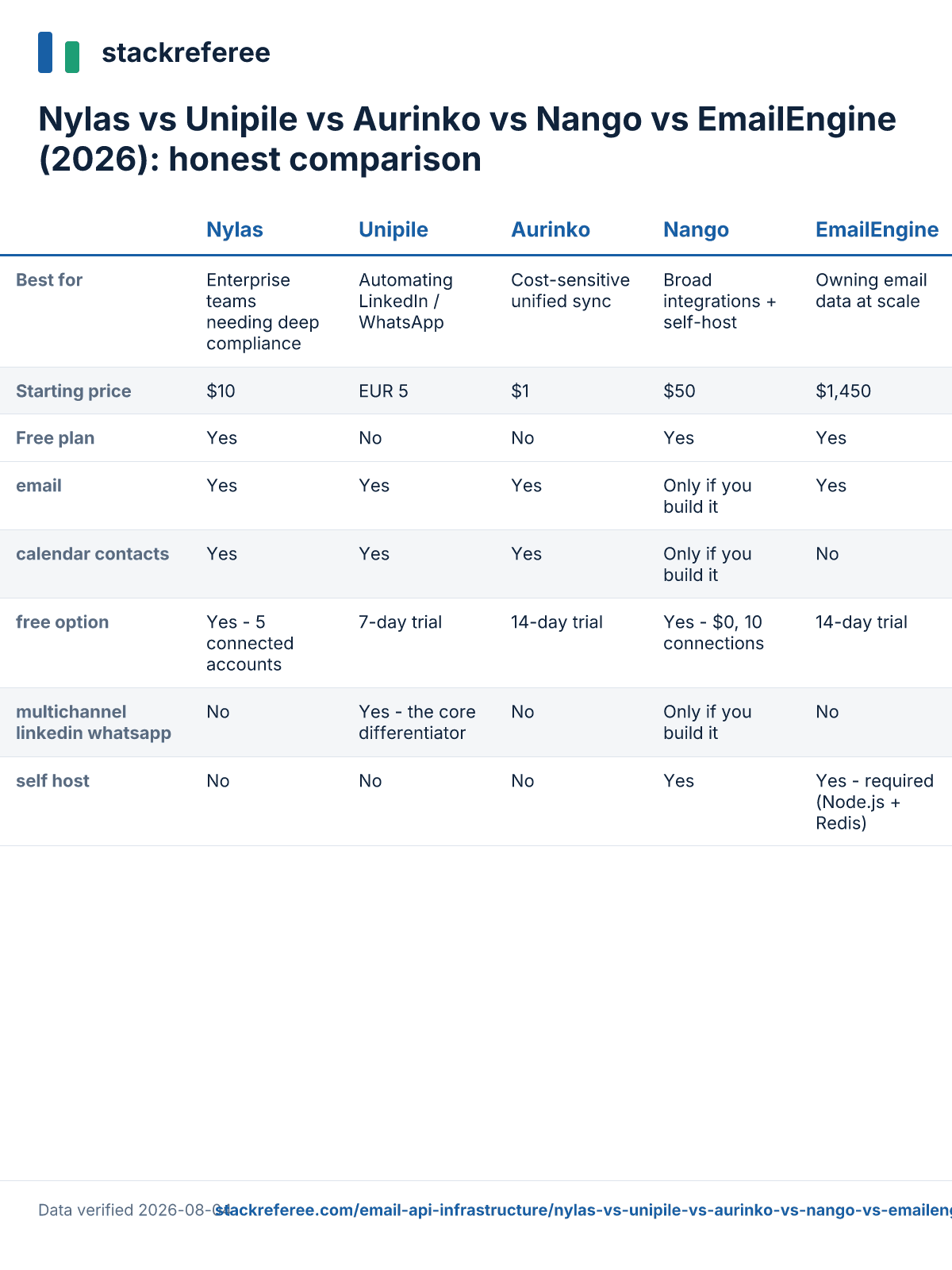
One caveat frames the whole comparison: because these tools sit in different categories, a missing capability usually means "out of scope," not "worse." EmailEngine has no calendar because it is an email gateway by design. Nango has no built-in email sync logic because it is integration plumbing, not a communications product. Read the notes below as "what job does this do," not "which one has more features." Two research caveats also apply throughout: every G2 page returned an access error during research, so no G2 star rating is stated as fact here, and all compliance claims except EmailEngine's (which has none by design) are first-party statements read on each vendor's own security page, not independently audited. Prices were read from each vendor's own pricing page on August 4, 2026.
What is Nylas
Nylas is the established, fully managed communications platform of the group: a hosted unified API for email, calendar and contacts across Google, Microsoft and Exchange, plus a Scheduler, a Notetaker product for meeting recording and AI summaries, and newer "Agent Accounts" that provision real mailboxes for AI agents. Its target user is a product team that wants a managed sync backend and does not want to run OAuth, token refresh and provider quirks itself. It is the incumbent and the enterprise-priced option, and its low self-serve tiers are best read as the floor rather than what a real enterprise deployment costs.
What is Unipile
Unipile is a multichannel messaging API, and its differentiator is the channels the others avoid: LinkedIn, WhatsApp, Instagram and Telegram, alongside email and calendar, behind one API. Its typical user is building sales-engagement, recruiting or "AI SDR" software that needs to operate LinkedIn and WhatsApp inboxes programmatically, a job Nylas and Aurinko simply do not do. It is a French company that keeps data in the EU, which makes it a clean fit for GDPR-sensitive buyers, with the important caveat that automating LinkedIn and WhatsApp carries inherent platform-terms and account-suspension risk.
What is Aurinko
Aurinko is the most direct alternative to Nylas: a managed unified API for email, calendar, contacts and tasks across Google, Office 365, Outlook.com and Exchange, plus a server-side sync product (BrightSync) and virtualized CRM integrations for Salesforce, HubSpot and Pipedrive. It positions itself as the cheaper, more usage-flexible Nylas, and its per-account pricing reflects that. The trade-off, covered below, is compliance maturity: it is a smaller company (Yoxel) and its formal certifications are not yet in place.
What is Nango
Nango is a different category: open-source, self-hostable OAuth and integration infrastructure covering 400-plus APIs, with managed authorization, token refresh, a proxy that injects credentials, and custom sync functions. Email is one integration among hundreds, not the product. You reach for Nango when you are building product integrations broadly and want to own the integration layer, accepting that for an email or calendar use case you assemble that logic yourself on top of raw API access. Its developer reputation is the strongest of the five, and it can be self-hosted to sidestep third-party data processing entirely.
What is EmailEngine
EmailEngine is self-hosted, source-available software: a headless email client you run on your own infrastructure that exposes IMAP, SMTP, the Gmail API and Microsoft Graph as one unified REST API with webhooks. It requires Node.js and Redis, and it handles email only, not calendar or contacts. Its user is a team that wants a unified email API but needs the data to stay on its own servers, whether for compliance, cost or control, and is willing to operate the software. Because Postal Systems never touches your email data, the compliance burden shifts entirely to you, which is simultaneously the point and the catch.
Nylas: pros and cons
The broadest managed feature set. Email, calendar, contacts, scheduling, meeting notes and agent mailboxes sit behind one platform, so a team standardizing on a single vendor gets the most coverage here. If you want one contract to cover several communications jobs, Nylas is the widest.
The deepest compliance stack of the five. On its own security pages Nylas states SOC 2 Type II, ISO 27001, ISO 27701, HIPAA with a signed BAA, and GDPR. For regulated buyers, especially in healthcare, that combination is hard to match among these tools and is Nylas's strongest argument.
Surprise price increases are the recurring complaint. The loudest, most consistent theme across reviews is aggressive commercial behavior once you are embedded. On Capterra, a CEO wrote that Nylas "arbitrarily raise the price excessively with minimal warning once you're embedded," describing "a 30% raise across our entire user base." Negotiate price protection into the contract before you build on it.
Support draws criticism. Capterra's small sample is unforgiving: an owner wrote it was "very difficult. No support. Hard to cancel." With only two Capterra reviews the sample is thin, but the theme lines up with the pricing complaints, so weigh support responsiveness during your trial.
Self-serve prices are not the real price. The published $10 to $15 base tiers are low, but Nylas's actual deployments are typically enterprise and quote-based, and third-party marketplaces list its deals well into four and five figures per month. Budget for the negotiated number, not the sticker.
Unipile: pros and cons
LinkedIn and WhatsApp that no one else here offers. Unipile's core value is a single API across LinkedIn, WhatsApp, Instagram, Telegram, email and calendar. If your product needs to send and receive on those channels, none of the other four can do it, which usually settles the decision on capability alone.
Simple, predictable pricing. It bills roughly EUR 5 per connected account with a EUR 49/month minimum, includes unlimited API requests (only the underlying provider limits apply), and offers hosted white-label auth. Compared with Nango's multi-axis meter, it is easy to forecast.
EU-only data residency plus CASA Tier II. Unipile hosts data exclusively in France and states Google CASA Tier II certification first-hand, the only tool of the five to make that specific claim. For a GDPR-first buyer, EU residency and a Google security assessment are a clean story.
Platform-terms risk is inherent. Automating LinkedIn and WhatsApp runs against those platforms' terms and carries account-restriction risk. Unipile mitigates with proxies and account protection, but the risk belongs to the category, and you are accepting it when you build on programmatic LinkedIn or WhatsApp.
A thin third-party track record and no HIPAA. Its verified review footprint is small, and it does not claim HIPAA or ISO 27001. For healthcare data or buyers who want a large reference base, that is a gap relative to Nylas.
Aurinko: pros and cons
The cheapest managed unified API. Aurinko starts at $1 per connected account per month, undercutting Nylas substantially, and adds CRM virtualization that Nylas tends to reserve for enterprise deals. For a cost-sensitive team that needs email and calendar sync, it is the value pick.
The healthiest satisfaction signal of the group. On its G2 search listing Aurinko shows the highest rating of the five, with the majority of reviews at five stars. That number could not be verified on the page directly because G2 blocked access, so treat it as directional, but it is a positive signal from a healthier review count than Unipile's.
Compliance is the real weakness. Aurinko's own certifications page states that it is "actively preparing for our formal SOC 2 Type I examination, targeted for Q3/2026." That is Type I, not Type II, and still in the future. There is no first-party HIPAA, ISO 27001, GDPR or CASA claim. For a regulated or enterprise buyer, that alone can rule it out today.
A smaller company behind it. Aurinko is built by Yoxel, a smaller vendor than Nylas, with less market presence. That is not disqualifying, but it is worth weighing for a dependency you plan to build a product on.
Nango: pros and cons
Open-source and self-hostable. Nango can be run on your own infrastructure, which is a genuine escape hatch from lock-in and third-party data processing. Combined with 400-plus supported APIs, it is the most flexible foundation here if integrations are your broader need.
An excellent developer reputation. Its Product Hunt page is strongly positive on exactly the pain it targets. One founder wrote that "Nango helped me with the integration piece, massive shoutout, ended up saving $10k worth of tokens," and another called it "by far the easiest way to launch 3rd party integrations inside your app." Solving OAuth quickly is the recurring praise.
More work for a pure email use case. Because Nango gives you managed auth and raw API access rather than an email product, you build the email and calendar logic yourself. For a team that only needs email sync, Nylas or Aurinko will be less effort, and that is the honest trade-off for Nango's flexibility.
The pricing meter is complex. Nango bills across connections, proxy requests, function compute, runs, logs, stored records and webhooks. That multi-axis meter draws consistent "hard to predict at scale" criticism, so model your volume before committing. Its compliance is solid, though: SOC 2 Type II, GDPR and a HIPAA BAA on request, with self-hosting as an additional lever.
EmailEngine: pros and cons
Radically cheap and predictable at scale. EmailEngine is a flat $1,450/year for unlimited instances, unlimited IMAP accounts and unlimited API calls. Once you run more than a few hundred mailboxes, that flat fee crushes any per-account model, and there is no metering to forecast.
Full data ownership. Because you self-host, your email never passes through a third-party vendor. That makes it straightforward to bring inside your existing compliance boundary and removes a sub-processor from your data flow, which is often the entire reason teams choose it.
You operate it, and that is real work. Node.js, Redis, servers, uptime, scaling and upgrades are your responsibility, and there is no managed SLA. If you do not have the appetite to run infrastructure, a managed API is the better fit even at higher cost.
Email only, and no vendor attestations. There is no calendar, contacts or multichannel, and as self-hosted software it carries no SOC 2, ISO or HIPAA certification of its own to hand an auditor beyond "we host it ourselves." It is also source-available rather than true open-source: the README states plainly that "you need a paid subscription to run it beyond the free 14-day trial." There is no meaningful G2 or Capterra presence, which is normal for self-hosted developer infrastructure rather than a mark against it.
Use-case comparison
"I need managed email and calendar sync with serious compliance." Nylas. It ships the widest feature set and the deepest first-party compliance stack, provided you negotiate against its documented habit of raising prices once you are embedded.
"I want the same managed sync but cheaper." Aurinko. At $1 per account it is the value option and has the best satisfaction signal, as long as its pending SOC 2 Type I is acceptable for your risk profile.
"I need to automate LinkedIn or WhatsApp." Unipile. It is the only one of the five that operates those channels, with EU data residency and CASA Tier II, and the platform-terms risk that comes with the territory.
"I'm building lots of integrations, not just email." Nango. It is integration infrastructure with a great developer reputation and a self-host option; you trade more build effort for far more flexibility.
"I want to own my data and beat per-account pricing at scale." EmailEngine. A flat annual fee for unlimited mailboxes and full self-hosting, if you can operate the software and only need email.
Pricing
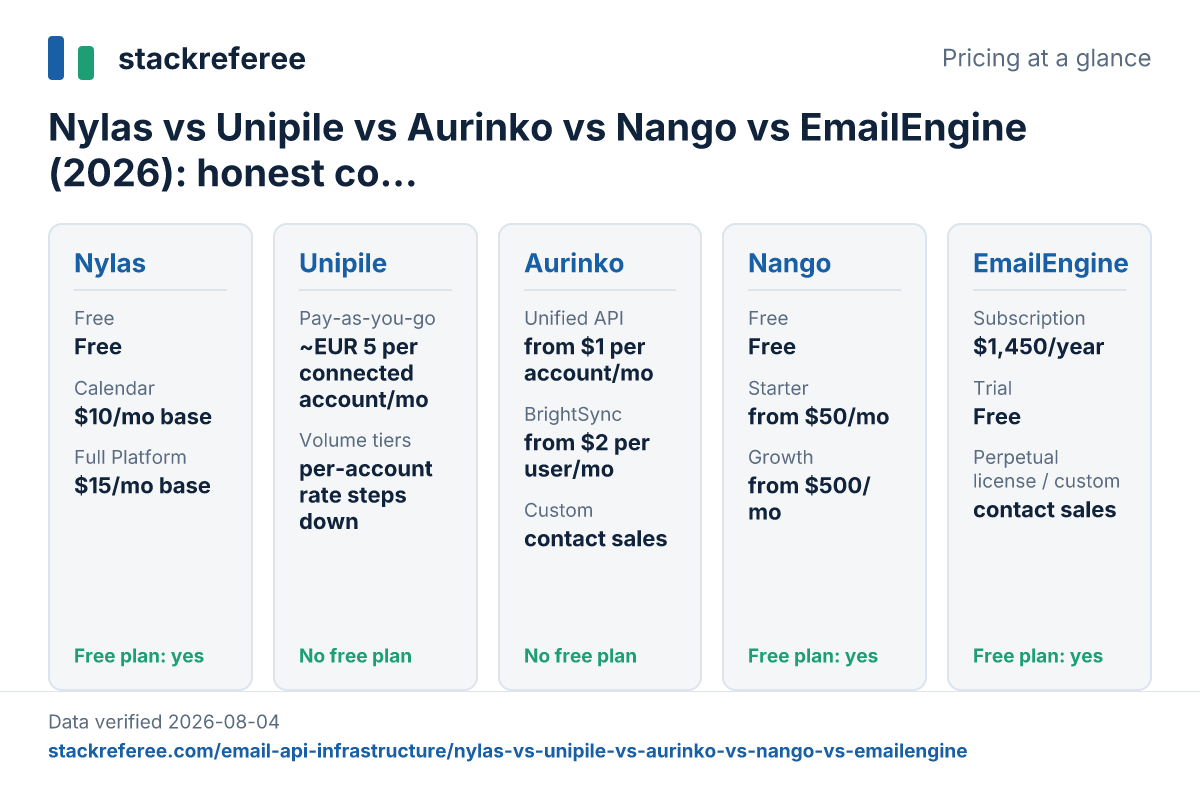
Every plan below was read from the vendor's own pricing page on the verification date noted per tool. Two structural points matter more than the headline numbers: the managed unified APIs (Nylas, Aurinko) bill per connected account, while Nango meters usage across several axes and EmailEngine charges one flat fee. Compare on the plan you will actually run.
Nylas pricing
- Free — $0/mo: 5 connected accounts, developer and sandbox use.
- Calendar — $10/mo base: 5 connected accounts included, then about $1.50 per connected account/mo.
- Full Platform — $15/mo base: 5 connected accounts plus 20 Agent Accounts included, then about $2.00 per connected account/mo; adds email send and sync, bounce detection and tracking.
- Enterprise — contact sales: volume discounts, branded customization, SLA and a signed BAA. Real enterprise deals run well above the self-serve tiers.
Pricing verified on nylas.com/pricing, August 4, 2026. Enterprise pricing is quote-only; treat the self-serve tiers as the floor, not the typical cost.
Unipile pricing
- Pay-as-you-go — about EUR 5 per connected account/mo, with a EUR 49/month minimum (covers roughly 10 accounts). All channels and endpoints included, unlimited API requests, hosted white-label auth and proxy protection.
- Volume tiers — the per-account rate steps down across usage bands; 5,000+ accounts move to custom pricing.
- Free trial — 7 days, no credit card. No separate annual price is published.
Pricing verified on unipile.com/pricing-api, August 4, 2026.
Aurinko pricing
- Unified API — from $1 per account/mo: $1 under 1 GB of data transfer, $1.50 under 5 GB, $2 unlimited.
- BrightSync — from $2 per user/mo for server-side calendar, contacts and tasks sync; $3 email-only; $4 for multiple syncs.
- Custom — CRM virtualization and custom integrations, price not published (contact sales). A 14-day trial is referenced on the site.
Pricing verified on aurinko.io/pricing, August 4, 2026.
Nango pricing
- Free — $0/mo: 10 connections, 100k proxy requests, limited function hours and runs, 2 environments.
- Starter — from $50/mo: 20 connections then $1 per connection, plus metered proxy requests, function compute and runs.
- Growth — from $500/mo: 100 connections then $1 per connection, with higher metered allowances.
- Enterprise — custom: HIPAA, self-hosting SLAs and more. API authorization is free on every tier.
Pricing verified on nango.dev/pricing, August 4, 2026. Billing is metered across several axes, so model your usage before committing.
EmailEngine pricing
- Subscription — $1,450/year (excl. VAT): unlimited instances, unlimited IMAP accounts and unlimited API calls. Single tier, all features included.
- Trial — 14 days, full functionality, no credit card.
- Perpetual license and custom terms — available on request via sales.
Pricing verified on postalsys.com/plans, August 4, 2026. A widely circulated $995/year figure is stale; the current first-party price is $1,450/year.
What users say
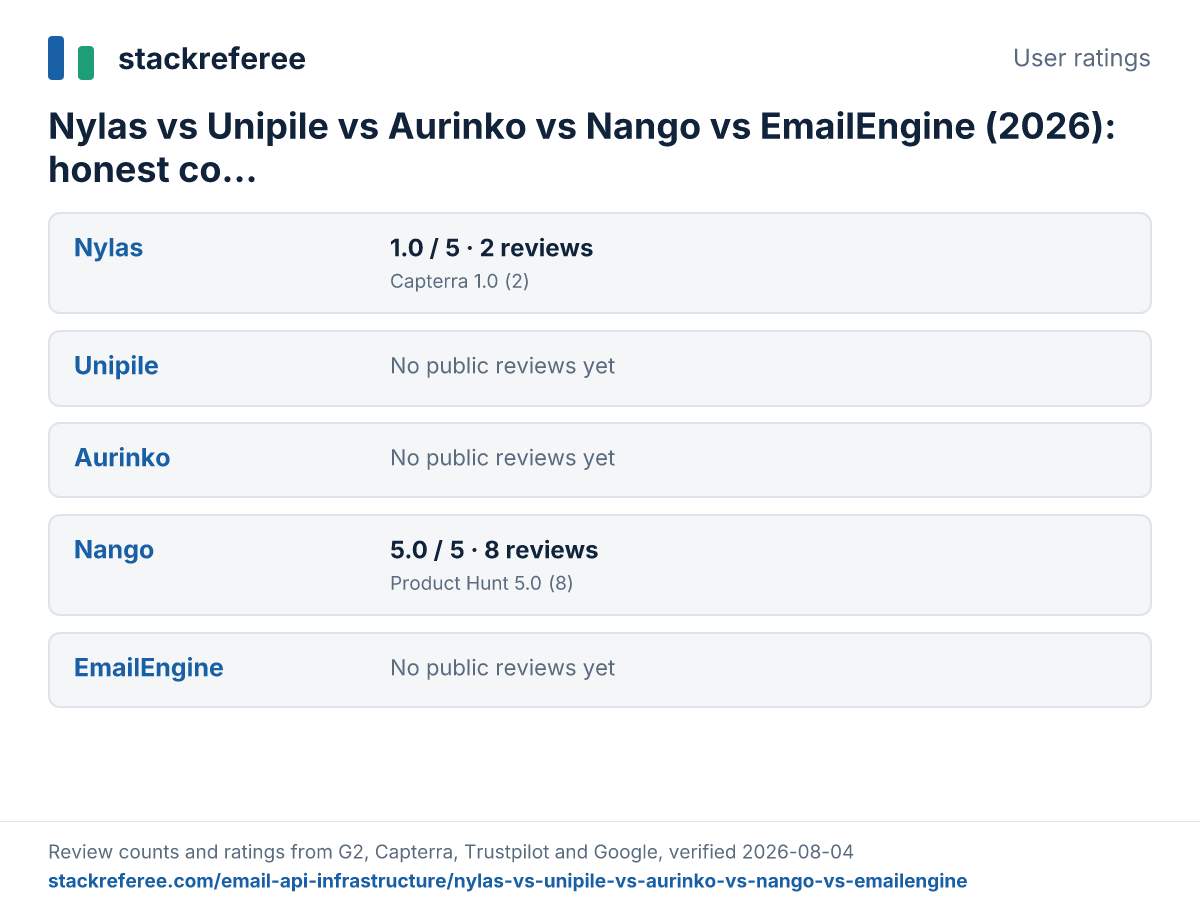
Ratings below come only from pages that could be verified first-hand. Every G2 page returned an access error during research, so G2 numbers are cited from its search listing as directional and never as fact.
- Nylas — Capterra: 1.0 from just 2 reviews, both scathing about surprise price increases and support ("no support, hard to cancel"). Its G2 search listing shows roughly 4.0 from 59 reviews, which could not be verified on the page. The two signals disagree, so treat Capterra as a warning flag rather than a verdict, and test support and pricing terms yourself.
- Unipile — no first-hand-verifiable rating; its G2 search listing shows roughly 4.3 from 15 reviews, praised for centralizing multichannel messaging. The verified review base is thin.
- Aurinko — its G2 search listing shows roughly 4.6 from 27 reviews, the highest of the five, though it could not be verified on the page. No verbatim quotes were captured.
- Nango — GitHub shows a large, active following (roughly 7k stars), and its Product Hunt page is 5.0 from a small sample, with developers repeatedly praising how fast it solves OAuth. Its G2 search listing shows roughly 4.4 from about 60 reviews.
- EmailEngine — no G2, Capterra or Trustpilot presence, which is normal for self-hosted infrastructure; GitHub shows a healthy following (roughly 2k stars). Its public issue tracker is restricted, so community-feedback signals are limited by design.
Verdict by use case
There is no single winner, because these tools are not solving the same problem. Choose by the job in front of you.
For managed email and calendar sync with serious compliance, choose Nylas. It has the widest feature set and the deepest first-party compliance of the five, offset by a documented pattern of raising prices once customers are embedded and a thin, unhappy public review sample. Negotiate price protection up front.
For the same managed sync at a lower price, choose Aurinko. At $1 per account with the best satisfaction signal of the group, it is the value pick, as long as you can accept that its SOC 2 is only Type I and still pending for Q3 2026.
For LinkedIn or WhatsApp automation, choose Unipile, accepting the platform-terms and account-suspension risk that comes with any tool operating those channels. Its EU data residency and CASA Tier II are genuine strengths, and it is the only option here that does the job at all.
For broad integrations with a self-host option, choose Nango. It is integration infrastructure with the best developer reputation of the five and solid compliance, in exchange for more build effort on a pure email use case and a usage meter that rewards planning.
For owning your data and beating per-account pricing at scale, choose EmailEngine. A flat annual fee for unlimited mailboxes and full self-hosting, if you only need email and can run the infrastructure yourself.
If you are weighing the real apples-to-apples decision, it is Nylas versus Aurinko: Aurinko wins on price and satisfaction, Nylas wins on compliance and breadth. The other three enter the conversation only when your job is specifically LinkedIn and WhatsApp (Unipile), broad integrations (Nango), or self-hosted data ownership (EmailEngine). Read more about our editorial policy; we take no vendor payment to rank these tools.
Recap table
| Nylas | Unipile | Aurinko | Nango | EmailEngine | |
|---|---|---|---|---|---|
| Core job | Managed email/calendar/contacts API | Multichannel messaging (LinkedIn/WhatsApp) API | Managed email/calendar/contacts API | Generic OAuth/integration infra | Self-hosted email gateway |
| Starting price | $15/mo base + ~$2/account | ~EUR 5/account (EUR 49/mo min) | from $1/account | Free, then $50/mo (metered) | $1,450/year flat, unlimited |
| Free option | Yes (5 accounts) | 7-day trial | 14-day trial | Yes ($0, 10 connections) | 14-day trial |
| Calendar/contacts | Yes | Yes | Yes | Build it yourself | No (email only) |
| LinkedIn/WhatsApp | No | Yes (core differentiator) | No | Only if you build it | No |
| Self-host option | No | No | No | Yes | Yes (required) |
| Verified compliance | SOC 2, ISO 27001, ISO 27701, HIPAA/BAA, GDPR | SOC 2, GDPR (EU data), CASA Tier II | SOC 2 Type I pending Q3 2026 | SOC 2, GDPR, HIPAA/BAA | None vendor-side (self-hosted) |
| Biggest caveat | Price hikes once embedded | Platform-terms/ban risk on LinkedIn/WhatsApp | Immature compliance | More build effort + complex meter | You operate it; email only |
Pricing and compliance details were verified against each vendor's own pages on August 4, 2026. G2 ratings could not be verified on-page and are cited as directional only. Prices and plans change; reconfirm before purchasing.
Frequently asked questions
Are Nylas, Unipile, Aurinko, Nango and EmailEngine the same kind of product?
No. They cluster into three different jobs. Nylas and Aurinko are managed unified email, calendar and contacts APIs. Unipile is a multichannel messaging API whose real differentiator is LinkedIn, WhatsApp and Instagram, not just email. Nango is generic OAuth and integration infrastructure for hundreds of APIs, where email is one integration among many. EmailEngine is self-hosted, source-available software you run yourself. Comparing them purely on price per connected account would mislead you.
Which is the cheapest per connected account?
Aurinko is the cheapest managed unified API, starting at $1 per connected account per month. Unipile is around EUR 5 per connected account with a EUR 49/month minimum. Nylas's self-serve Full Platform is $15/month base plus about $2 per account. EmailEngine is a flat $1,450/year for unlimited accounts, which becomes the cheapest option once you run into the hundreds of mailboxes. Prices were read from each vendor's own page on August 4, 2026.
Which one can automate LinkedIn or WhatsApp?
Only Unipile. Its whole reason to exist is one API across LinkedIn, WhatsApp, Instagram, Telegram, email and calendar. Nylas, Aurinko and EmailEngine do not touch LinkedIn or WhatsApp at all. Note that automating LinkedIn or WhatsApp runs against those platforms' terms and carries account-suspension risk regardless of the tool.
Which has the strongest verified compliance?
Nylas, on its own security pages, states the broadest stack: SOC 2 Type II, ISO 27001, ISO 27701, HIPAA with a signed BAA, and GDPR. Unipile states SOC 2 Type II, GDPR with EU-only data residency, and Google CASA Tier II. Nango states SOC 2 Type II, GDPR and HIPAA, and can be self-hosted. Aurinko is the weak spot: its own page says SOC 2 Type I is still being prepared for Q3 2026. EmailEngine has no vendor-side certification by design, because you host it.
Do I still need Nango if I only need email and calendar?
Probably not. Nango is generic integration infrastructure for 400-plus APIs, so for a pure email or calendar use case you would build the email and calendar logic yourself on top of raw API access. Nylas and Aurinko ship that logic for you. Choose Nango when you are integrating many services broadly and want to own the integration layer, not when email is your only target.
Why would I self-host EmailEngine instead of using a managed API?
Two reasons: data control and cost at scale. EmailEngine never sends your email through a third party, so it stays inside your own compliance boundary, and the flat $1,450/year covers unlimited mailboxes, which beats per-account pricing once you pass a few hundred accounts. The trade-off is that you operate it yourself (Node.js and Redis, uptime, scaling) and get no vendor SLA, and it handles email only, not calendar or contacts.
Why are there no G2 star ratings quoted as fact here?
During research, G2 blocked direct access (HTTP 403) for every one of these tools, so G2 numbers could only be read from its search listing, not verified on the page itself. They are cited here as directional and clearly flagged. The only review quotes stated as fact are the ones read first-hand on Capterra (Nylas) and Product Hunt (Nango).
Comments
No comments yet.