RB2B vs Snitcher vs 6sense vs Warmly vs Vector (2026): honest comparison
Every tool in this comparison promises to tell you who is visiting your website, but they mean very different things by "who," and they carry very different privacy and price implications. Some name the individual person; some only name the company; one turns visitors into advertising audiences; one is a full enterprise revenue platform. Choosing on the marketing headline alone leads teams to buy a five-figure ABM platform when a $49 company-level tool would have done the job, or to deploy a US-only person-level tool on EU traffic where it legally cannot fire. This guide separates identification level, geography, price and privacy posture, and reports what could and could not be verified.
| Metric | RB2B | Snitcher | 6sense | Warmly | Vector |
|---|---|---|---|---|---|
| Identification level | Person-level (+ company) | Company-level only | Account + anonymous intent | Company + some person | Person/contact-level |
| Geography | Person = US-only | Global | Global | Global (EU consent caveats) | US-only (geofenced) |
| Category | Point tool | Point tool | Enterprise ABM platform | ID + orchestration + AI chat | ID + paid-media audiences |
| Starting price | $79/mo (free tier) | ~$34-49/mo | Quote-only (~$50k+/yr reported) | ~$10k/yr (page) | $399/mo |
| Verified compliance | SOC 2 Type II; GDPR by exclusion | GDPR tools; SOC 2 unverified | SOC 2, ISO 27001 + 42001, GDPR (strongest) | SOC 2, GDPR, CCPA | SOC 2 preparing (not certified) |
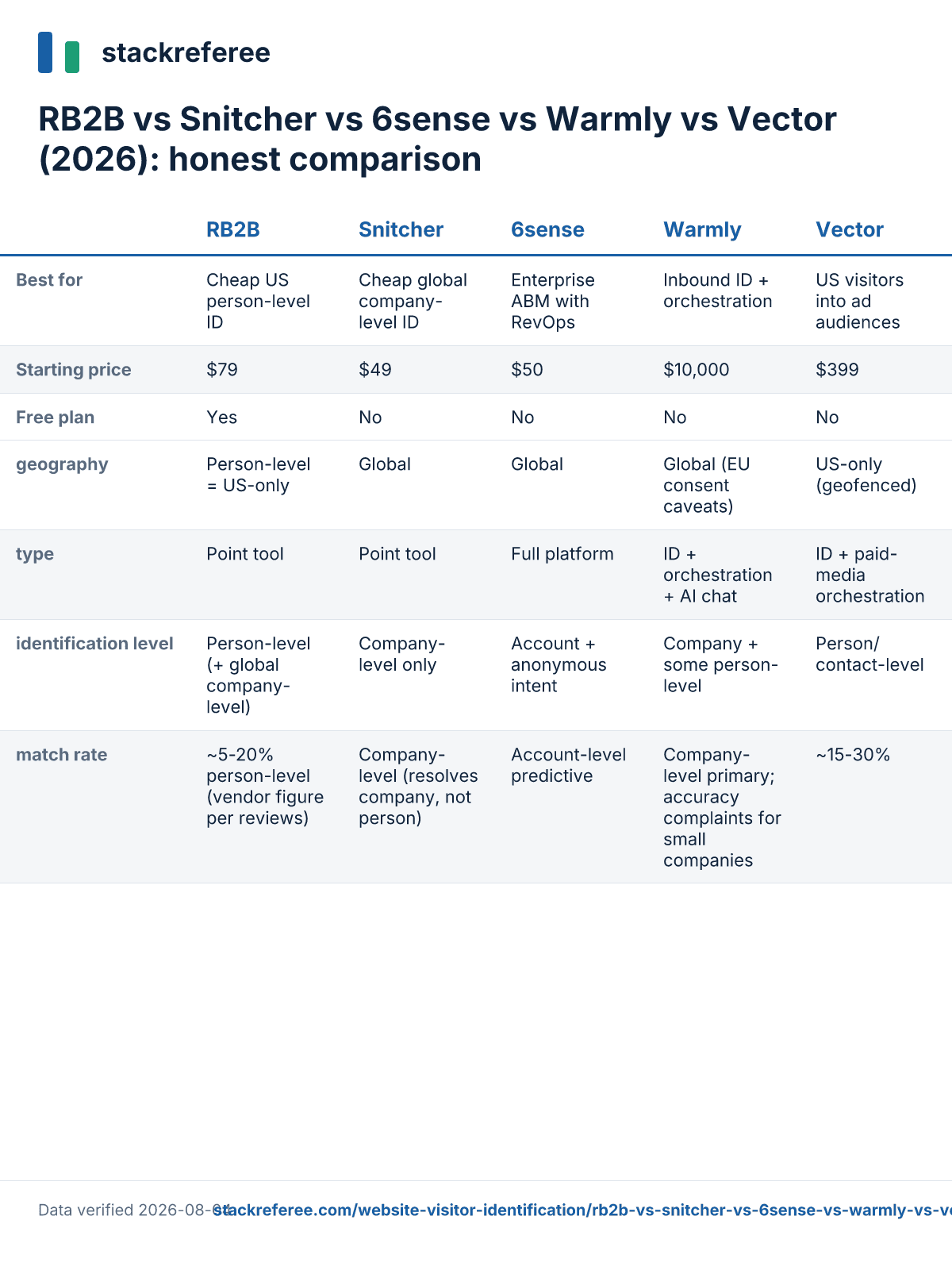
Two caveats frame the comparison. First, identification level is not a quality ranking: company-level is not "worse" than person-level, it is a different, lower-risk job, and for many EU-facing teams it is the only viable option. Read the notes as "what does this reveal, and where." Second, on data quality: every major review platform (G2, TrustRadius, Trustpilot, Product Hunt) blocked direct access during research, so their ratings are cited from search listings as directional only, and the sole verbatim quotes stated as fact are the ones read first-hand on Capterra (Snitcher). Several pricing figures for RB2B's upper tiers and 6sense come from third-party sources because the vendors do not publish them; those are flagged inline. Prices were checked on August 4, 2026.
What is RB2B
RB2B is a person-level US website visitor identification tool. It de-anonymizes anonymous traffic and matches individual visitors to a LinkedIn profile and a validated business email, pushing real-time alerts to Slack. It resolves people using a mix of cookies, device IDs and IP addresses matched against a permissioned publisher network, and that person-level resolution is deliberately ringfenced to US traffic; it also offers global company-level identification through a partnership. Its user is an SMB or mid-market sales and marketing team, and it is a point tool rather than a full platform, though it has begun layering light outbound and enrichment on top.
What is Snitcher
Snitcher is company-level visitor identification through IP-to-company matching, plus a proprietary database and firmographic enrichment. It de-noises traffic, detects intent signals and triggers go-to-market workflows and CRM sync, identifying the company rather than the individual person, and it works globally rather than being US-ringfenced. Its user is an SMB-to-mid-market team that wants affordable, transparent company-level identification, often as a complement to GA4. Because it never de-anonymizes an individual, its privacy exposure is materially lower than the person-level tools here.
What is 6sense
6sense is an enterprise ABM and revenue-intelligence platform: predictive AI that scores accounts by buying stage, combined with third-party intent data, technographics, anonymous-visitor and account identification, and orchestration including display advertising. This is a full platform, not a point de-anonymization tool, aimed at mid-market to enterprise revenue teams with dedicated revenue operations. It publishes no prices, and its depth in predictive intent and orchestration puts it in a different category, and a different budget, from the rest of this list.
What is Warmly
Warmly is a signal-based revenue orchestration platform built on website visitor de-anonymization, layered with ideal-customer-profile filtering, intent signals, AI chat and automated outbound across email and LinkedIn. It goes further than pure identification tools by acting on warm visitors: alerting a rep, firing a chatbot or launching a sequence. Its user is an SMB-to-mid-market inbound-driven team. One material fact to weigh: multiple sources reported an agreement for Warmly to be acquired by HubSpot, which raises product-continuity questions a buyer should factor in.
What is Vector
Vector de-anonymizes website visitors at the individual contact level using device fingerprinting matched against a compliantly-sourced identity graph, then turns those contacts into dynamic advertising audiences that auto-sync to LinkedIn, Google, Meta and other networks, plus an "Ad Reveal" feature for who clicked your ads without converting. Its differentiator against RB2B is the paid-media and ad-audience orchestration layer, not just alerting. It is US-only by design, geofencing its identification to the United States, and its user is an SMB-to-mid-market go-to-market and paid-media team.
RB2B: pros and cons
The cheapest real entry to person-level identification. RB2B resolves individual US visitors to a LinkedIn profile and business email starting at $79/month, with a free company-level tier, and pushes real-time Slack alerts. For a US team that specifically wants named people rather than just companies, it is the most affordable way in.
Fast setup and a strong satisfaction signal. It is quick to deploy, and its G2 search listing is high (roughly 4.5 from around 280 reviews, majority five-star), though that could not be verified on-page. The praised themes are easy integrations and reliable lead generation.
A modest match rate means most visitors are missed. The honest limitation is coverage. RB2B's own figure, per reviews, is roughly a 5 to 20 percent person-level match rate, so 80 to 95 percent of identifiable US visitors go unnamed, and the most consistent critical theme across its reviews is lead quality, low identification rates and contact-data accuracy.
Person-level is US-only, and that is a design choice about privacy. RB2B does not do person-level identification outside the US, which sidesteps GDPR consent by geography rather than satisfying it. For an EU-traffic site, its person-level product is effectively unavailable, and a reported January 2026 change also removed some contact-level data from the free tier, so verify current free-tier contents.
Snitcher: pros and cons
Genuinely transparent, low pricing. Snitcher is the only tool here with a fully public pricing table, starting around $34 to $49/month with unlimited team members and no feature gating. For a buyer tired of "contact sales," that transparency is itself a selling point.
The lowest privacy risk in the category. Because Snitcher identifies the company and not the individual, matching an IP to a business raises far fewer GDPR questions than naming a person, and it works globally. For an EU-facing team, that combination is the honest default recommendation.
A weak spot on value-for-money and high-volume performance. Its Capterra sample is small (7 reviews) but pointed: value for money is its lowest sub-score, and one reviewer running a very high-traffic site wrote that the tool "pretty much died out when trying to show us leads" at about 1.5 million pageviews per month. Another described it, in awkward but positive terms, as "an extraordinary instrument to recognize your site guests." Validate it at your traffic level.
Company-level only, and compliance is partly unconfirmed. If you need the individual person, Snitcher is not the tool. Its page states GDPR tooling first-hand, but a SOC 2 or ISO attestation could not be verified on a first-party trust page during research, so treat formal certification as unconfirmed and ask directly.
6sense: pros and cons
The deepest platform and the strongest compliance. 6sense combines predictive scoring, third-party intent, account identification and orchestration in one platform, and it publishes the broadest first-party compliance of this group: SOC 2 Type II, SOC 3, ISO 27001, ISO 42001, GDPR and CCPA, audited by a named third party. For a regulated enterprise, that credential stack is best-in-class here.
A privacy posture built for the enterprise. Because 6sense works primarily at the account and anonymous-intent level with opt-in contact data, it carries less of the individual-cookie-de-anonymization controversy that follows the person-level tools. That makes it easier to defend to a security and legal review.
Opaque, high pricing with long commitments. 6sense publishes no prices. Third-party marketplaces report a Growth tier around $50,000/year and enterprise deals from roughly $130,000 into the mid-six figures, plus implementation fees and multi-year terms; one buyer cited $120,000 in year one on a two-year commitment. All of those figures are market-reported, not vendor-confirmed, and they put 6sense far outside SMB budgets.
Complexity and trust in the scoring are the critiques. Its G2 search listing is roughly 4.0 from around 930 reviews, the lowest satisfaction score in this group, with recurring themes of a steep learning curve, heavy setup and some users distrusting why accounts land in particular buying stages. It is powerful, but it demands a dedicated team to run well, and it is overkill for a small operation.
Warmly: pros and cons
Identification plus orchestration in one tool. Warmly does more than name visitors: it filters by ideal-customer profile, fires AI chat, and launches outbound across email and LinkedIn, acting on warm traffic in real time. For an inbound-driven team that wants to engage high-intent visitors live, that end-to-end flow is its appeal, and its real-time alerting is well liked.
A recognizable review standing. Its G2 search listing is roughly 4.6 from around 200 reviews, a solid position for the category, though it could not be verified on-page. Reviewers particularly credit its usefulness for small teams engaging high-intent visitors quickly.
Steep entry price for an SMB, and accuracy complaints. Warmly's current public page starts around $10,000/year, a high floor for a small team, and aggregated critiques cite visitor-identification inaccuracy (worse for small companies and shared networks) and credits burned on internal or own-team visits. Its pricing also appears to have shifted recently, with older third-party snapshots describing a free tier and a much cheaper startup plan that do not match the current page, so confirm the live numbers.
Acquisition and continuity risk. With an acquisition by HubSpot reported, there is genuine product-continuity risk to weigh, and its ISO 27001 status is unconfirmed even though it publishes a SOC 2 and GDPR posture through a trust center. Ask about roadmap and data handling before signing.
Vector: pros and cons
Contact-level identification wired straight into paid media. Vector's differentiator is turning identified individuals into dynamic ad audiences that auto-sync to LinkedIn, Google and other networks, plus revealing who clicked your ads without converting. For a US paid-media team, that identification-to-audience pipeline is genuinely distinctive, and reviewers praise very fast setup and a clean interface.
Fast time-to-value and a modern UX. Aggregated review themes highlight visitors "flowing in within minutes," an intuitive interface, and strong ad-audience match rates. For a team that wants to act on identified visitors through advertising rather than just alerts, it fits neatly.
SOC 2 is not yet certified. The important compliance nuance: Vector's own security page says it is "ready and preparing for audit" on SOC 2 Type 2, which means it is not yet certified. It lists GDPR, CCPA and several other frameworks, but ISO 27001 is not mentioned, so a security review should treat its SOC 2 as in-progress.
US-only, a modest match rate, and integration limits. Vector geofences identification to the US, so Canada and EU coverage is poor, and its match rate is roughly 15 to 30 percent, missing most traffic. Reviewers also cite a clunky HubSpot integration limited to a single list and a reliance on webhooks over native connectors, and the Target ad-audience plan jumps to $3,000/month. Its privacy model, device fingerprinting to reveal individuals, is aggressive, and its defense is the same US geofence RB2B uses, plus pushing consent obligations onto the customer.
Use-case comparison
"I want cheap, transparent company-level identification, including on EU traffic." Snitcher. Public pricing, global coverage and the lowest privacy risk make it the honest default for most SMB teams, as long as company-level is enough.
"I'm a US team that wants named individuals cheaply." RB2B. The most affordable person-level tool with fast Slack alerts, accepting a modest match rate and US-only scope.
"I want enterprise ABM with predictive intent and the strongest compliance." 6sense. The deepest platform and best credentials here, if you have the budget and a dedicated team, and can accept opaque, high pricing.
"I want to identify visitors and act on them with chat and outbound." Warmly. Identification plus orchestration in one tool, weighed against a high SMB entry price, accuracy complaints and reported acquisition risk.
"I want to turn identified US visitors into ad audiences." Vector. A distinctive identification-to-paid-media pipeline, if you can accept US-only coverage, a modest match rate, and a SOC 2 that is still in preparation.
Pricing
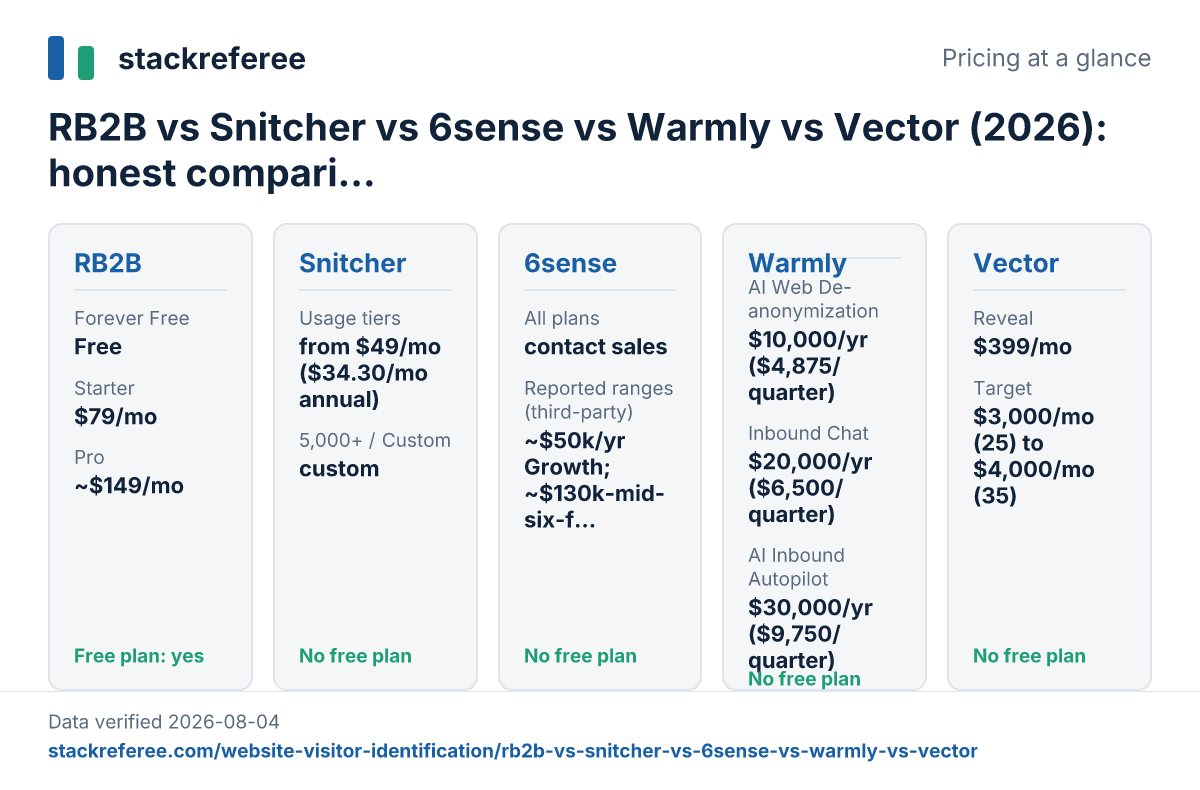
Every plan below was read from the vendor's own page where possible on August 4, 2026; where a vendor publishes no prices or only a partial page, the figures come from third-party sources and are flagged. The structural split matters: Snitcher and Vector publish full tables, RB2B publishes its lower tiers, and 6sense and (in part) Warmly are quote-driven.
RB2B pricing
- Forever Free — company-level identification, about 150 monthly resolutions, after a 7-day full-featured trial.
- Starter — $79/mo: person-level identification, about 300 monthly resolutions, LinkedIn URLs.
- Pro — about $149/mo: roughly 600 credits, business emails and CRM integrations.
- Pro+ — about $199/mo (third-party figure). Overage credits about $0.25 each.
Free and Starter verified on rb2b.com, August 4, 2026. The Pro and Pro+ figures come from third-party review sites, not a vendor pricing page, so reconfirm. A January 2026 change reportedly reduced contact-level data on the free tier.
Snitcher pricing
- Usage-based tiers — from $49/mo ($34.30/mo annual) for up to 50 company identifications, scaling by identified companies per month (for example, roughly $99/mo at 101-250, $229/mo at 751-1,000, $529/mo at 4,001-5,000), with 5,000+ moving to custom.
- All plans include intent detection, real-time alerts, CRM sync, REST API and GDPR tools, with unlimited team members. 14-day free trial, no credit card.
Pricing verified on snitcher.com/pricing, August 4, 2026. A third-party-alleged fair-usage cap could not be confirmed on the vendor page.
6sense pricing
- All plans — contact sales. 6sense publishes no prices; the page presents configurations of Sales Intelligence, Data Credits and Predictive AI rather than named tiers.
- Reported ranges (third-party, not vendor-confirmed) — Growth around $50,000/year; Enterprise roughly $130,000 into the mid-six figures; implementation fees on top; display-ad add-ons priced separately.
Confirmed quote-only on 6sense.com/pricing, August 4, 2026. All dollar figures are market-reported estimates, not published by 6sense.
Warmly pricing
- AI Web De-anonymization — $10,000/year ($4,875/quarter).
- Inbound Chat — $20,000/year ($6,500/quarter).
- AI Inbound Autopilot — $30,000/year ($9,750/quarter). Add-ons for GTM Signals and Warm Experiences at $10,000/year each. Annual is roughly 30 percent cheaper than quarterly.
Pricing verified on the warmly.ai pricing page, August 4, 2026. Older third-party snapshots describe a free tier and a cheaper startup plan that do not match the current page; treat those as stale and reconfirm.
Vector pricing
- Reveal (month-to-month, by identified visitors/mo) — $399 for 2,500, $599 for 5,000, $799 for 7,500, $999 for 10,000, custom above. Includes Ad Reveal, site de-anonymization and CRM sync. 14-day trial.
- Target (annual, by active ad audiences) — $3,000/mo for 25 audiences, $3,500 for 30, $4,000 for 35, custom above. Includes everything in Reveal plus ad-audience sync and a dedicated CSM.
Pricing verified on vector.co/pricing, August 4, 2026. A separate free plan appears in third-party snippets but was not on the vendor page.
What users say
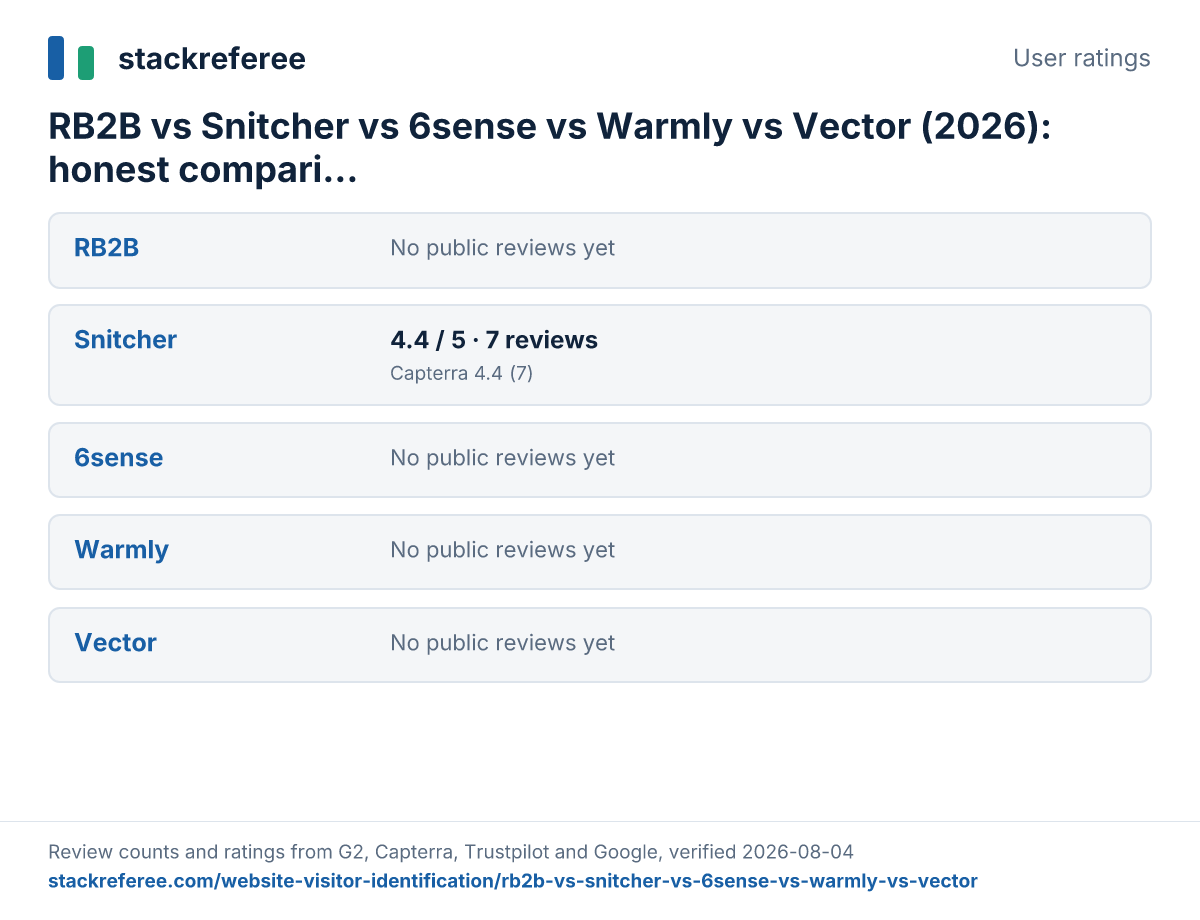
Ratings below come only from pages that could be verified first-hand. Every major review platform blocked direct access during research, so their numbers are cited from search listings as directional, and the only verbatim quotes stated as fact are from Snitcher's Capterra page.
- Snitcher — Capterra: 4.4 from 7 reviews, with value for money the weakest sub-score; its G2 search listing is very high (roughly 4.8) but could not be verified on-page. One reviewer flagged it struggling at very high pageview volume.
- RB2B — its G2 search listing is roughly 4.5 from around 280 reviews, majority five-star, not on-page verified. Praised for easy integrations; criticized for lead quality and low identification rates.
- 6sense — its G2 search listing is roughly 4.0 from around 930 reviews, the lowest here. Praised for intent-data depth; criticized for a steep learning curve and scoring transparency.
- Warmly — its G2 search listing is roughly 4.6 from around 200 reviews. Praised for real-time alerting; criticized for high SMB pricing and identification accuracy.
- Vector — its G2 search listing is roughly 4.5 from around 26 reviews, a small sample. Praised for fast setup and UX; criticized for US-only coverage and integration limits.
Verdict by use case
There is no single winner, because these tools identify different things at very different prices. Choose by what you need to know and where your traffic is.
For cheap, transparent, low-risk company-level identification, choose Snitcher. Public pricing, global coverage and minimal privacy exposure make it the honest default for most SMB teams, provided company-level is enough and you validate it at your traffic volume.
For affordable US person-level identification, choose RB2B, accepting a modest match rate, US-only scope and the recurring critiques about lead quality and data accuracy.
For enterprise ABM with the strongest compliance, choose 6sense, if you have the budget and a dedicated revenue-operations team, and can accept opaque, high, multi-year pricing and a steep learning curve.
For identification plus orchestration and AI chat, choose Warmly, weighed against a high SMB entry price, accuracy complaints and the reported HubSpot acquisition that raises continuity questions.
For turning US visitors into paid-media audiences, choose Vector, if you can accept US-only coverage, a modest match rate, and a SOC 2 that is still in preparation rather than certified.
The clearest way to decide is to answer three questions first: do you need the person or just the company, is your traffic US or global, and do you want a point tool or a platform. Person-level and US-only narrows you to RB2B or Vector; global and company-level points to Snitcher; and enterprise scale with a compliance mandate points to 6sense, with Warmly as the orchestration-heavy middle. We take no vendor payment to rank these tools; read our editorial policy.
Recap table
| RB2B | Snitcher | 6sense | Warmly | Vector | |
|---|---|---|---|---|---|
| Identification level | Person-level (+ company) | Company-level only | Account + anonymous intent | Company + some person | Person/contact-level |
| Geography | Person = US-only | Global | Global | Global (EU consent caveats) | US-only (geofenced) |
| Category | Point tool | Point tool | Enterprise ABM platform | ID + orchestration + AI chat | ID + paid-media audiences |
| Starting price | $79/mo (free tier) | ~$34-49/mo | Quote-only (~$50k+/yr reported) | ~$10k/yr (page) | $399/mo |
| Verified compliance | SOC 2 Type II; GDPR by exclusion | GDPR tools; SOC 2 unverified | SOC 2, ISO 27001 + 42001, GDPR (strongest) | SOC 2, GDPR, CCPA | SOC 2 preparing (not certified) |
| Verified reviews | G2 ~4.5 (~280), not on-page verified | Capterra 4.4 (7); G2 ~4.8 not verified | G2 ~4.0 (~930), not on-page verified | G2 ~4.6 (~200), not on-page verified | G2 ~4.5 (~26), not on-page verified |
| Biggest caveat | Low match rate; US-only person-level | Company-level only; SOC 2 unconfirmed | Opaque high price; steep learning curve | High SMB price; acquisition risk | US-only; SOC 2 not yet certified |
Pricing and compliance details were verified against each vendor's own pages on August 4, 2026, except where third-party sources are noted. Review-platform ratings could not be verified on-page and are cited as directional only. Prices and plans change; reconfirm before purchasing.
Frequently asked questions
What is the difference between person-level and company-level visitor identification?
It is the most important distinction in this category. Company-level tools (Snitcher) match an anonymous visitor's IP to a company, which is far less contentious under privacy law. Person-level tools (RB2B, Vector) try to resolve the individual visitor to a name, LinkedIn profile and email, which is far more aggressive and, by design, US-only. 6sense and Warmly sit broader, working at the account and company level with some person-level signals.
Which is the cheapest to start with?
Snitcher, at roughly $34 to $49/month depending on term, with a fully public pricing table and no per-seat fees. RB2B starts at $79/month for person-level identification and has a free company-level tier. Vector's Reveal plan starts at $399/month. Warmly's public page starts around $10,000/year, and 6sense is quote-only in the five-to-six-figure range. Prices were read from each vendor's own page on August 4, 2026.
Can I use these tools on EU traffic?
Company-level tools like Snitcher work globally, because matching an IP to a company raises far fewer GDPR issues than naming an individual. Person-level tools are the problem: RB2B deliberately excludes person-level identification outside the US, and Vector geofences its person-level identification to the US only. For an EU-traffic-heavy site, the honest options are company-level identification (Snitcher) or account-level ABM (6sense), not US person-level tools.
Which has the strongest verified compliance?
6sense. It publishes the broadest first-party stack: SOC 2 Type II, SOC 3, ISO 27001, ISO 42001, GDPR, CCPA and more, audited by a named third party. RB2B states SOC 2 Type II. Vector is the watch-item: its own security page says SOC 2 is being prepared for audit, meaning it is not yet certified. Snitcher's SOC 2 status could not be verified first-hand.
Is Warmly being acquired?
Multiple sources reported an agreement for Warmly to be acquired by HubSpot, which a buyer should weigh for product-continuity reasons. That status was not confirmed against a primary vendor press release during research, so treat it as reported rather than certain, and ask Warmly directly about roadmap and continuity before committing.
Why do these tools only identify a fraction of my visitors?
Identification depends on matching a visitor against a known dataset, and that match only succeeds part of the time. Person-level tools report modest match rates - RB2B's own figure is roughly 5 to 20 percent of US visitors, and Vector cites roughly 15 to 30 percent - so most identifiable traffic is still missed. Company-level matching tends to resolve more traffic but only to the company, not the person. Budget your expectations to the match rate, not the total visitor count.
Comments
No comments yet.