Amplitude vs Simulithic vs LaunchDarkly: 2026 Guide
Picking an experimentation stack usually starts with a narrower question than "which tool is best": do you need to understand what already happened in your product, control what gets shipped and to whom, or find out what will happen before you ship it at all? Amplitude, LaunchDarkly, and Simulithic answer three different versions of that question, and conflating them leads to buying the wrong tool for your actual workflow.
Each of these three sits at a different point in the ship-and-learn cycle. Amplitude is downstream: it tells you what users did after a change went live. LaunchDarkly sits in the middle: it controls who sees a change and when, then layers experimentation on top of that control. Simulithic tries to sit upstream of both, predicting reaction before anything reaches production. That ordering matters more than any single feature checkbox when you're deciding where to spend budget first.
This comparison sticks to what each vendor publishes and what verified reviewers report, including the gaps where Simulithic simply hasn't disclosed information yet. Where research turned up no confirmed data, that's stated plainly rather than filled in with assumptions.
Amplitude vs Simulithic vs LaunchDarkly at a glance
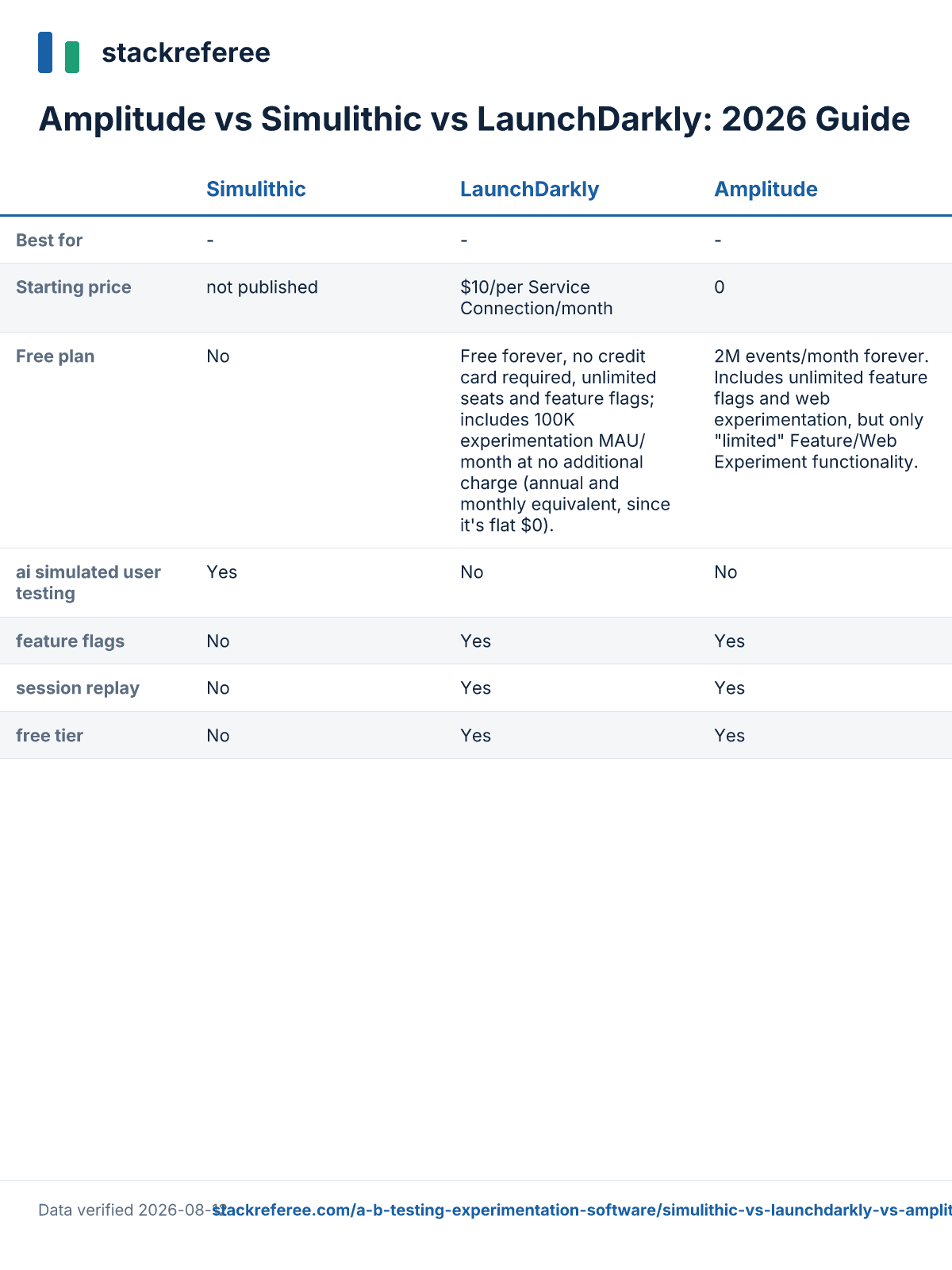
| Amplitude | Simulithic | LaunchDarkly | |
|---|---|---|---|
| Best for | Teams running experimentation inside an existing product analytics workflow | Teams wanting to predict user reaction before shipping | Engineering teams needing feature flag infrastructure with SDKs |
| Starting price | $0/month (Free, 2M events) | Not published (early access only) | $0/month (Developer plan, flat) |
| Free plan | Yes, 2M events/month forever | No public free plan | Yes, free forever, no credit card |
| Core differentiator | Product analytics and experimentation in one workflow | AI-simulated user testing before shipping | Feature flag infrastructure with server-side SDKs |
| GDPR / SOC 2 | Yes / Yes | Unknown / Unknown | Yes / Yes |
| SSO/SAML | Yes (Growth and Enterprise tiers) | Unknown | Yes |
What is Amplitude
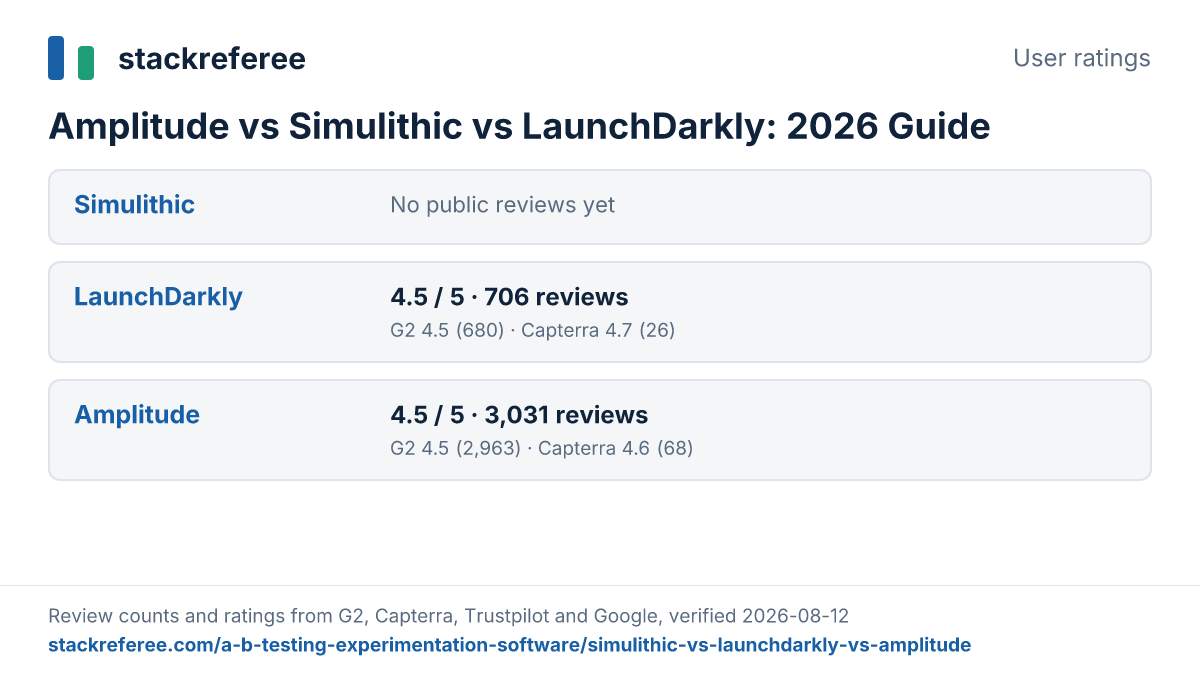
Amplitude is a product analytics platform that bundles feature flags, session replay, and A/B testing into one workflow, according to its pricing page and feature listings. Its Trust Center confirms SOC 2 Type II and SOC 1 Type II status, and its security page details GDPR-related privacy commitments. Amplitude's release notes show active investment in experimentation tooling, including an "Experiment Report" feature powered by Amplitude AI, which points to ongoing product work rather than a stagnant feature set. On review platforms, it carries a 4.5/5 rating across 2,963 G2 reviews and 4.6/5 across 68 Capterra reviews, one of the larger public review footprints in this comparison. Teams that already lean on Amplitude for usage tracking get experimentation as a natural extension rather than a separate tool to stitch in, which matters most for teams who don't want to reconcile numbers across two dashboards.
What is Simulithic
Simulithic positions itself around a single promise: know how users react before you ship. Per its feature matrix, it offers AI-simulated user testing and pre-launch impact prediction, and it connects to a team's existing analytics and session tools rather than replacing them. The company has not reached general availability. Its only listed plan is "Early Access," with pricing marked as not published, and the sole path in is a signup form rather than a self-serve checkout or published tier list. Public information also links it to Y Combinator backing and a San Francisco base. There are no G2, Capterra, or Trustpilot reviews on record yet, and no published GDPR, SOC 2, or SSO/SAML compliance claims, which matters if you need to vet a vendor for a security review before onboarding. Anyone evaluating Simulithic today is evaluating a bet on an unproven, pre-revenue product category rather than a mature, benchmarked platform.
What is LaunchDarkly
LaunchDarkly is a feature flag management platform with server-side SDKs, A/B testing and experimentation, session replay, and SSO/SAML support, per its pricing and security pages. The company has published SOC 2 Type II certification, detailed on its dedicated trust, security, and privacy page. Its changelog shows continued integration work, including a native Databricks experimentation integration, suggesting the platform is being extended toward data-warehouse-adjacent workflows rather than staying flag-only. Review volume is substantial: 4.5/5 across 680 G2 reviews and 4.7/5 across 26 Capterra reviews. Engineering-heavy organizations that need to control flag rollouts across environments before running experiments tend to start here, since flagging is the platform's foundation rather than an add-on bolted onto an analytics product.
Pros and cons
Amplitude
Combines product analytics with experimentation in one workflow. Amplitude's feature matrix confirms product analytics, A/B testing, feature flags, and session replay all live in the same platform, which cuts down on stitching together separate tools for tracking and testing and reduces the number of vendor contracts a team has to manage.
Free tier covers meaningful usage. The Free plan includes 2 million events per month forever, with unlimited feature flags and web experimentation included, even if that experimentation functionality is described as limited at that tier. For small products, that ceiling can cover real production traffic for months before a paid plan becomes necessary.
Large, consistent review base. A 4.5/5 rating across 2,963 G2 reviews and 4.6/5 across 68 Capterra reviews gives prospective buyers a sizable sample to judge fit against, more than either other tool in this comparison, which lowers the risk of an unrepresentative outlier review skewing the decision.
Full experimentation features are gated behind higher tiers. Free and Plus plans only get "limited" Feature Experiment and Web Experiment functionality; full capability requires the Growth plan, which is custom-priced and requires a sales conversation, meaning teams can't self-serve their way to the complete feature set.
Overage pricing isn't a fixed, published number. The Plus plan states it "starts at $0" and uses an interactive bill estimator rather than a listed per-event rate, making it harder to forecast costs before talking to sales or committing budget for the following quarter.
Reviewers flag usability friction at scale. One Capterra reviewer with 2+ years of use reported slow load times and said "creating custom reports was complicated and the interface wasn't particularly user-friendly," even while praising Amplitude's power elsewhere in the same review.
Simulithic
AI-simulated user testing is a genuine category difference. Unlike Amplitude and LaunchDarkly, which both measure real user behavior after a change goes live, Simulithic's feature matrix shows it predicts impact before shipping, letting teams de-risk decisions earlier in the cycle instead of learning from a live rollout that already reached real users.
Built to sit alongside existing tools rather than replace them. Simulithic connects to existing analytics and session tools per its feature matrix, so teams don't have to abandon their current analytics stack to try pre-launch prediction, which lowers the switching cost of testing it out.
Backed by a recognized startup accelerator. The product is linked to Y Combinator and based in San Francisco, which at minimum signals institutional vetting at the seed stage, even though it says nothing about product maturity or long-term viability.
No public pricing exists yet. There is no plan tier list or price on the Simulithic site; the only path in is an early-access signup form, which makes it impossible to budget for or compare against the other two tools on cost today.
Narrower feature scope than the other two. The feature matrix confirms Simulithic does not offer feature flags, product analytics, or session replay, meaning it can't function as a standalone replacement for either Amplitude or LaunchDarkly and would need to run alongside one of them.
Compliance status is unverified. No GDPR, SOC 2, or SSO/SAML claims appear on the homepage, and no dedicated security or trust page was found, so teams with compliance requirements currently have no public documentation to evaluate before a procurement review.
LaunchDarkly
Free Developer plan has no meaningful catch. It's free forever, requires no credit card, and includes unlimited seats and feature flags plus 100,000 experimentation MAU per month at no extra charge, according to the pricing page, which is a rare combination among tools with this scale of enterprise adoption.
Compliance documentation is thorough and public. LaunchDarkly publishes a SOC 2 Type II certification blog post alongside a dedicated trust, security, and privacy page, giving security teams a paper trail to review directly instead of requesting documents under NDA.
Reviewers consistently praise ease of onboarding. A Capterra reviewer with 1-2 years of use called it a "clean UI for managing flags and environments" where "onboarding new engineers is straightforward," echoed by a second reviewer citing incredibly easy navigation and logic.
Paid tier pricing gets complex fast. Foundation runs $10 per Service Connection per month billed yearly, or $8.33 per 1,000 client-side MAU per month on annual billing, a structure that takes real math to forecast against usage rather than a flat per-seat number.
Enterprise pricing is entirely opaque. Enterprise tier pricing is not published; features like advanced targeting, custom roles, and the Guardian release-monitoring add-on all require a sales conversation to price out, which slows down budget approval for larger rollouts.
Cost scales awkwardly for smaller teams. One Engineering Manager reviewer with 6-12 months of use wrote that "the pricing is expensive to get enough users to make auditing sensible," a direct complaint about cost-to-value at lower usage volumes.
Use-case comparison
Product teams already tracking usage data. If your team lives in dashboards and funnels daily, Amplitude keeps experimentation in the same place your analytics already sit, avoiding a second tool for interpreting results and a second login for the same product data. This matters most when the same analysts who build retention reports also need to read experiment results, since context-switching between platforms tends to slow down decision cycles. Reach for Amplitude here.
Engineering teams rolling out changes gradually. If the priority is controlling which users see a change before you even think about statistical significance, LaunchDarkly's flag infrastructure and server-side SDKs are the more direct fit, with the free Developer plan covering small teams entirely. Organizations with multiple services and environments benefit from a flagging layer that's independent of any single analytics vendor, since flags need to work the same way whether or not an experiment is attached to them.
Teams wanting to de-risk a launch before it happens. If you'd rather know how users are likely to react before writing a single line of production code, Simulithic is the only option here built around that question, though its early-access status means you're evaluating a bet on a young company rather than a proven, priced product. Teams in this bucket should plan to keep their existing analytics or flagging tool in place, since Simulithic is designed to connect to that stack rather than substitute for it.
Pricing
Amplitude pricing
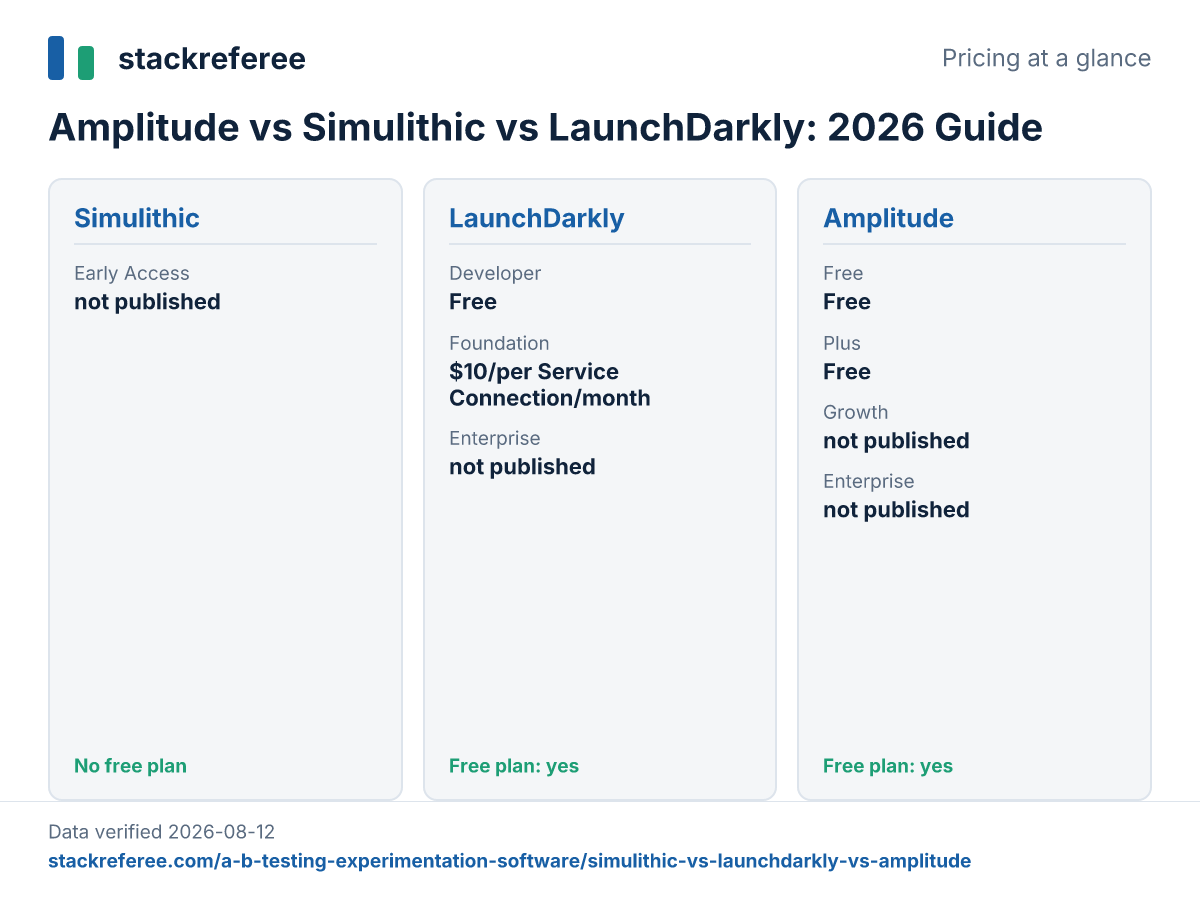
- Free: $0/month, 2 million events/month forever, unlimited feature flags and web experimentation with limited functionality.
- Plus: Starts at $0/month; first 2 million events/month free, then usage-based pricing calculated through an interactive bill estimator rather than a fixed rate.
- Growth: Custom, event-based pricing; contact sales. Adds full Feature Experiment and Web Experiment capability plus SSO and project permissions.
- Enterprise: Custom, event-based pricing; contact sales. Adds unlimited projects, advanced data access controls, and RBAC.
Pricing verified on August 12, 2026.
Simulithic pricing
- Early Access: Price not published. Simulithic has no public price list or plan tiers; entry is limited to an early-access signup form rather than a self-serve checkout or published rate card.
Pricing verified on August 12, 2026.
LaunchDarkly pricing
- Developer: $0/month flat, free forever, no credit card required. Unlimited seats and feature flags, including 100,000 experimentation MAU/month at no additional charge.
- Foundation: $10 per Service Connection/month, billed yearly. Also priced at $8.33 per 1,000 client-side MAU/month on annual billing; 5 service connections included, then pay-as-you-go.
- Enterprise: Custom pricing; contact sales. Includes advanced targeting, custom roles, workflows/approvals, and the separate Guardian add-on for release monitoring.
Pricing verified on August 12, 2026.
What users say
Amplitude
"I've used Amplitude to AB Test product onboarding...the UI is really good for a tool that's quite complex." - Belen B., Sr. CRM Manager, Consumer Goods (5,001-10,000 employees), used 2+ years, via Capterra
"This tool is extremely easy to deploy yet extremely powerful...you can very easily monitor any aspect of your user's experience." - Yaron K., Co-founder, Computer Software, via Capterra
"It took a long time to load...creating custom reports was complicated and the interface wasn't particularly user-friendly." - Liam S., Software Engineer, IT Services (51-200 employees), used 2+ years, via Capterra
Simulithic
No independent reviews for Simulithic were found on G2, Capterra, or Trustpilot at the time of this research. That's consistent with a pre-launch, early-access product with a limited signup pool rather than a sign of poor reception; there's simply no public review record yet to cite, and prospective buyers should treat that absence as unresolved risk rather than a passing grade.
LaunchDarkly
"Clean UI for managing flags and environments; onboarding new engineers is straightforward." - Soumya N., Software Developer, Financial Services (10,001+ employees), used 1-2 years, via Capterra
"The UI and logic is incredibly easy to navigate and follow." - Mark B., Senior Developer, Financial Services, used 2+ years, via Capterra
"The pricing is expensive to get enough users to make auditing sensible." - Corina L., Engineering Manager, Marketing and Advertising, used 6-12 months, via Capterra
Verdict per use case
Choose Amplitude if you already track product usage inside Amplitude and want A/B testing, feature flags, and session replay in the same workspace, and you can accept that full experimentation power requires moving past the Free and Plus tiers into Growth. This is the more consolidated option for teams that want one bill and one login rather than a flagging tool plus a separate analytics subscription.
Choose Simulithic if your priority is predicting how users will react to a change before it ships, you're comfortable joining an early-access program with a limited signup pool, and you don't yet need SSO/SAML or a confirmed SOC 2 certification to move forward. Treat it as a supplementary tool that sits ahead of your existing analytics stack, not a replacement for it.
Choose LaunchDarkly if feature flag control across environments is your starting requirement, you want SOC 2 and GDPR documentation in hand before a security review, and you're prepared to model Foundation-tier costs carefully as your service connections and MAU grow. It's the stronger pick when flags need to work independently of whichever analytics vendor you happen to use.
None of the three is a universal answer. Amplitude and LaunchDarkly compete more directly with each other on flags, experimentation, and session replay; Simulithic occupies a different stage of the product cycle entirely, and its lack of public pricing and reviews means it carries more evaluation risk today than the other two.
Recap table
| Price | Best audience | Core differentiator | |
|---|---|---|---|
| Amplitude | From $0/month (Free, 2M events) | Product teams that already run analytics and want experimentation built in | Product analytics and experimentation in one workflow |
| Simulithic | Not published (early access) | Early-stage teams wanting to test reactions before shipping | AI-simulated user testing and pre-launch impact prediction |
| LaunchDarkly | From $0/month (Developer, flat) | Engineering teams needing feature flag infrastructure with SDKs | Feature flag infrastructure with server-side SDKs and SSO/SAML |
If you're still narrowing down the shortlist, browse more A/B Testing & Experimentation Software comparisons to see how these three stack up against other vendors in the category. For context on how this comparison was put together and what we do and don't accept from vendors, see our editorial policy. Teams evaluating compliance requirements alongside experimentation tooling may also want to check TrustAI vs Vanta vs Drata vs Secureframe: 2026 guide for how SOC 2 and GDPR documentation gets verified in an adjacent category, since flag and analytics vendors are often assessed by the same security team that reviews compliance-automation tools.
Frequently asked questions
What is the difference between Amplitude and LaunchDarkly?
Amplitude centers on product analytics with A/B testing, feature flags, and session replay built around usage data. LaunchDarkly centers on feature flag infrastructure with server-side SDKs, and adds experimentation on top of that flagging layer. Teams already tracking product analytics often start with Amplitude; teams that need robust flag rollout controls first often start with LaunchDarkly.
Is Simulithic available to the public yet?
No. As of August 2026, Simulithic has no public pricing page and no published plan tiers. The only listed plan is "Early Access," with price marked as not published, and entry runs through a signup form rather than a self-serve checkout. Broad public availability and published pricing have not launched yet.
Does LaunchDarkly have a free plan?
Yes. The Developer plan is free forever, requires no credit card, and includes unlimited seats and feature flags plus 100,000 experimentation MAU per month at no additional charge. Paid tiers start with Foundation at $10 per Service Connection per month, billed yearly.
Is Amplitude free for A/B testing?
Amplitude's Free plan includes unlimited feature flags and web experimentation with 2 million events per month, but that experimentation functionality is described as limited. Full Feature Experiment and Web Experiment capability requires the Growth plan, which is custom and event-based priced.
What is the best alternative to LaunchDarkly for feature flags?
Amplitude is the closest direct alternative in this comparison since it also ships feature flags, A/B testing, and session replay with SSO/SAML support. Simulithic is not a flag-management alternative; it targets pre-launch impact prediction rather than live flag rollout.
Does Simulithic replace product analytics tools like Amplitude?
No, based on available research. Simulithic's feature matrix shows it connects to existing analytics and session tools rather than replacing them, and it does not list product analytics or session replay as native capabilities. It is built to predict user reactions before you ship, not to track usage after launch.
Is LaunchDarkly SOC 2 certified?
Yes. LaunchDarkly has published a SOC 2 Type II certification and maintains a dedicated trust and security page covering compliance details. Amplitude also confirms SOC 2 Type II and SOC 1 Type II status through its own trust center.
How much does Amplitude cost per month?
Amplitude's Free plan is $0/month for 2 million events. The Plus plan states it starts at $0/month, with usage-based pricing calculated through an interactive bill estimator rather than a fixed published rate. Growth and Enterprise plans are custom, event-based, and require contacting sales.
Comments
No comments yet.