ChatGPT vs Claude vs Induction Labs: 2026 AI Agent Guide
Comparing three AI agents that operate on your behalf sounds simple until you realize only two of them have a sign-up page. ChatGPT and Claude both let you hand off browsing, file work, and multi-step tasks today. Induction Labs, meanwhile, published a research model that plays checkers and simulates a desktop from a single pretraining run, but you cannot install it, license it, or ask it to touch a live account. This guide treats all three honestly: what you can actually use in August 2026, and what's still a paper.
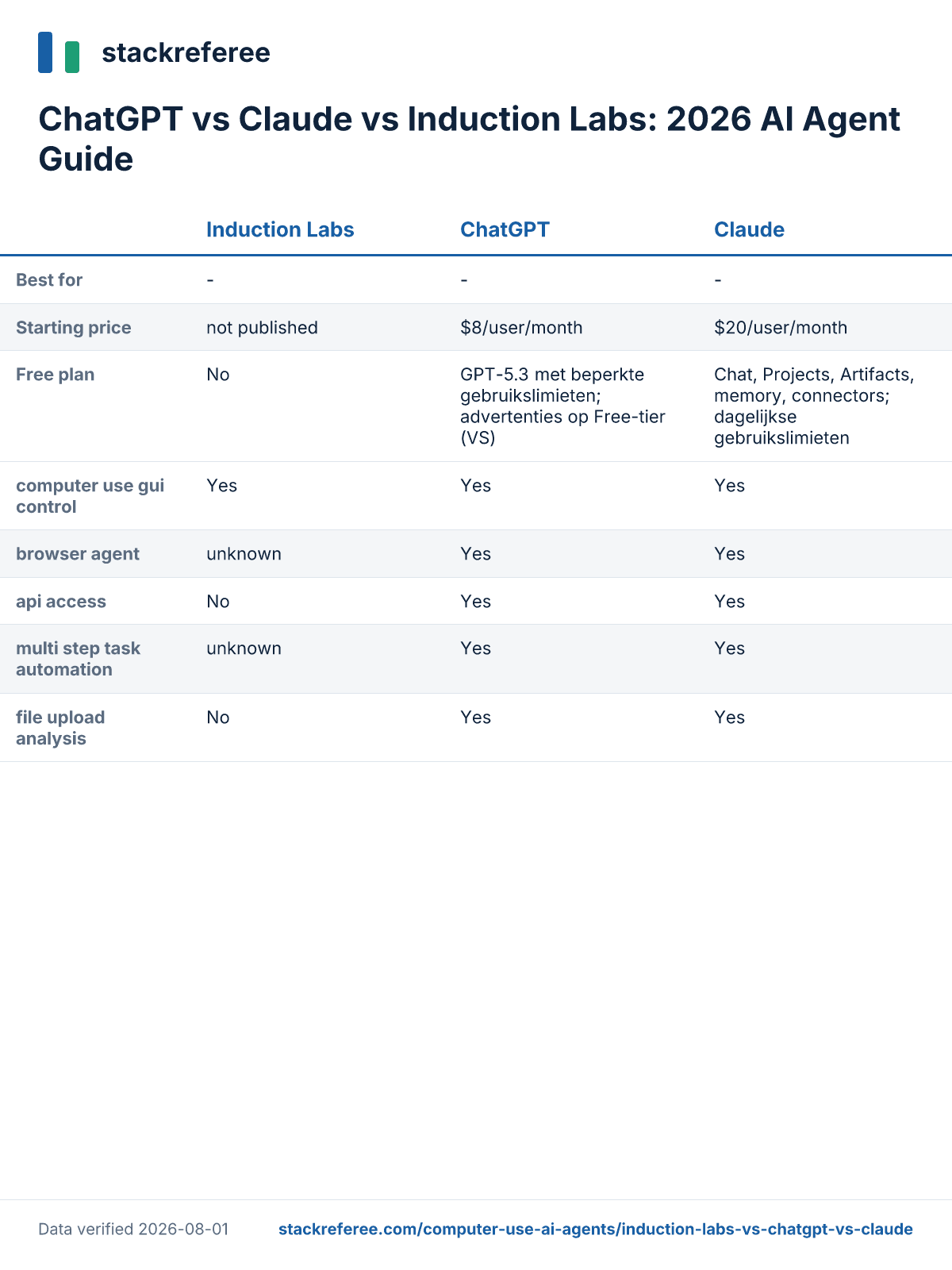
| ChatGPT | Claude | Induction Labs | |
|---|---|---|---|
| Best for | General-purpose agent work: browsing, file analysis, multi-step automation | Writing-heavy and dev workflows via Claude Code, plus early browser automation | Tracking computer-use research (no usable product) |
| Starting paid price | $8/month (Go plan) | $20/month (Pro plan), $17/month billed annually | Not published; no commercial offering exists |
| Free plan | Yes, GPT-5.3 with usage limits and ads (US) | Yes, chat, Projects, Artifacts, memory, connectors with daily limits | No public access of any kind |
| Core differentiator | Agent mode, Deep Research, Sora, and Codex bundled at Plus | Claude Code, Cowork, Design, and Science bundled at Pro; Claude for Chrome pilot | Photon-1 learns computer-use behavior from video pretraining alone |
| GDPR / SOC 2 | Confirmed | Confirmed | Unknown, not applicable (no enterprise product) |
| SSO/SAML | Yes, on Business tier ($25/user/month) | Yes, on Team and Enterprise tiers | Unknown, not applicable |
What is ChatGPT
ChatGPT is OpenAI's consumer and business AI assistant, extended with a dedicated agent capability documented in OpenAI's help center as "ChatGPT agent." OpenAI also introduced Operator, a browsing agent product, as a separate milestone in its computer-use lineup. The current plan lineup runs from a free, ad-supported tier in the US up through a $200/month Pro tier, with a $100/month Pro entry tier added April 9, 2026, that carries the same model suite, including GPT-5.5 Pro. ChatGPT targets everyone from individual freelancers to enterprises, backed by an admin console, SAML SSO on Business, and a public OpenAI Trust Portal documenting its security posture.
What is Claude
Claude is Anthropic's assistant, built around Projects, Artifacts, and a growing set of specialized modes: Cowork, Design, and Science, all bundled into the $20/month Pro plan alongside Claude Code. Anthropic is piloting Claude for Chrome, a browser extension that gives Claude computer-use style control inside the browser, according to Anthropic's own announcement. Claude's plans scale from a free daily-limited tier to Max plans at $100 and $200/month for individuals, and Team and Enterprise tiers with SSO, SCIM, and audit logs for organizations that need governance controls.
What is Induction Labs
Induction Labs is a research team based in San Francisco, launched through Y Combinator to build foundation models that learn from observation rather than instruction. Its only published result, Photon-1, is described in the company's own blog post on scaling video pretraining as an "imagination model." Third-party coverage reports that a single pretraining run let Photon-1 simulate desktop environments, play checkers, and model billiard physics. There are no released weights, no public API, no license, and no sign-up flow. Induction Labs is a research effort to watch, not a vendor you can currently deploy.
ChatGPT: pros and cons
Pro: Agent mode and Operator give you a working browsing agent today
ChatGPT's help documentation describes a dedicated "ChatGPT agent" capability, and OpenAI separately introduced Operator as a browsing-agent product. Combined with confirmed file upload analysis, third-party app connectors, and API access in the feature matrix, this is a computer-use stack you can put in front of a real workflow this week, not a research preview.
Pro: An $8/month entry point undercuts most competitors
The Go plan, rolled out globally in January 2026, offers unlimited GPT-5.3 Instant and 10x the message volume of the Free tier for $8/user/month. For individuals who don't need Deep Research or agent mode, this is a low-cost way into the ecosystem before committing to Plus.
Pro: Enterprise controls are already in place
Business plans include an admin console and SAML SSO starting at $25/user/month ($20 annually), and Enterprise pricing is available on request. Combined with confirmed GDPR and SOC 2 status, ChatGPT is positioned for procurement teams that need governance sign-off before rollout, not just individual adoption.
Con: Trustpilot sentiment is far weaker than Capterra sentiment
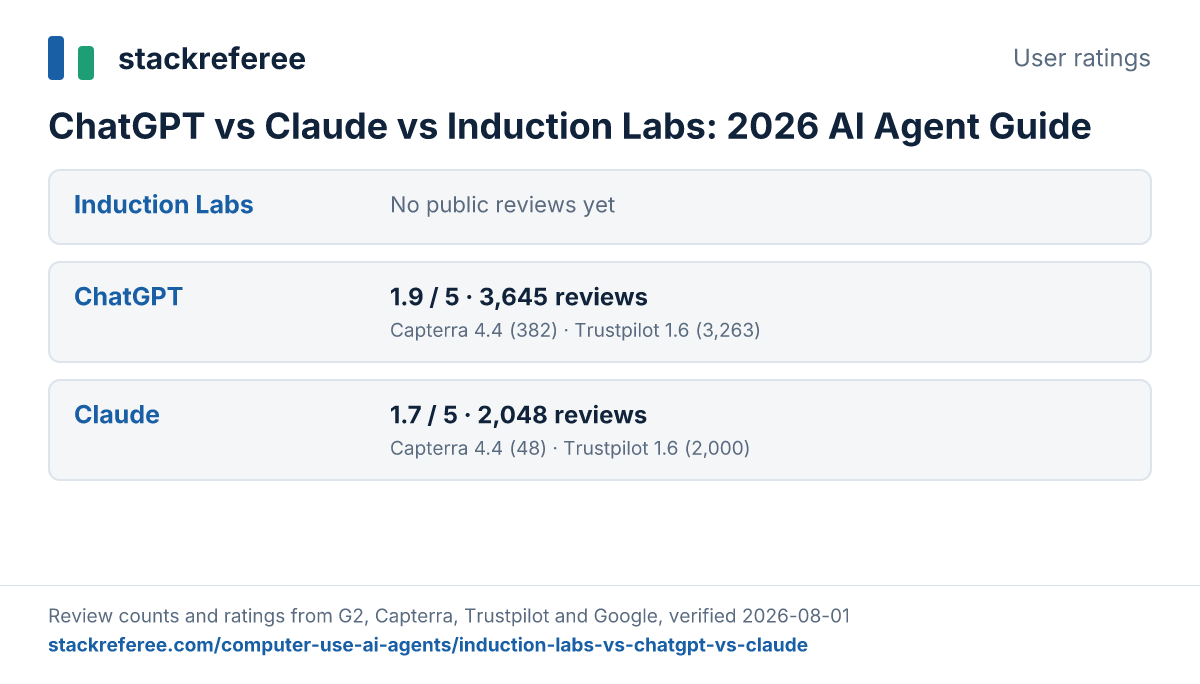
ChatGPT holds a 4.4/5 rating across 382 Capterra reviews but only 1.6/5 across 3,263 Trustpilot reviews. That gap suggests a split between satisfied business/productivity users and a large volume of dissatisfied consumer reviewers; treat either number alone as incomplete.
Con: Reviewers flag confident-sounding errors
A Capterra reviewer, a CEO at a sole proprietorship, wrote that ChatGPT "can produce confident-sounding errors, especially in technical analysis or niche research," and said they don't treat it as fully trustworthy. That's a direct caution for any workflow involving technical or specialized output without a human check.
Con: The jump from Plus to Pro is steep
Plus costs $20/month, but the full model suite, including GPT-5.5 Pro, requires the $100/month Pro entry tier or the $200/month Pro tier for 20x the usage limits. Individuals who outgrow Plus face a 5x to 10x price jump rather than a gradual step up.
Claude: pros and cons
Pro: Reviewers single out writing quality
A Capterra reviewer, a Founder in Health & Wellness, called Claude "the best AI to use if you want to enhance your writing," citing "the most natural and human writing style" among the tools they'd tried. For content-heavy workflows, that's a direct, sourced signal Claude doesn't get from spec sheets alone.
Pro: Users describe it as precise and reliable
A Consultant in Financial Services wrote that Claude "does what it's supposed to do, and it does it with a lot of precision," adding that the solutions "feel reliable." Paired with Claude Code, Cowork, Design, and Science all bundled into the $20/month Pro plan, that reliability signal extends across more than just chat.
Pro: Claude for Chrome adds a browser-native computer-use path
Anthropic's own announcement describes Claude for Chrome as a pilot giving Claude direct control inside the browser. Combined with confirmed browser agent and multi-step task automation in the feature matrix, this gives Claude a second computer-use surface beyond the standalone app.
Con: At least one reviewer reports serious data loss
A Founder & Software Engineer in Information Services wrote that Claude "LOST projects, twice I had to recreate a project," concluding that "even if Claude is the better product, it is too unstable." That's a concrete reliability risk worth weighing against the precision praise above.
Con: Trustpilot rating matches ChatGPT's low mark
Claude scores 4.4/5 on Capterra across 48 reviews but only 1.6/5 on Trustpilot across roughly 2,000 reviews on claude.ai. As with ChatGPT, the small Capterra sample and the much larger, harsher Trustpilot sample tell different stories; neither should be read in isolation.
Con: The team tier jump to Premium is expensive
Team Standard costs $25/seat/month ($20 annually), but Claude Code access requires Team Premium at $125/seat/month ($100 annually), a 5x jump for teams that need the developer environment rather than just chat and search.
Induction Labs: pros and cons
Pro: Photon-1 demonstrates computer-use skill learned purely from observation
Induction Labs' technical blog post on scaling video pretraining, and third-party coverage of the resulting benchmarks, describe a model that picked up desktop simulation, checkers, and billiard physics from one pretraining run, without task-specific instruction. That's a distinct research approach from prompted or fine-tuned agents.
Pro: Backed by Y Combinator as a foundation-model research bet
Induction Labs launched publicly through a Y Combinator listing describing its mission as building foundation models that learn from observation. That framing signals a longer-term research trajectory rather than a rushed product launch, for readers tracking where computer-use agents are headed next.
Pro: Broad task generalization from a single training run
Coverage of Photon-1 highlights that one pretraining run produced desktop control, game play, and physics modeling simultaneously, according to third-party reporting on the technical report. For a research-stage model, that breadth is notable even without a deployable product attached to it.
Con: There is no product to sign up for or buy
Induction Labs has not released weights, a public API, a license, or a sign-up flow for Photon-1. Whatever the benchmarks show, there is nothing here you can put into a workflow, a pilot, or a procurement process today.
Con: No compliance certifications or enterprise controls exist
GDPR, SOC 2, and SSO/SAML status are all unknown or not applicable, because there is no enterprise product to certify. Any organization evaluating computer-use agents for regulated work has nothing to assess here yet.
Con: No independent reviews exist to validate the claims
There are no G2, Capterra, Trustpilot, or GetApp reviews for Induction Labs or Photon-1, which is expected for an unreleased research project but still means every claim traces back to the company's own materials and press coverage rather than user experience.
Use-case comparison
Individuals who need an agent for daily work now. ChatGPT and Claude are both viable; the deciding factor is what you're producing. Reviewers point to ChatGPT for research, brainstorming, and daily productivity tasks, and to Claude for writing quality and precision on technical or financial output. Induction Labs isn't an option here at all, since there's no product to open.
Teams that need governance sign-off before rollout. ChatGPT Business and Claude Team Standard are both $25/seat/month ($20 annually), with confirmed GDPR, SOC 2, and SSO on both sides. Claude Team Premium adds Claude Code access at $125/seat/month for teams building software; ChatGPT Enterprise offers custom pricing for larger deployments. Induction Labs again has nothing to evaluate; there is no admin console, connector list, or compliance page to review.
Researchers and technical teams tracking where computer-use agents are headed. This is the one segment where Induction Labs belongs in the conversation. Its video-pretraining approach to computer-use is a distinct research direction worth monitoring through the company's newsroom, even though it offers nothing to deploy. For production computer-use work today, stick with ChatGPT or Claude and revisit Induction Labs if it publishes an API or weights.
Pricing
ChatGPT pricing
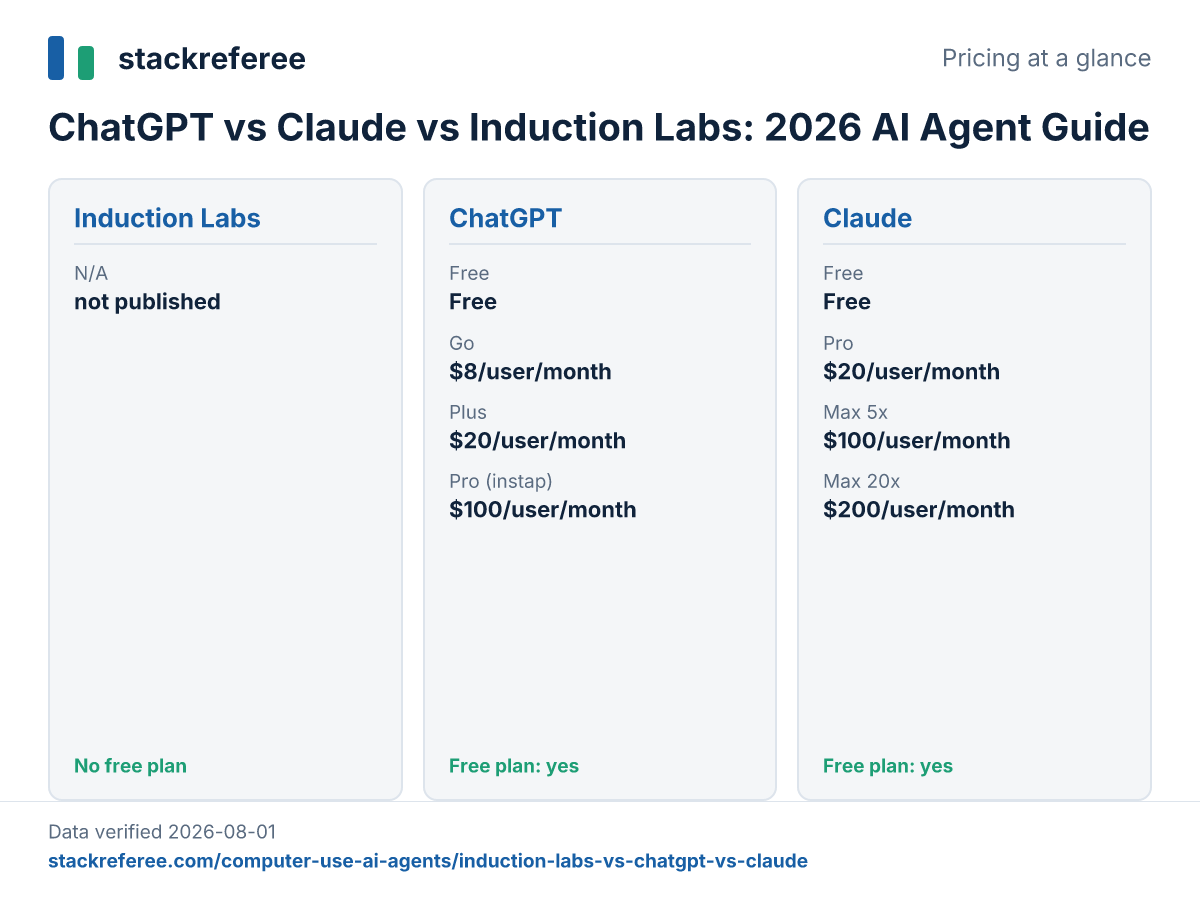
ChatGPT's Free plan runs GPT-5.3 with usage limits and ads in the US, at $0/month. The Go plan, at $8/user/month, offers unlimited GPT-5.3 Instant and 10x the message volume of Free. Plus, at $20/user/month, unlocks the full model suite, Deep Research (10 runs/month), agent mode, Sora, and Codex. Two Pro tiers exist: a $100/user/month entry tier launched April 9, 2026 with the same model suite as the top tier, including GPT-5.5 Pro, at 5x Plus usage limits, and a $200/user/month tier at 20x Plus limits with the highest priority. Business costs $25/user/month billed monthly or $20 billed annually, including an admin console and SAML SSO. Enterprise pricing is available on request.
Pricing verified on August 1, 2026.
Claude pricing
Claude's Free plan includes chat, Projects, Artifacts, memory, and connectors at $0/month, with daily usage limits. Pro costs $20/user/month billed monthly, or $17/month billed annually ($200 upfront), and includes Claude Code, Cowork, Design, Science, and unlimited projects. Max 5x costs $100/user/month for 5x the Pro usage limit, and Max 20x costs $200/user/month for 20x the limit plus priority access and early feature access. Team Standard costs $25/seat/month billed monthly or $20 billed annually, with centralized billing, SSO, and enterprise search. Team Premium costs $125/seat/month billed monthly or $100 billed annually, adding the Claude Code developer environment and 5x the usage of Standard. Enterprise starts at $20/seat plus usage at API rates, with SCIM, audit logs, and a HIPAA-ready option.
Pricing verified on August 1, 2026.
Induction Labs pricing
Induction Labs has no published pricing. Photon-1 is a research publication, not a commercial product: there are no plans, no free tier, no usage-based pricing, and no sign-up. If you're comparing costs across this category, budget for ChatGPT or Claude and treat Induction Labs as a research line to monitor rather than a line item.
Pricing verified on August 1, 2026.
What users say
ChatGPT
"I love using ChatGPT to streamline my real estate business, it helps me quickly create engaging listing descriptions."
- Realtor, sole proprietor, via Capterra
"ChatGPT has become one of my main AI tools I use daily for research, brainstorming ideas, and improving productivity."
- Sales Specialist, 201-500 employees, via Capterra
"It can produce confident-sounding errors, especially in technical analysis or niche research, so I don't treat it as something I can trust."
- CEO, sole proprietorship, via Capterra
Claude
"Claude is the best AI to use if you want to enhance your writing. It has the most natural and human writing style of the AI tools I've tried."
- Founder, Health & Wellness, via Capterra
"It simply does what it's supposed to do, and it does it with a lot of precision. The solutions it provides are really great and feel reliable."
- Consultant, Financial Services, via Capterra
"It LOST projects, twice I had to recreate a project... Even if Claude is the better product, it is too unstable."
- Founder & Software Engineer, Information Services, via Capterra
Induction Labs
No reviews exist for Induction Labs or Photon-1 on G2, Capterra, Trustpilot, GetApp, or Product Hunt. That absence is consistent with a research project that has no public sign-up and, therefore, no users to review it. Check back once, or if, Induction Labs releases a usable product.
Verdict per use case
Choose ChatGPT if you want the widest set of confirmed capabilities, browsing, file analysis, connectors, and agent mode, paired with a low $8/month entry tier and enterprise controls already in place at $25/user/month. It's the stronger fit if research, brainstorming, and daily productivity work is your priority, and you can live with a Trustpilot rating well below its Capterra score.
Choose Claude if writing quality and precision on technical or financial output matter more than raw feature breadth. Reviewers back this up directly, and Claude Code bundled into the $20/month Pro plan is a strong value case for developers. Weigh that against at least one report of lost projects before trusting it with irreplaceable work without backups.
Choose Induction Labs if you're a researcher or technical team tracking where computer-use agents are headed next, and you're comfortable reading a technical blog post instead of using a product. It is not a deployable option for any workflow today; there's no API, no weights, and no sign-up to evaluate.
Recap table
| ChatGPT | Claude | Induction Labs | |
|---|---|---|---|
| Starting paid price | $8/month (Go) | $20/month (Pro), $17/month annually | Not published, no commercial product |
| Best audience | Individuals to enterprises needing a general-purpose agent | Writers, consultants, and dev teams via Claude Code | Researchers tracking computer-use foundation models |
| Core differentiator | Agent mode, Operator lineage, Deep Research, Sora, Codex | Claude Code, Cowork, Design, Science, Claude for Chrome pilot | Photon-1 imagination model, learns computer-use from video pretraining |
For more context on how this category is evolving, see our broader roundup of Computer-Use AI Agents comparisons, and if you're also evaluating the browser layer these agents run on, our guide to Browserbase vs Steel vs Anchor Browser covers the infrastructure side. We disclose the standards behind these comparisons in our editorial policy; Induction Labs, like every tool covered here, gets no special treatment.
Frequently asked questions
Is ChatGPT or Claude better for computer-use AI agents?
Both ship a working computer-use agent with browser control, file analysis, and multi-step task automation. ChatGPT bundles Operator-style agent mode and Deep Research into Plus ($20/month); Claude bundles Claude Code and a Claude for Chrome pilot into Pro ($20/month). Neither is a clear technical leader in the research provided; the choice depends on whether you value OpenAI's broader app connector ecosystem or Claude's writing precision.
Does Induction Labs have a public product?
No. As of August 1, 2026, Induction Labs has published research on its Photon-1 model but has not released weights, a public API, a license, or a sign-up flow. There is nothing to buy, subscribe to, or test outside the company's own research posts and third-party coverage of its benchmarks.
What is Photon-1 by Induction Labs?
Photon-1 is described by Induction Labs as an 'imagination model' trained through video pretraining. Third-party coverage reports that a single pretraining run let it simulate desktop environments, play checkers, and model billiard physics. It is a research result, not a shipped computer-use agent you can deploy.
Is Claude for Chrome available to everyone?
Claude for Chrome is described by Anthropic as a pilot, per its own product announcement. The research reviewed here does not specify open general availability, so treat it as a staged rollout rather than a feature every Claude plan can access today.
Which AI agent tool has SOC 2 and GDPR compliance?
ChatGPT and Claude both confirm GDPR and SOC 2 coverage, along with SSO/SAML support on their business tiers. Induction Labs has no enterprise product, so its compliance status is not applicable; there is nothing to certify yet.
Can I use ChatGPT agent mode on the free plan?
Agent mode is listed under the ChatGPT Plus plan ($20/month) in OpenAI's published pricing, alongside Deep Research, Sora, and Codex. The Free tier runs GPT-5.3 with limited usage and ads in the US market, without agent mode included.
Is Claude cheaper than ChatGPT for teams?
Claude Team Standard costs $25/seat/month billed monthly ($20 annually), matching ChatGPT Business at $25/user/month ($20 annually). They are priced identically at the entry team tier; the difference shows up in what's bundled, like Claude Code access on Claude's Premium team tier.
Is Induction Labs a startup or a research lab?
Induction Labs launched through Y Combinator as a foundation-model research effort focused on learning from observation. The research available describes it as an early-stage team publishing technical results rather than operating a commercial product business.
Comments
No comments yet.