Vorelios vs Ansys vs COMSOL Multiphysics: 2026 Guide
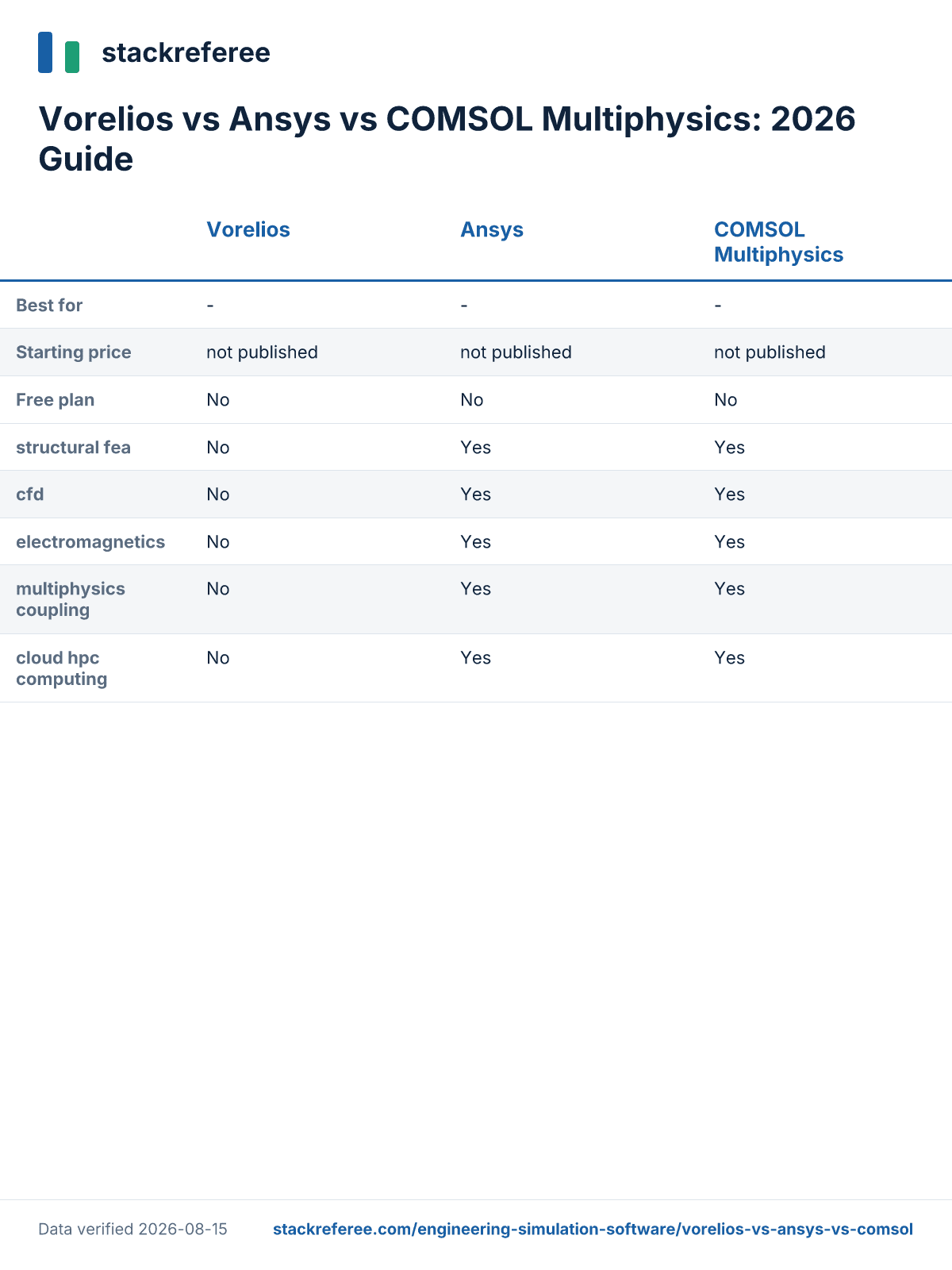
| Vorelios | Ansys | COMSOL Multiphysics | |
|---|---|---|---|
| Best for | Unclear; no public product information exists to define fit | Enterprise teams needing one vendor across FEA, CFD, EM, and cloud/HPC | Teams wanting deeply coupled multiphysics in a single, usable environment |
| Starting price | Not published anywhere | Not published; quote-based via Contact Sales | Not published; quote-based via Contact COMSOL |
| Free plan | Not disclosed | None found (separate academic licensing available) | None found |
| Core differentiator | Tagline only: "Toward Engineering Superintelligence" | Broadest single-vendor multiphysics portfolio with AI/ML-assisted simulation | Coupled multiphysics workflow praised for geometry/meshing usability |
| GDPR / SOC 2 | Unknown | SOC Attestation Report / ISO 27001-aligned CSA cert referenced; GDPR unknown | Unknown |
| SSO / SAML | Unknown | Unknown | Unknown |
What is Vorelios?
Vorelios is difficult to describe with any confidence. Its homepage carries a single tagline, "Toward Engineering Superintelligence," and a contact email, contact@vorelios.com. No product description, feature list, pricing page, screenshots, documentation, or changelog exists on the site, and checks of common secondary paths (/about, /product) turned up nothing further.
No presence was found on G2, Capterra, Trustpilot, GetApp, or ProductHunt, and searches for a company profile on LinkedIn or Crunchbase returned no results either. This does not confirm Vorelios lacks simulation capability; it means nothing about that capability has been made public. Treat every claim about Vorelios in this article as unverified until you have spoken with the company directly.
What is Ansys?
Ansys is a multi-product engineering simulation suite spanning Mechanical, Fluent, Discovery, and Electronics Desktop, among others. Its feature set, per the current product catalog, covers structural FEA, CFD, electromagnetics, true multiphysics coupling, cloud/HPC computing, AI/ML-assisted simulation, CAD integration, API/scripting automation, academic licensing, and on-premise deployment.
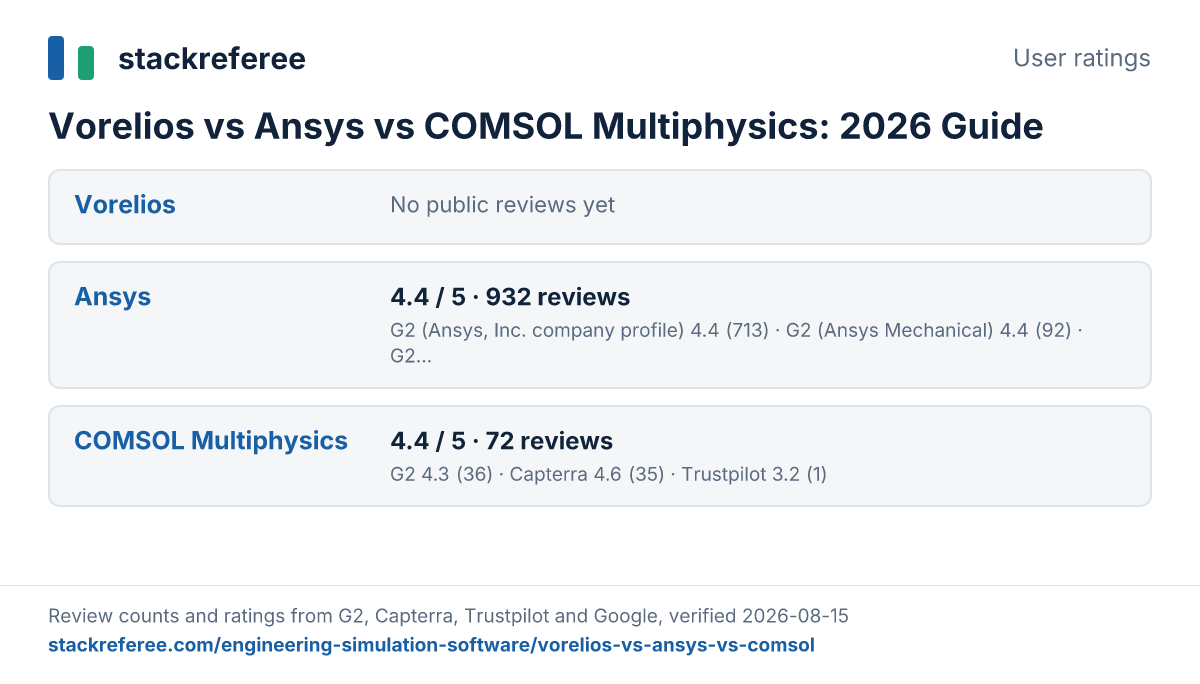
Synopsys completed its acquisition of Ansys on July 17, 2025, and the product catalog now lives at ansys.synopsys.com rather than a standalone ansys.com storefront. On G2, the Ansys, Inc. company profile carries a 4.4 average across 713 reviews, with individual products (Mechanical, Discovery, Electronics Desktop) rating between 4.4 and 4.7 on smaller review counts. The Ansys security page references a SOC Attestation Report and an ISO 27001-aligned CSA certification, though explicit GDPR and SSO/SAML statements were not found.
What is COMSOL Multiphysics?
COMSOL Multiphysics is built around a single coupled-simulation environment rather than a portfolio of separate products. Its published feature set covers structural FEA, CFD, electromagnetics, multiphysics coupling, cloud/HPC computing, AI/ML-assisted simulation, CAD integration, and API/scripting automation. Academic licensing could not be confirmed on the product site during this research and should be treated as unverified rather than confirmed absent.
COMSOL ships version-numbered releases (6.4's release highlights are documented publicly) and holds a 4.3 average on G2 (36 reviews) and 4.6 on Capterra (35 reviews). A single Trustpilot review (3.2) exists but concerns marketing and training emails rather than product quality, so it is not representative of the simulation software itself.
Vorelios: Pros and Cons
Direct vendor contact, nothing else. The only information Vorelios publishes is an email address, contact@vorelios.com. For a buyer who prefers reaching a vendor directly instead of a multi-step sales funnel, that is technically a low-friction entry point, though it is also the entirety of what's available before you make contact.
A stated AI-first positioning. The tagline "Toward Engineering Superintelligence" signals an ambition around AI/ML-driven simulation rather than a traditional broad multiphysics suite. That is a positioning statement, not a documented capability, so weigh it as a hint about direction rather than a feature claim.
No competing noise to evaluate. With no public feature list, pricing page, or marketing copy, there is nothing to wade through before a vendor conversation. That can save time for a buyer only interested in a direct briefing, but it also means there is no self-serve way to screen fit beforehand.
Zero published pricing. Unlike Ansys and COMSOL Multiphysics, which at least route buyers to a sales quote, Vorelios's site contains no pricing information and no "contact sales for pricing" language at all. Budgeting a comparison against the other two tools is not currently possible.
No documented features. Every entry in Vorelios's feature matrix, structural FEA, CFD, electromagnetics, multiphysics coupling, cloud/HPC, and the rest, reads false only because no public evidence was found, not because capability was confirmed absent. Buyers cannot verify what the product actually does from public sources.
No third-party review presence. Searches across G2, Capterra, Trustpilot, GetApp, and ProductHunt turned up no reviews for Vorelios. There is no way to gauge real-world user satisfaction or reliability before a direct vendor conversation.
Ansys: Pros and Cons
Full multiphysics breadth under one vendor. Mechanical, Fluent, Discovery, and Electronics Desktop together cover structural FEA, CFD, and electromagnetics, with genuine multiphysics coupling, cloud/HPC scaling, AI/ML-assisted simulation, and CAD/API integration all marked true in the feature matrix. Few single-vendor stacks span that much ground.
Deep, consistent review validation. The G2 company profile shows 4.4 across 713 reviews, and per-product scores stay in the same range: Mechanical 4.4 (92), Discovery 4.7 (11), Electronics Desktop 4.5 (15). Capterra adds Fluent at 4.6 (51) and Ansys Gateway on AWS at 4.6 (50). One Capterra reviewer called Fluent "the greatest software for Computational Fluid Dynamics simulations," and another praised its data visualization as "one of the best in the industry."
Academic licensing plus on-premise deployment. Ansys Academic offers a separate path for educators, researchers, and students, while on-premise deployment remains available alongside cloud/HPC options. That flexibility suits both cost-sensitive research use and data-residency-sensitive enterprise deployments.
No published pricing. Every path on the Ansys product site leads to "Contact Sales," with no list price disclosed. Third-party buyer-guide estimates (not published by Ansys itself) range from roughly $5,000 per user per year to over $1.8 million per year for large enterprise deployments, a spread too wide to budget from confidently.
Support quality complaints. A Capterra reviewer, a PhD student, wrote that "the customer support is now directed to the ansys forum, which is a very badly maintained source." A separate Trustpilot reviewer described "Horrible UI and interface, constantly crashing, super slow and filled with bugs," though Ansys's Trustpilot sample is very small (around two reviews) and should be weighted accordingly.
Multi-package heaviness. A Capterra reviewer, a PhD engineer, noted that "the use of different packages makes the program heavy, which is slow in opening and closing." That points to real overhead when running several Ansys modules together, particularly on smaller workstations.
COMSOL Multiphysics: Pros and Cons
Coupled multiphysics in one environment. Structural FEA, CFD, electromagnetics, and genuine multiphysics coupling all sit in a single product, alongside cloud/HPC computing, AI/ML-assisted simulation, CAD integration, and API/scripting automation, all marked true in the feature matrix.
Usability specifically called out by reviewers. A Capterra reviewer, an optical engineer in semiconductors, said the interface "simplifies geometry creation and meshing, speeding up the design process." A mechanical engineer added it is "very easy and intuitive to use, while keeping functionality and options available for highly technical users."
Solid scores across independent platforms. COMSOL Multiphysics holds 4.3 on G2 (36 reviews) and 4.6 on Capterra (35 reviews), a consistent result across two separate review communities. Its single Trustpilot review (3.2) concerns marketing emails, not the software, so it shouldn't be read as a product-quality signal.
No published pricing. COMSOL's product site directs every pricing inquiry to a Contact COMSOL form. University procurement pages (not COMSOL's own materials) reference a base license around $4,000 to $4,500 plus roughly 20% annual maintenance, but these figures are third-party, potentially outdated, and unverified against COMSOL's own pricing.
Parallel computing setup friction. A Capterra reviewer, a research associate, wrote that "setting up parallel computing...can be difficult to configure, and it can be hard to tell whether the software is actually running in parallel." That's a real workflow cost for teams planning to scale simulations across multiple cores.
Cost and compute barriers for smaller teams. A separate Capterra reviewer noted that "the high computational requirements and cost may limit accessibility for smaller organizations and individuals." Combined with unverified GDPR, SOC 2, and academic licensing status, smaller or education-focused buyers face more upfront diligence than the feature list alone suggests.
Use Case Comparison
Enterprise teams running FEA, CFD, and EM at scale. Ansys's combination of Mechanical, Fluent, Discovery, and Electronics Desktop, plus cloud/HPC computing and AI/ML-assisted simulation, fits organizations that need one vendor across multiple simulation domains. If your workloads already lean on distributed compute, it's worth reading how teams evaluate serverless GPU inference platforms for the underlying infrastructure question, since HPC/cloud scaling decisions often run in parallel with the simulation-tool choice.
Teams wanting one coupled multiphysics workspace. COMSOL Multiphysics fits organizations that would rather work in a single, tightly integrated environment than juggle multiple Ansys products, especially where reviewers' usability comments (easier geometry creation and meshing) matter more than having the single broadest product catalog.
Buyers evaluating an early-stage or undocumented AI-simulation vendor. Vorelios fits only teams willing to contact the vendor directly for a briefing before any real evaluation; with no published features, pricing, or reviews, it isn't yet suitable for buyers who need documentation upfront for procurement or compliance review. If your evaluation also touches adjacent categories like firmware-level simulation, the Simantic vs QEMU vs Renode comparison covers a differently scoped but related toolset.
Pricing
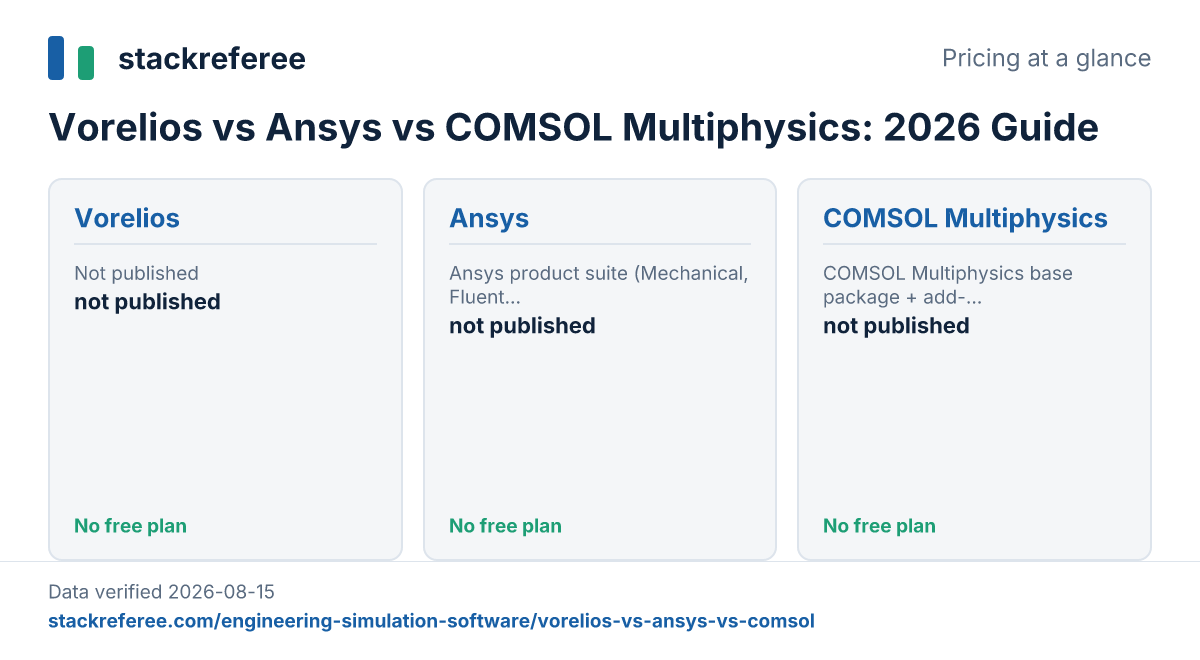
Vorelios Pricing
No plans, tiers, or pricing language of any kind are published on vorelios.com, not even "contact sales" copy. The only path to pricing information is the listed contact email, contact@vorelios.com.
Pricing verified on August 15, 2026.
Ansys Pricing
Ansys does not publish list pricing. The product site and contact page route every inquiry to a sales quote, with cost varying by user count, module selection, and HPC/cloud usage. Third-party buyer-guide sites (not Ansys) cite estimates from roughly $5,000 per user per year up to $1.8 million or more per year for large enterprise deployments; these are unverified third-party figures, not Ansys-published prices, and are not treated as fact here.
Pricing verified on August 15, 2026.
COMSOL Multiphysics Pricing
COMSOL Multiphysics is sold as a base package plus add-on modules, available as a perpetual or annual license depending on the agreement. No list price appears on comsol.com; all inquiries go through the Contact COMSOL form. University procurement references (not COMSOL's own site) mention a base license around $4,000 to $4,500 plus roughly 20% annual maintenance, but these are third-party, possibly outdated figures excluded from the verified pricing above.
Pricing verified on August 15, 2026.
We explain more about how sourcing works on this site in our editorial policy.
What Users Say
Vorelios
No reviews for Vorelios could be found on G2, Capterra, Trustpilot, GetApp, or ProductHunt. This is reported honestly rather than filled in with unrelated quotes; there is currently no independent user feedback to cite.
Ansys
"ANSYS Fluent is the greatest software for Computational Fluid Dynamics simulations."
- Elkouche A., Freelancer, Computer Software industry, 2+ years use, via Capterra
"The data visualization on this software is one of the best in the industry."
- Siddhant P., Automotive industry, 1,001-5,000 employees, via Capterra
"The customer support is now directed to the ansys forum, which is a very badly maintained source."
- Atul S., PhD Student, Research sector, via Capterra
COMSOL Multiphysics
"COMSOL's user-friendly interface simplifies geometry creation and meshing, speeding up the design process."
- Jalal S., Optical Engineer, Semiconductors, 10,001+ employees, via Capterra
"Very easy and intuitive to use, while keeping functionality and options available for highly technical users."
- Karthik V., Mechanical Engineer, Electrical/Electronic Manufacturing, 11-50 employees, via Capterra
"Setting up parallel computing...can be difficult to configure, and it can be hard to tell whether the software is actually running in parallel."
- Felipe S., Research Associate, Education Management, 1,001-5,000 employees, via Capterra
Verdict: Which Should You Choose?
Choose Ansys if you need one vendor covering structural FEA, CFD, and electromagnetics with cloud/HPC scaling and AI/ML-assisted simulation, and you can tolerate a quote-based pricing process with no published list price. Its 4.4 average across 713 G2 reviews is the deepest validation of the three tools here, though budget for support friction; reviewers flag both a badly maintained community forum and multi-package heaviness.
Choose COMSOL Multiphysics if you'd rather work in a single, tightly coupled multiphysics environment and value an interface reviewers specifically call intuitive for geometry and meshing work. Expect the same quote-based pricing model as Ansys, plus real setup friction around parallel computing configuration.
Choose Vorelios only if you're comfortable reaching out cold, by email, with no public feature list, pricing, or reviews to screen fit beforehand. It is not a fair substitute for Ansys or COMSOL Multiphysics in this comparison; treat any evaluation as starting from zero documentation. For a broader set of options in this space, the Engineering Simulation Software comparisons hub tracks additional tools as more verified data becomes available.
Recap Table
| Price | Best-fit audience | Core differentiator | |
|---|---|---|---|
| Vorelios | Not published | Buyers willing to contact the vendor directly with no prior documentation | Unverified; tagline-only positioning around AI-driven simulation |
| Ansys | Not published; quote-based | Enterprise teams needing FEA, CFD, EM, and cloud/HPC under one vendor | Broadest single-vendor multiphysics portfolio, largest review base |
| COMSOL Multiphysics | Not published; quote-based | Teams wanting one coupled multiphysics workspace | Interface praised for geometry/meshing usability |
FAQ
Is Vorelios cheaper than Ansys or COMSOL Multiphysics? No pricing is published for any of the three. Vorelios's website lists no plans at all, while Ansys and COMSOL Multiphysics both route buyers to a sales quote. You cannot compare costs without contacting each vendor directly.
Does Ansys or COMSOL Multiphysics offer a free plan? Neither publishes a self-serve free plan. Both are quote-based, with Ansys offering separate academic licensing and COMSOL Multiphysics selling perpetual or annual licenses plus add-on modules through a sales contact form.
What is a good alternative to Ansys for coupled multiphysics simulation? COMSOL Multiphysics covers the same core categories, structural FEA, CFD, electromagnetics, and true multiphysics coupling, and reviewers specifically praise its interface for geometry and meshing work. Vorelios cannot be recommended here; its capabilities are unverified.
Is COMSOL Multiphysics easier to learn than Ansys? Capterra reviewers describe COMSOL Multiphysics as intuitive for both new and highly technical users. Ansys reviewers instead flag a heavier, multi-package feel that can be slow to open and close, though it covers more ground overall.
What happened to Ansys after the Synopsys acquisition? Synopsys completed its acquisition of Ansys on July 17, 2025. The Ansys product catalog now lives on ansys.synopsys.com, though the underlying Mechanical, Fluent, Discovery, and Electronics Desktop products are unchanged in this research.
Is Vorelios a verified engineering simulation vendor? Vorelios's public web presence is a single page reading "Toward Engineering Superintelligence" plus a contact email. No features, pricing, reviews, or compliance claims could be found, so treat it as unverified pending direct vendor contact.
Which tool has more third-party reviews, Ansys or COMSOL Multiphysics? Ansys has far more review volume: 713 ratings on its G2 company profile alone (4.4 average), plus per-product G2 and Capterra scores. COMSOL Multiphysics shows fewer but still solid results: 4.3 on G2 (36 reviews) and 4.6 on Capterra (35 reviews).
Frequently asked questions
Is Vorelios cheaper than Ansys or COMSOL Multiphysics?
No pricing is published for any of the three. Vorelios's website lists no plans at all, while Ansys and COMSOL Multiphysics both route buyers to a sales quote. You cannot compare costs without contacting each vendor directly.
Does Ansys or COMSOL Multiphysics offer a free plan?
Neither publishes a self-serve free plan. Both are quote-based, with Ansys offering separate academic licensing and COMSOL Multiphysics selling perpetual or annual licenses plus add-on modules through a sales contact form.
What is a good alternative to Ansys for coupled multiphysics simulation?
COMSOL Multiphysics covers the same core categories, structural FEA, CFD, electromagnetics, and true multiphysics coupling, and reviewers specifically praise its interface for geometry and meshing work. Vorelios cannot be recommended here; its capabilities are unverified.
Is COMSOL Multiphysics easier to learn than Ansys?
Capterra reviewers describe COMSOL Multiphysics as intuitive for both new and highly technical users. Ansys reviewers instead flag a heavier, multi-package feel that can be slow to open and close, though it covers more ground overall.
What happened to Ansys after the Synopsys acquisition?
Synopsys completed its acquisition of Ansys on July 17, 2025. The Ansys product catalog now lives on ansys.synopsys.com, though the underlying Mechanical, Fluent, Discovery, and Electronics Desktop products are unchanged in this research.
Is Vorelios a verified engineering simulation vendor?
Vorelios's public web presence is a single page reading 'Toward Engineering Superintelligence' plus a contact email. No features, pricing, reviews, or compliance claims could be found, so treat it as unverified pending direct vendor contact.
Which tool has more third-party reviews, Ansys or COMSOL Multiphysics?
Ansys has far more review volume: 713 ratings on its G2 company profile alone (4.4 average), plus per-product G2 and Capterra scores. COMSOL Multiphysics shows fewer but still solid results: 4.3 on G2 (36 reviews) and 4.6 on Capterra (35 reviews).
Comments
No comments yet.