Simantic vs QEMU vs Renode: Firmware Simulation in 2026
Picking a firmware simulator usually starts with a narrow, practical question: can this tool reproduce the exact hardware behavior my code depends on, and can I trust the test result it gives me? This guide compares Simantic, QEMU, and Renode, three tools that take different approaches: a general-purpose open-source emulator, a deterministic CI-focused simulation framework, and a pre-launch AI-driven startup with no published pricing yet. We compare them on what's actually documented, and flag clearly where the data runs out. For more comparisons in this space, see our full list of Firmware Simulation Software comparisons; for how we handle vendor relationships, read our editorial policy.
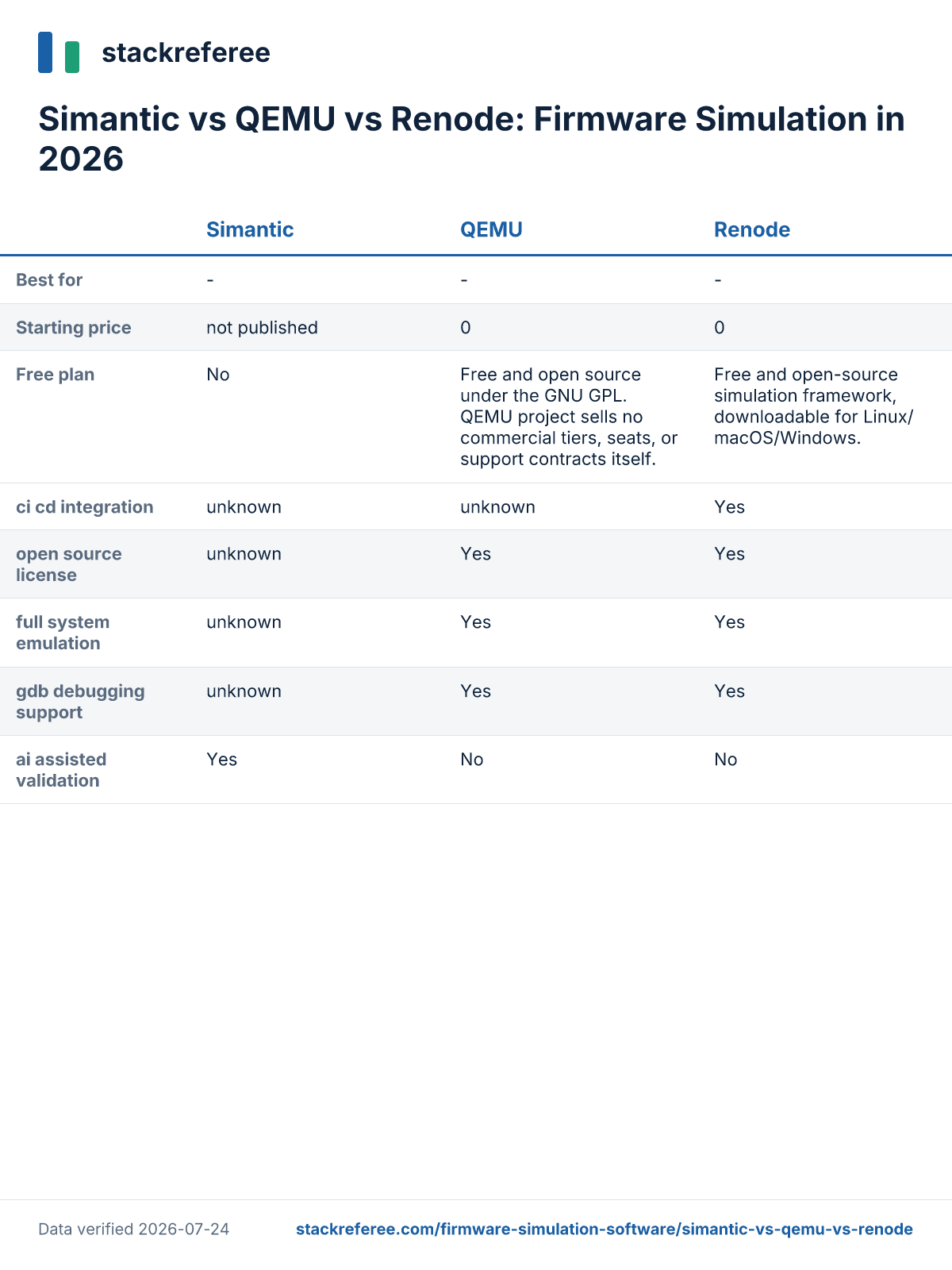
Simantic vs QEMU vs Renode at a glance
| Simantic | QEMU | Renode | |
|---|---|---|---|
| Best for | AI-assisted firmware validation with PCB signal analysis | Multi-architecture full-system emulation | Deterministic, CI-integrated multi-node simulation |
| Starting price | Not published | $0 (open source, GPL) | $0 (Community edition); commercial support by quote |
| Free plan | Unknown (no public plan documented) | Yes, fully free | Yes, Community edition is free |
| Core differentiator | AI-driven validation + PCB signal integrity analysis | Broad architecture support, host-CPU performance | Determinism + multi-node network simulation + CI/CD |
| GDPR | Unknown, no public documentation | Not applicable (locally installed software) | Not applicable (open-source framework) |
| SOC 2 | Unknown, no public documentation | Unknown, not documented | Unknown, not documented |
| SSO/SAML | Unknown | Not applicable | Not applicable |
What is Simantic
Simantic is an early-stage startup positioned around automated firmware validation, founded in 2025 and part of Y Combinator's F26 batch. The company lists 4 employees, and its Y Combinator profile describes it as "firmware simulation for AI agents." Its feature positioning centers on two claims confirmed by our research: AI-assisted validation and PCB signal integrity analysis, a combination none of the other tools in this comparison advertise. Beyond that core positioning, Simantic has not published a changelog, detailed product documentation, or an architecture page, so claims about CI integration, debugging support, or licensing model can't be verified. Teams evaluating Simantic today are evaluating a pre-launch product, not a mature platform with a track record.
What is QEMU
QEMU is a generic, open-source machine emulator and virtualizer distributed under the GNU GPL. It provides full-system emulation across multiple architectures, supports GDB debugging natively, and models peripheral devices as part of its emulation layer. QEMU runs on host CPU resources rather than a dedicated cloud service, which is why compliance frameworks like GDPR or SSO are not applicable to it in the way they'd apply to a hosted SaaS product. It is free for any use case, with no commercial tier sold by the QEMU project itself; whether it supports deterministic execution or multi-node network simulation is not documented in the sources reviewed for this comparison.
What is Renode
Renode is an open-source simulation framework created by Antmicro, built to model complete embedded systems, from a single microcontroller up to networks of interconnected devices. Its documented feature set includes deterministic execution, multi-node network simulation, and native CI/CD integration, alongside the full-system emulation, multi-architecture support, and GDB debugging it shares with QEMU. Antmicro also sells commercial support and custom development work on top of the free Community edition, though pricing for that service is quote-based rather than published. Renode fits teams that need reproducible test runs across distributed embedded systems, not just single-device emulation.
Pros and cons
Simantic
AI-assisted firmware validation is the core product, not an add-on. The feature matrix confirms ai_assisted_validation: true, and Simantic's own positioning ("firmware simulation for AI agents") backs this up. If your team is already building AI-driven test workflows, this is a narrower, more targeted fit than a general-purpose emulator retrofitted with scripts.
PCB signal integrity analysis is unique among the three tools compared here. Neither QEMU nor Renode's documented feature set includes this capability. For teams whose validation problem spans both firmware behavior and board-level signal integrity, this combination isn't something you'd otherwise get from one vendor.
Y Combinator backing (F26 batch) signals external validation for a very young company. Founded in 2025 with 4 employees, Simantic has passed at least one layer of investor diligence, which counts for something when public reviews don't exist yet.
No public pricing exists anywhere. Every plan is listed as "contact sales," with price itself marked "not published." Budget-conscious teams can't scope a cost without a sales conversation, which slows down evaluation compared to tools with a visible price list.
No reviews exist on G2, Capterra, Trustpilot, GetApp, or ProductHunt. There's no independent user feedback to weigh against the company's own claims, which is expected for a company this young but still a real gap for buyers doing diligence.
Most of the feature matrix is unverified. CI/CD integration, open-source licensing, GDB debugging, deterministic execution, and multi-architecture support are all marked unknown, not confirmed absent, because no changelog or detailed documentation was found to check them against.
QEMU
It's free for any use case, with no license fee, full stop. A Capterra reviewer, a CEO in Food & Beverages, put it plainly: "Open sourced and free, so it fits any budget. It's available on almost every platform." That's not a marketing claim, it's the GPL license itself.
Multi-architecture full-system emulation with integrated GDB debugging covers most emulation needs out of the box. The feature matrix confirms full system emulation, peripheral device modeling, and multi-architecture emulation are all supported, directly, not inferred from marketing copy.
Performance running on host CPU resources is a documented strength. A Software Engineer reviewer on Capterra noted, "Qemu offers unparalleled performance as it runs the code on host CPU through emulation," which matters when simulation speed determines how many test cycles you can run per day.
Documentation is a genuine barrier for newcomers. The same Software Engineer reviewer who praised its performance also said, "Getting started and learning are not easy with Qemu. The documentation is not straightforward." Budget onboarding time accordingly, especially for engineers new to emulator tooling.
It requires a technical baseline that not every team has on day one. A Technology Analyst reviewer on Capterra noted, "For end users with knowledge it can be a bit confusing since it requires a technical level," which tracks with QEMU's roots as a systems-level tool rather than a polished product.
Determinism and multi-node network simulation are undocumented, not confirmed. Unlike Renode, QEMU's sources don't explicitly address whether execution is reproducible run-to-run or whether it supports simulating networks of interacting nodes, both of which matter for CI-grade embedded testing.
Renode
Deterministic execution is a documented, confirmed capability. For teams that need a test run to produce the same result every time, this is a meaningful difference from QEMU, where the same property is simply undocumented rather than confirmed present or absent.
CI/CD integration and multi-node network simulation are both confirmed in the feature matrix. That combination fits teams simulating fleets of interconnected embedded devices inside automated pipelines, rather than a single chip in isolation.
Commercial support is available through Antmicro if you need it. Unlike QEMU, which sells no support tier at all, Renode's creator offers paid professional support and custom platform development on top of the free Community edition, giving teams an escalation path.
No public reviews exist on G2, Capterra, or Trustpilot. Like Simantic, Renode has no independent review data to check vendor claims against, despite being a more established open-source project than a pre-launch startup.
Commercial support pricing is entirely quote-based. Antmicro's site offers a contact form, not a price list, so teams can't estimate the cost of paid support without starting a sales conversation.
No official compliance documentation exists for GDPR, SOC 2, or SSO/SAML. As an open-source framework rather than a hosted service, this is expected, but it does mean compliance responsibility sits entirely with whoever deploys and operates it.
Use-case comparison
Solo firmware engineers or small teams validating on a tight budget. QEMU is the practical default: it's free with no license fee, runs on almost any platform, and has the broadest documented architecture support of the three. Budget two to three weeks to get comfortable with its documentation before it pays off.
Teams automating CI pipelines across multiple embedded nodes. Renode's confirmed deterministic execution, CI/CD integration, and multi-node network simulation make it the better-documented fit for reproducible, pipeline-driven testing, especially where a single flaky run can block a release.
Teams building AI-driven validation workflows or needing PCB-level signal analysis. Simantic is the only tool of the three positioned around this combination, but go in aware that pricing, reviews, and most of its feature set beyond that core positioning are currently undocumented. Treat it as an early-access evaluation, not a drop-in replacement for an established emulator.
Pricing
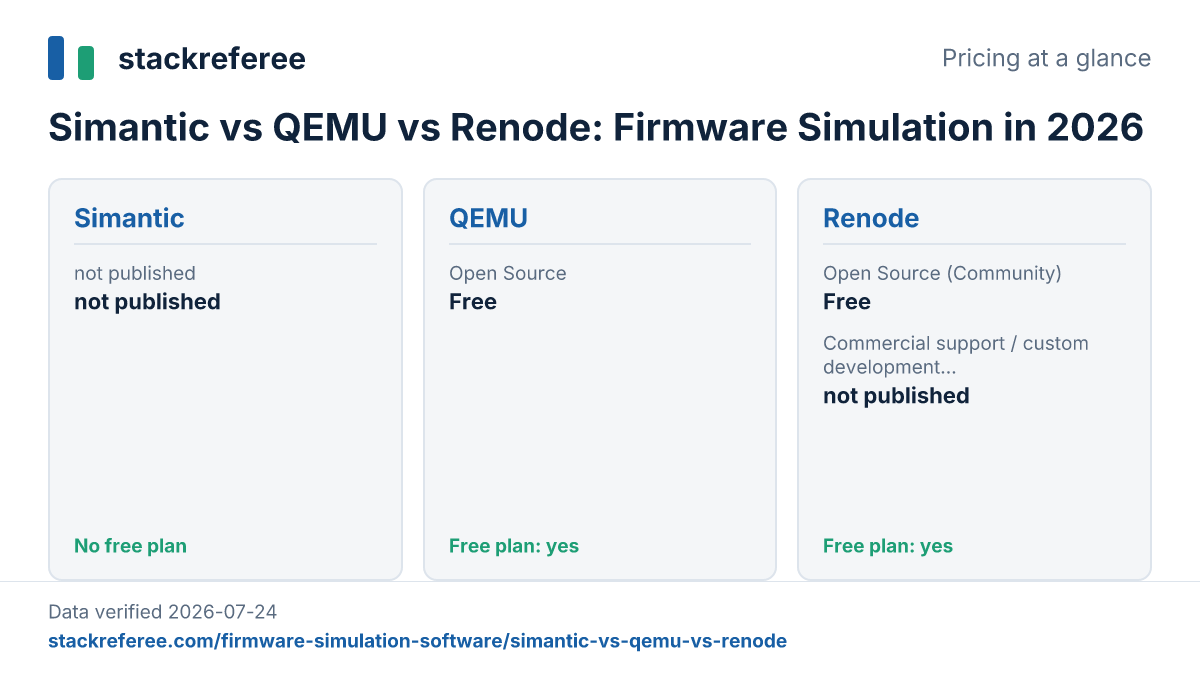
Simantic pricing
Simantic has not published a pricing page. The only listed plan is "contact sales," with price marked "not published." As an early-stage company founded in 2025 with 4 employees, its product appears pre-launch or early-access as of this verification date.
Pricing verified on July 24, 2026.
QEMU pricing
| Plan | Price | Notes |
|---|---|---|
| Open Source | $0, no license fee | Free and open source under the GNU GPL. The QEMU project sells no commercial tiers, seats, or support contracts itself. |
Pricing verified on July 24, 2026.
Renode pricing
| Plan | Price | Notes |
|---|---|---|
| Open Source (Community) | $0, no license fee | Free and open-source, downloadable for Linux, macOS, and Windows. |
| Commercial support / custom development | Contact sales | Antmicro offers paid professional support and custom platform or tooling development. No public price list, only a contact form. |
Pricing verified on July 24, 2026.
What users say
QEMU
"Open sourced and free, so it fits any budget. It's available on almost every platform."
- CEO, Food & Beverages industry via Capterra
"Qemu offers unparalleled performance as it runs the code on host CPU through emulation."
- Software Engineer, IT Services via Capterra
"Getting started and learning are not easy with Qemu. The documentation is not straightforward."
- Software Engineer, IT Services via Capterra
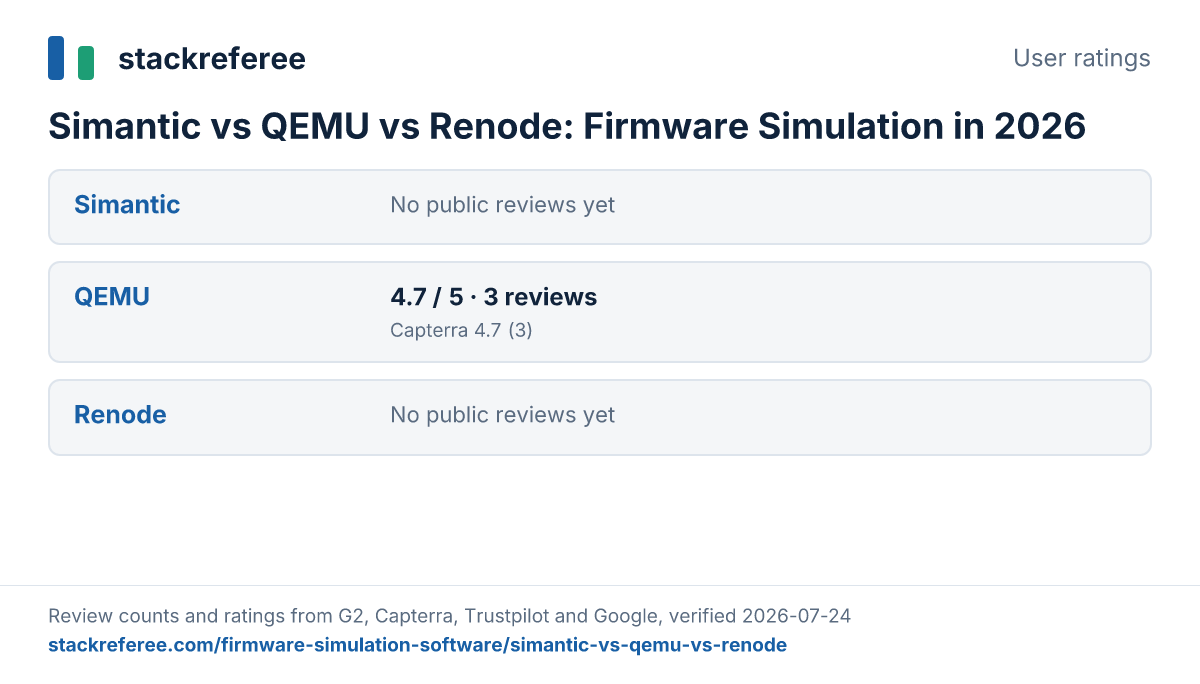
QEMU holds a 4.7 out of 5 rating on Capterra, based on 3 reviews as of July 24, 2026. Its G2 review page could not be verified directly and is left out of the figures above rather than estimated.
Simantic
No public reviews for Simantic were found on G2, Capterra, Trustpilot, GetApp, or ProductHunt as of this writing. That's consistent with a company founded in 2025 with 4 employees and a product that appears pre-launch. We're not filling that gap with invented quotes; treat the absence of review data itself as a data point when weighing risk.
Renode
No public reviews for Renode were found on G2, Capterra, or Trustpilot as of this writing, despite Renode being a more established open-source project than Simantic. This may reflect the tool being niche enough to sit outside the audience these review platforms typically capture, rather than any quality signal. As with Simantic, we're reporting the gap rather than guessing at sentiment.
Verdict per use case
Choose Simantic if you're already building AI-agent-driven validation workflows and want PCB signal integrity analysis in the same tool, and you're comfortable evaluating a pre-launch product with no public pricing or third-party reviews yet. Go in through a direct sales conversation, not a self-serve trial.
Choose QEMU if you need free, broad multi-architecture full-system emulation today, you have the technical background to work through documentation that reviewers describe as "not straightforward," and you don't need vendor-provided commercial support. It's the safest default for local development and general emulation work.
Choose Renode if your priority is reproducible, CI-integrated testing across multiple embedded nodes, and you want the option of paid commercial support from Antmicro without giving up a free, open-source Community edition. It's the better-documented choice when determinism is a hard requirement rather than a nice-to-have.
Recap
| Simantic | QEMU | Renode | |
|---|---|---|---|
| Starting price | Not published | $0 | $0 (Community); commercial support by quote |
| Best fit | Firmware teams building AI-driven, PCB-aware validation | Engineers needing free, broad-architecture emulation | Teams automating deterministic, multi-node CI testing |
| Core differentiator | AI-assisted validation + PCB signal integrity analysis | Multi-architecture emulation at zero cost | Deterministic execution + CI/CD + multi-node simulation |
If your evaluation also touches compliance tooling outside firmware simulation, our TrustAI vs Vanta vs Drata vs Secureframe: 2026 guide covers that adjacent category. For more on how vendors in this space stack up, browse the rest of our Firmware Simulation Software comparisons.
FAQ
Is QEMU free to use? Yes. QEMU is free and open source under the GNU GPL, with no license fee for any use case. The QEMU project itself sells no commercial tiers, seats, or paid support contracts, so every feature documented for QEMU is available at $0.
What is the difference between QEMU and Renode? Both are free, open-source system emulators with GDB debugging and multi-architecture support. Renode adds deterministic execution and multi-node network simulation, plus CI/CD integration and paid commercial support through Antmicro. QEMU's determinism and multi-node simulation status is undocumented in the sources reviewed.
Does Renode support CI/CD integration? Yes. Renode's feature set includes CI/CD integration alongside deterministic execution, which is why teams building automated embedded test pipelines often reach for it over a general-purpose emulator.
How much does Simantic cost? Simantic has not published pricing. It is an early-stage Y Combinator (F26 batch) startup founded in 2025 with 4 employees, and its product appears to be pre-launch or early-access. Interested teams need to contact the company directly.
Which firmware simulator has the best documentation? Based on available review data, QEMU users describe its documentation as "not straightforward" and note a real learning curve for newcomers. No comparable review data exists yet for Renode or Simantic documentation quality.
Is Renode open source? Yes. Renode's Community edition is free and open source, downloadable for Linux, macOS, and Windows. Antmicro, the company behind Renode, separately offers paid commercial support and custom development, though it publishes no price list for that service.
Can QEMU do deterministic execution for testing? It's unclear. Deterministic execution for QEMU is not explicitly documented in the sources reviewed, so we list it as unknown rather than assuming parity with Renode, which does document deterministic execution as a supported capability.
What is Simantic used for? Simantic positions itself around automated firmware validation, combining AI-assisted validation with PCB signal integrity analysis. It targets firmware teams that want AI agents involved in the validation loop, though most of its feature set beyond that core positioning is undocumented publicly.
Frequently asked questions
Is QEMU free to use?
Yes. QEMU is free and open source under the GNU GPL, with no license fee for any use case. The QEMU project itself sells no commercial tiers, seats, or paid support contracts, so every feature documented for QEMU is available at $0.
What is the difference between QEMU and Renode?
Both are free, open-source system emulators with GDB debugging and multi-architecture support. Renode adds deterministic execution and multi-node network simulation, plus CI/CD integration and paid commercial support through Antmicro. QEMU's determinism and multi-node simulation status is undocumented in the sources reviewed.
Does Renode support CI/CD integration?
Yes. Renode's feature set includes CI/CD integration alongside deterministic execution, which is why teams building automated embedded test pipelines often reach for it over a general-purpose emulator.
How much does Simantic cost?
Simantic has not published pricing. It is an early-stage Y Combinator (F26 batch) startup founded in 2025 with 4 employees, and its product appears to be pre-launch or early-access. Interested teams need to contact the company directly.
Which firmware simulator has the best documentation?
Based on available review data, QEMU users describe its documentation as 'not straightforward' and note a real learning curve for newcomers. No comparable review data exists yet for Renode or Simantic documentation quality.
Is Renode open source?
Yes. Renode's Community edition is free and open source, downloadable for Linux, macOS, and Windows. Antmicro, the company behind Renode, separately offers paid commercial support and custom development, though it publishes no price list for that service.
Can QEMU do deterministic execution for testing?
It's unclear. Deterministic execution for QEMU is not explicitly documented in the sources reviewed, so we list it as unknown rather than assuming parity with Renode, which does document deterministic execution as a supported capability.
What is Simantic used for?
Simantic positions itself around automated firmware validation, combining AI-assisted validation with PCB signal integrity analysis. It targets firmware teams that want AI agents involved in the validation loop, though most of its feature set beyond that core positioning is undocumented publicly.
Comments
No comments yet.