Assemble vs Gearset vs Copado: 2026 DevOps Comparison
Salesforce admins and release managers already know the pain: a sandbox refresh breaks a validation rule nobody remembers writing, and the only way to find out is after a failed production deployment. Enterprise IT teams running more than Salesforce face a bigger version of the same problem across NetSuite, SAP, or ServiceNow, where a change in one system can quietly break a downstream integration nobody was watching. This comparison looks at three tools tackling that problem from different angles: Assemble, Gearset, and Copado. Two are mature, Salesforce-specific DevOps platforms with years of reviews behind them; the third is a brand-new, multi-system AI agent play with no track record yet. Treating all three as interchangeable would be misleading, so this guide is explicit about where the comparison holds and where it does not. For more options in this space, see our broader roundup of Enterprise Change Management comparisons.
Assemble vs Gearset vs Copado at a glance
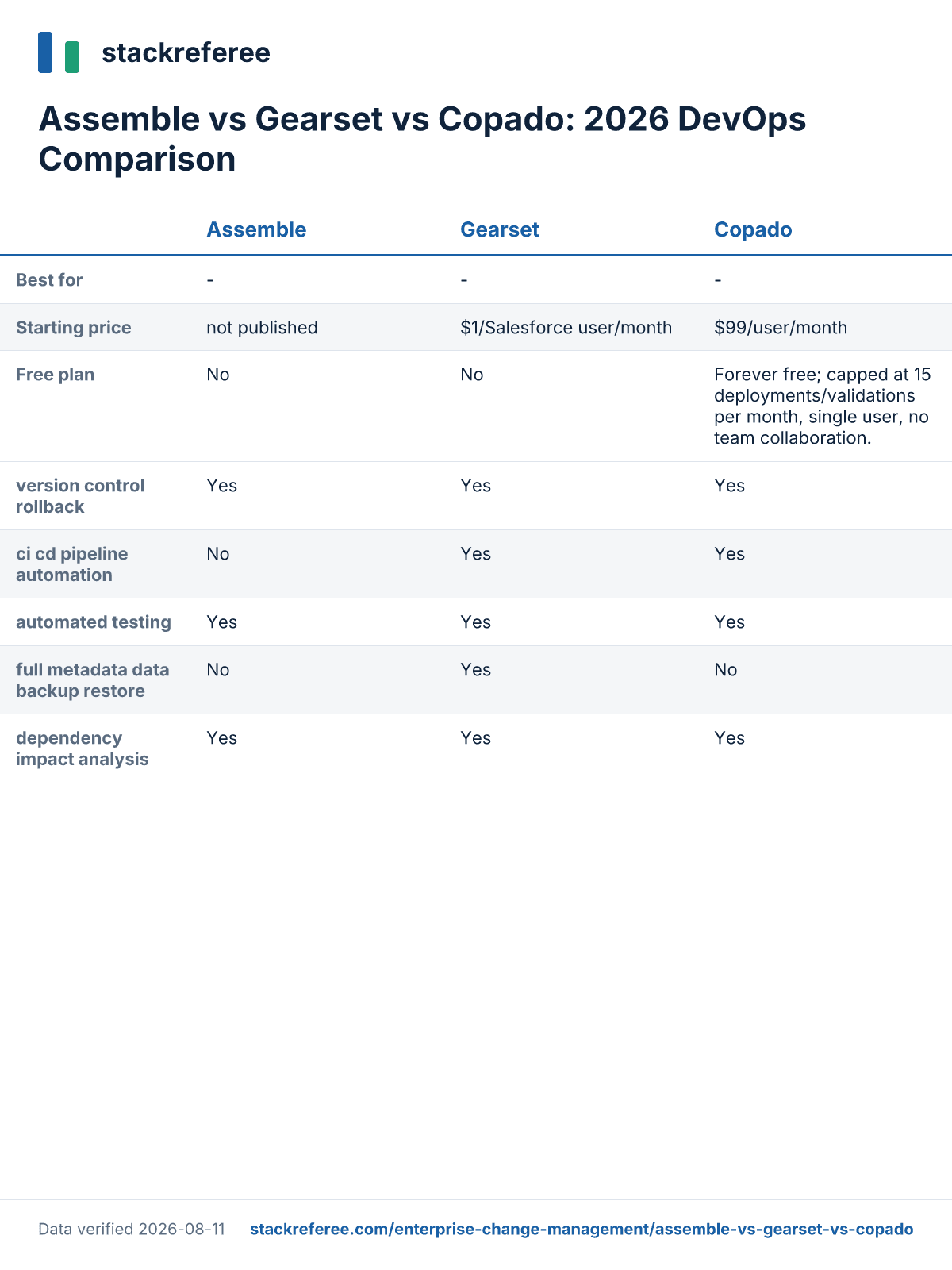
| Assemble | Gearset | Copado | |
|---|---|---|---|
| Best for | Multi-system change automation via AI agents (Salesforce + NetSuite, SAP, ServiceNow, etc.) | Salesforce-native DevOps with backup and sandbox seeding built in | Salesforce teams wanting a free-to-paid ramp into CI/CD pipelines |
| Starting price | Not published (contact sales) | $215/user/month (Core Starter) | $0/user/month (Essentials Free) |
| Free plan | No | No | Yes, capped at 15 deployments/validations per month |
| Core differentiator | AI agents that scope, run, and verify changes across 8 enterprise systems | Full metadata + data backup/restore and sandbox data masking in one platform | Agentia AI platform with CI/CD pipelines available from a free tier |
| Compliance (GDPR/SOC 2) | Unknown, not publicly documented | GDPR and SOC 2 documented | GDPR and SOC 2 documented |
| SSO/SAML | Not documented | SAML listed under Enterprise tier only; lower tiers unconfirmed | Okta SSO documented for Essentials; platform-wide SAML not independently verified |
What is Assemble
Assemble is a Y Combinator Summer 2026 startup, meaning it is only weeks to months old at the time of this comparison. Rather than building a Salesforce-only release pipeline, Assemble deploys AI agents that scope, run, and verify changes across a wider set of enterprise systems, including Salesforce, NetSuite, SAP, Oracle, ServiceNow, Workday, HubSpot, and MuleSoft. That positions it closer to a cross-system change automation layer than a direct Gearset or Copado substitute, and buyers should not assume the three tools compete for the exact same budget line. Its confirmed feature set includes version control and rollback, automated testing, dependency and impact analysis, and audit trail governance, all driven through AI agent automation rather than manually configured pipelines. Assemble has no published pricing page; prospects are routed to a "Talk to Team" demo request form instead of a self-serve checkout. Given how new the company is, treat any Salesforce-specific feature comparison against it carefully rather than as apples-to-apples, and expect the product to change shape as it matures.
What is Gearset
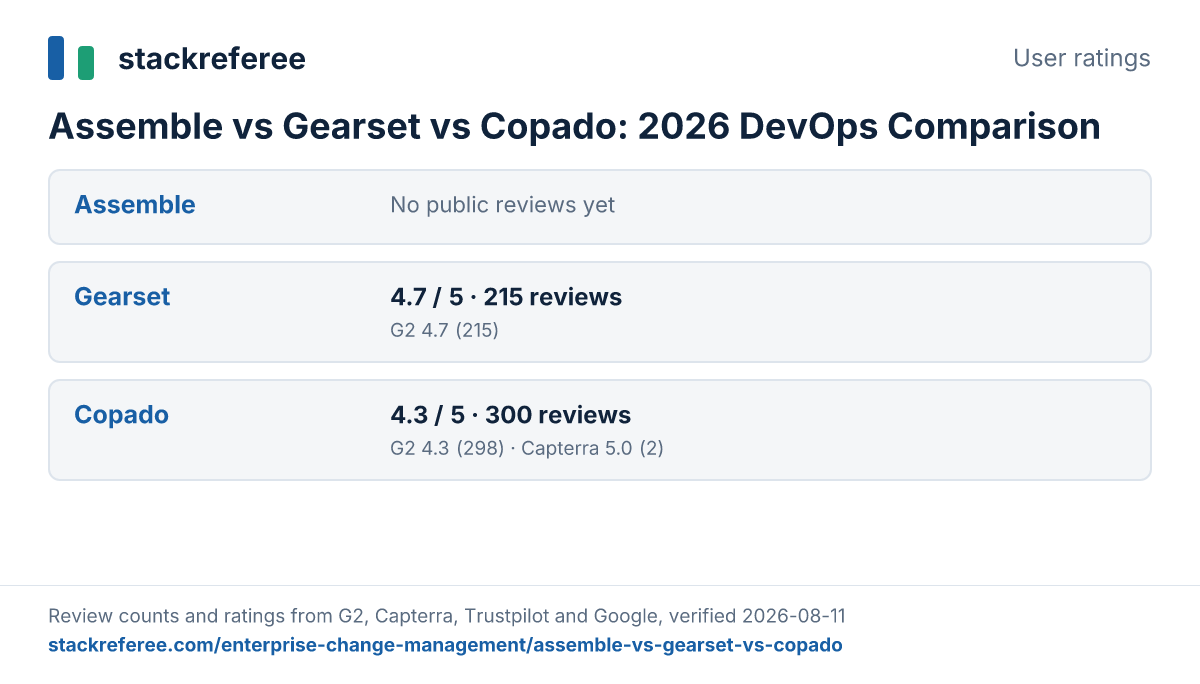
Gearset is a Salesforce DevOps platform built around comparing and deploying metadata between orgs, backed by source control integration and full deployment history. Its product line splits into Core plans (compare/deploy, unlimited production orgs), Automation plans (scheduled change monitoring, CI/CD orgs, unit and UI testing), and standalone add-ons for Backup, Code Reviews, and Observability, which lets teams buy only the capability they currently need rather than one bundled suite. Gearset confirms a broad feature set: version control and rollback, CI/CD pipeline automation, automated testing, full metadata and data backup/restore, dependency and impact analysis, and sandbox seeding with data masking. It documents GDPR alignment and SOC 2 compliance, and its pricing page lists SAML single sign-on under the Enterprise tier only; whether any lower tier supports SSO at all is not independently confirmed, so treat SAML as an Enterprise-conversation item rather than a given. On G2, Gearset holds a 4.7 out of 5 rating across 215 reviews, making it the highest-rated of the three tools with a public review base.
What is Copado
Copado is a Salesforce DevOps platform spanning a free single-user tier through an enterprise offering built on its Agentia AI platform. The Essentials line targets small teams: a permanently free plan, then paid tiers adding unlimited deployments, release pipelines, work items, and Git integration, which gives smaller Salesforce shops a way to grow into more advanced DevOps practices without switching vendors partway through. Its Enterprise tier (Agentia Advanced/Pro) is sold through a "Book a Consultation" process with no published pricing, similar to Gearset's own Enterprise gap. Copado confirms version control and rollback, CI/CD pipeline automation, automated testing, dependency and impact analysis, audit trail governance, and AI agent automation, and it was named as attaining broad security compliance across its products in a 2022 press release. It documents GDPR and SOC 2, and its published SSO documentation covers Okta-based one-click sign-on for Copado Essentials specifically; SAML scope for the main Enterprise/Agentia platform rests on that 2022 press release and is not independently verified. On G2, Copado DevOps rates 4.3 out of 5 across 298 reviews, plus a 5 out of 5 rating from 2 reviews on Capterra, giving it a large but slightly lower-rated review base than Gearset.
Pros and cons
Assemble: pros and cons
Pros
- Reaches beyond Salesforce. Assemble's confirmed multi-system support covers Salesforce, NetSuite, SAP, Oracle, ServiceNow, Workday, HubSpot, and MuleSoft, a scope neither Gearset nor Copado claims. That matters if your change management pain point is spread across more than one system of record rather than concentrated in a single Salesforce org.
- AI agents handle the full change loop. Assemble's model has agents scope, run, and verify changes rather than just automate a deployment step. Combined with confirmed dependency and impact analysis, this targets the planning stage that Salesforce-only tools mostly skip, potentially catching risk earlier in the process.
- Audit trail governance is built in from day one. Even as an early-stage product, Assemble confirms audit trail governance and version control with rollback, giving teams a paper trail without waiting for a later release to bolt one on.
Cons
- No published pricing anywhere. Assemble's site has no pricing page and routes every prospect to a demo request form. Buyers evaluating budget against Gearset's or Copado's published tiers have nothing concrete to compare against yet, which slows down procurement.
- No CI/CD pipeline automation confirmed. Unlike Gearset and Copado, Assemble's feature set does not confirm CI/CD pipeline automation, sandbox seeding and data masking, or full metadata/data backup and restore, three areas both incumbents treat as core.
- No public track record. As a Summer 2026 YC startup, Assemble has no reviews on G2, Capterra, Trustpilot, or TrustRadius, and no documented SOC 2, GDPR, or SSO/SAML compliance. That is expected for its age, but it leaves buyers without third-party validation to lean on.
Gearset: pros and cons
Pros
- Full metadata and data backup/restore is confirmed. Gearset is the only tool of the three that confirms this in its feature matrix, sold as an add-on from $2.75 per Salesforce user/month ($275/month minimum). That closes a gap both Copado and Assemble leave open in their published feature sets.
- Sandbox seeding and data masking are included. This is unique to Gearset among the three tools compared, useful for teams that need realistic but compliant test data in lower sandboxes before deployment, particularly under stricter data-privacy requirements.
- Reviewers call out ease of source-control DevOps. A G2 reviewer described it as making "source control-based SFDC DevOps a breeze," and another called it "an outstanding tool to assist in deploying metadata between Salesforce orgs."
Cons
- Reviewers flag the license cost directly. One G2 dislikes-section comment reads simply "Expensive license." At $215 to $320/user/month for Core plans alone, and $550 to $1,100/team/month for Automation, costs stack fast across a large release team.
- Backup is not in the base plan. A G2 reviewer listed "Data Backup not included in the base plan" as a dislike, confirming it is a paid add-on rather than a built-in capability, even though the feature itself is strong once purchased and budgeted for.
- Salesforce-only scope. Gearset's feature matrix confirms no multi-system support beyond Salesforce, so teams managing change across other enterprise systems need a separate tool alongside it, which adds another vendor relationship to manage.
Copado: pros and cons
Pros
- A genuine free tier exists. Essentials Free is $0/user/month permanently, the only free plan among the three tools, even though it caps usage at 15 deployments or validations per month with no team collaboration.
- CI/CD pipelines paired with an AI platform. Copado confirms CI/CD pipeline automation and AI agent automation through its Agentia platform, with dedicated AI release notes tracking ongoing updates as recently as April 2026, suggesting active investment in that direction.
- Reviewers praise native Salesforce fit. One Capterra reviewer, a Tech Lead, called it "natively built on top of Salesforce, easy to use even administrator can easily manage the Dev operations." A Sr. Salesforce Developer highlighted automatic sandbox-to-production deployment reducing manual work.
Cons
- Setup and learning curve concerns. A G2 reviewer wrote that "the initial setup and learning curve can feel complex for new users, especially for teams that aren't already familiar with DevOps practices," which matters for smaller teams without a dedicated release manager.
- Gaps in backup and sandbox data handling. Copado's feature matrix does not confirm full metadata/data backup and restore, or sandbox seeding and data masking, both of which Gearset confirms outright.
- Cost and edge-case friction at the higher end. One G2 reviewer summarized dislikes as "Destructive changes doesn't really work - For the edge cases you need to have a complicated workaround - Expensive," and a Capterra reviewer separately noted pricing "can be more cheaper when compared to other alternate products."
Use-case comparison
Salesforce-only enterprise release teams needing backup and rollback. If your primary risk is losing metadata or data during a bad deployment, Gearset's confirmed full backup/restore and sandbox data masking cover ground the other two do not. Budget for the add-on cost on top of Core or Automation plans, since Backup and Observability are billed separately from the main platform.
Small or early-stage Salesforce teams testing DevOps discipline. Copado's Essentials Free tier lets a single admin trial real deployment pipelines at $0/user/month before committing budget. Once usage outgrows the 15-deployment cap, Essentials Basic at $99/user/month (annual) is still cheaper than Gearset's entry tier, making Copado the lower-risk starting point for teams new to formal release management.
Enterprises managing change across multiple systems, not just Salesforce. If NetSuite, SAP, ServiceNow, or similar systems are also in scope, Assemble is the only tool here built for that breadth. Weigh that against its lack of published pricing, reviews, and confirmed compliance credentials before committing, and treat an initial engagement as a pilot rather than a full rollout.
Pricing
Assemble pricing
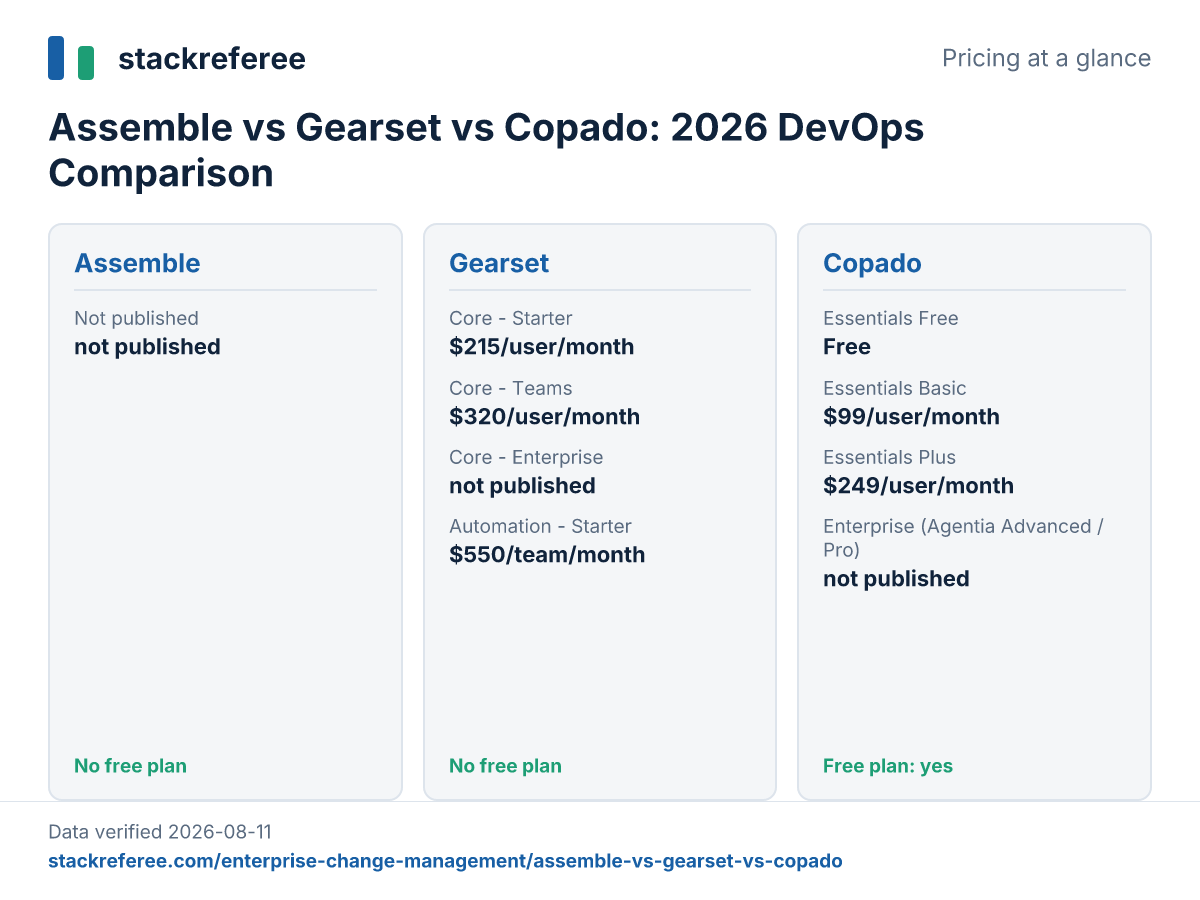
Assemble publishes no pricing tiers. The site directs every prospect to a "Talk to Team" demo request form, with no self-serve plan, no per-user rate, and no published minimum spend. Budget for a sales conversation rather than a self-serve signup, and ask directly how pricing scales with the number of connected systems.
Pricing verified on August 11, 2026
Gearset pricing
| Plan | Price | Notes |
|---|---|---|
| Core Starter | $215/user/month | Compare and deploy metadata, source control integration, full deployment history, unlimited production orgs |
| Core Teams | $320/user/month | Adds scheduled deployments, deployment rollback, RBAC, team-shared connections |
| Core Enterprise | Not published | Contact sales; adds SAML SSO |
| Automation Starter | $550/team/month | 5 change monitoring jobs, 5 CI/CD orgs, unlimited unit testing |
| Automation Teams | $1,100/team/month | 15 change monitoring jobs, 15 CI/CD orgs, UI testing integrations |
| Automation Enterprise | Not published | Contact sales; unlimited jobs/orgs, all features |
| Backup Starter | $2.75/Salesforce user/month | $275/month minimum |
| Code Reviews | $160/individual contributor/month | Add-on product |
| Observability | $1/Salesforce user/month | $100/month minimum |
Gearset's public pricing page does not explicitly split annual versus monthly billing terms for Core and Automation tiers, unlike Copado's published dual rates. Ask a Gearset sales rep directly whether an annual commitment changes the per-user number before signing.
Pricing verified on August 11, 2026
Copado pricing
| Plan | Price | Notes |
|---|---|---|
| Essentials Free | $0/user/month | Forever free; capped at 15 deployments/validations per month, single user, no team collaboration |
| Essentials Basic | $99/user/month (annual) / $119/user/month (monthly) | Unlimited deployments |
| Essentials Plus | $249/user/month (annual) / $289/user/month (monthly) | Adds release pipelines, work items, Git integration, advanced automation |
| Enterprise (Agentia Advanced/Pro) | Not published | "Book a Consultation"; contact sales |
Copado is the only one of the three vendors that publishes both an annual and a monthly rate side by side, which makes budgeting easier for teams comparing multi-year commitments against a month-to-month start.
Pricing verified on August 11, 2026
What users say
Assemble
No public reviews for Assemble were found on G2, Capterra, Trustpilot, TrustRadius, or ProductHunt as of August 11, 2026. That is plausible given how recently the company launched out of Y Combinator's Summer 2026 batch; there is simply no review history to cite yet, and prospective buyers will need to rely on direct demos and reference calls instead of published feedback.
Gearset
"an outstanding tool to assist in deploying metadata between Salesforce orgs"
- long-time user via G2
"makes doing source control-based SFDC DevOps a breeze"
- Salesforce admin/developer via G2
"Expensive license"
- dislikes section via G2
Copado
"Natively built on top of Salesforce, easy to use even administrator can easily manage the Dev operations such as deployments, back-up, setting code quality level."
- Anonymous Tech Lead via Capterra
"The most critical features in Copado are the automatic deployment from sandbox org to production org as per the pipeline and we can less worry about the deployments doing manually."
- Santosh K., Sr Salesforce Developer via Capterra
"One thing I dislike about Copado DevOps is that the initial setup and learning curve can feel complex for new users, especially for teams that aren't already familiar with DevOps practices."
- dislikes section via G2
Verdict per use case
Choose Gearset if full metadata and data backup/restore, sandbox seeding with data masking, or unit and UI test automation are must-haves, and your change management scope is Salesforce-only. Expect to pay $215 to $320/user/month for Core plans, plus separate add-on pricing for Backup, Code Reviews, and Observability, and factor that add-on cost into your total budget from the start rather than discovering it later.
Choose Copado if you want to start at $0/user/month and grow into CI/CD pipelines and release management without switching platforms later, or if an AI-driven Agentia workflow matters to your roadmap. Budget $99 to $249/user/month once you outgrow the free tier's 15-deployment cap, and plan for a real, if manageable, setup and learning curve based on reviewer feedback.
Choose Assemble if your change management problem spans multiple enterprise systems beyond Salesforce, such as NetSuite, SAP, or ServiceNow, and you are comfortable evaluating a Summer 2026 startup without a published price, public reviews, or documented compliance certifications yet. Talk to their sales team to scope a pilot before committing budget, and revisit the vendor's public track record again in six to twelve months as it matures.
Recap table
| Price | Best-fit audience | Core differentiator | |
|---|---|---|---|
| Assemble | Not published (contact sales) | Enterprises managing change across multiple systems (Salesforce + ERP/ITSM) | AI agents that scope, run, and verify change across 8 enterprise systems |
| Gearset | From $215/user/month | Salesforce-only teams needing backup, sandbox masking, and full deployment control | Full metadata + data backup/restore and sandbox seeding in one platform |
| Copado | From $0/user/month | Small teams to enterprise Salesforce orgs wanting a free-to-paid CI/CD ramp | Agentia AI platform with pipelines available from a free tier upward |
This comparison draws only on the sources listed in our research, including each vendor's own pricing and security pages and public reviews on G2 and Capterra. Read our editorial policy for how we handle vendor relationships and disclosure. If compliance automation outside Salesforce is also on your radar, our TrustAI vs Vanta vs Drata vs Secureframe: 2026 guide covers that adjacent category in depth, and our wider Enterprise Change Management comparisons hub tracks other tools worth scoping alongside these three.
Frequently asked questions
Is Assemble a Salesforce DevOps tool like Gearset and Copado?
Not exactly. Assemble is a Y Combinator (Summer 2026) startup that deploys AI agents to scope, run, and verify changes across Salesforce, NetSuite, SAP, Oracle, ServiceNow, Workday, HubSpot, and MuleSoft. Gearset and Copado are Salesforce-specific DevOps pipelines. If your change management spans multiple enterprise systems, Assemble targets a different problem than a Salesforce-only release tool.
How much does Gearset cost compared to Copado?
Gearset's Core Starter plan starts at $215/user/month, rising to $320/user/month for Core Teams, with Automation plans at $550 to $1,100/team/month. Copado starts free with Essentials Free ($0/user/month, capped usage), then $99/user/month for Essentials Basic and $249/user/month for Essentials Plus, both billed annually.
Does Copado have a free plan?
Yes. Copado Essentials Free is $0/user/month, permanently, but it caps you at 15 deployments or validations per month and offers no team collaboration. Neither Gearset nor Assemble publishes a free tier, so Copado is the only option here for testing Salesforce DevOps at zero cost.
Which tool is best for Salesforce metadata backup?
Gearset is the only tool of the three with full metadata and data backup/restore confirmed in its feature set, sold as a separate Backup add-on starting at $2.75 per Salesforce user/month ($275/month minimum). Copado and Assemble do not list full backup/restore as a confirmed capability in their published feature sets.
Is Gearset or Copado better for CI/CD pipelines?
Both confirm CI/CD pipeline automation in their feature sets. Gearset bundles it into Automation plans starting at $550/team/month; Copado includes release pipelines starting at the Essentials Plus tier ($249/user/month annually). Assemble does not list CI/CD pipeline automation as a confirmed feature.
What is the cheapest Salesforce release management tool in 2026?
Copado Essentials Free is the cheapest entry point at $0/user/month, though usage is capped at 15 deployments or validations monthly. For unlimited deployments, Copado Essentials Basic at $99/user/month (annual) undercuts Gearset's Core Starter tier at $215/user/month. Assemble has no published pricing to compare.
Does Assemble support Salesforce, or other systems too?
Assemble's stated scope covers Salesforce alongside NetSuite, SAP, Oracle, ServiceNow, Workday, HubSpot, and MuleSoft. That multi-system reach is Assemble's core differentiator from Gearset and Copado, which are both built specifically for Salesforce metadata and deployments.
Which of these tools has SSO and SOC 2 compliance?
Gearset and Copado both document GDPR alignment and SOC 2. On SSO the picture is less settled: Gearset's pricing page lists SAML only under its Enterprise tier, with lower-tier support unconfirmed, and Copado's SSO documentation covers Okta-based sign-on for Essentials, with SAML scope for its wider platform not independently verified. Assemble has no published SOC 2, GDPR, or SSO/SAML documentation as of this writing.
Comments
No comments yet.