Tesla Optimus vs Figure AI vs OS3: 2026 Comparison
Tesla Optimus vs Figure AI vs OS3 at a glance
| Tesla Optimus | Figure AI | OS3 | |
|---|---|---|---|
| Best for | Buyers betting on Tesla's manufacturing scale and long-run price ambitions | Enterprises that want a robot with a disclosed, already-producing deployment | Early pilot partners comfortable with a 2-person, pre-launch startup |
| Starting price | Not published; $20,000-$30,000 cited by Tesla leadership as a long-run target, not a current price | Not published; B2B contact-sales only | Not published; contact-sales only (hi@os3robotics.com) |
| Free plan / trial | N/A - hardware product, no plan tiers | N/A - hardware product, B2B sales cycle only | N/A - hardware product, no plan tiers |
| Core differentiator | Tesla's in-house manufacturing base and capital | Confirmed tactile sensing, third-party safety certification, live BMW output | YC-backed (S2026) proprietary AI foundation model, unverified elsewhere |
| Compliance signal | Unpublished; general Tesla, Inc. OSHA inspection/violation record exists but isn't Optimus-specific | Unpublished; third-party safety certification confirmed at the product level | Unpublished; no spec sheet available |
| Confirmed commercial deployment | Not confirmed externally as of Q2 2026 | Yes - BMW production, per Figure AI and BMW Group | Yes, per OS3's own site, though the company is pre-launch and 2 people |
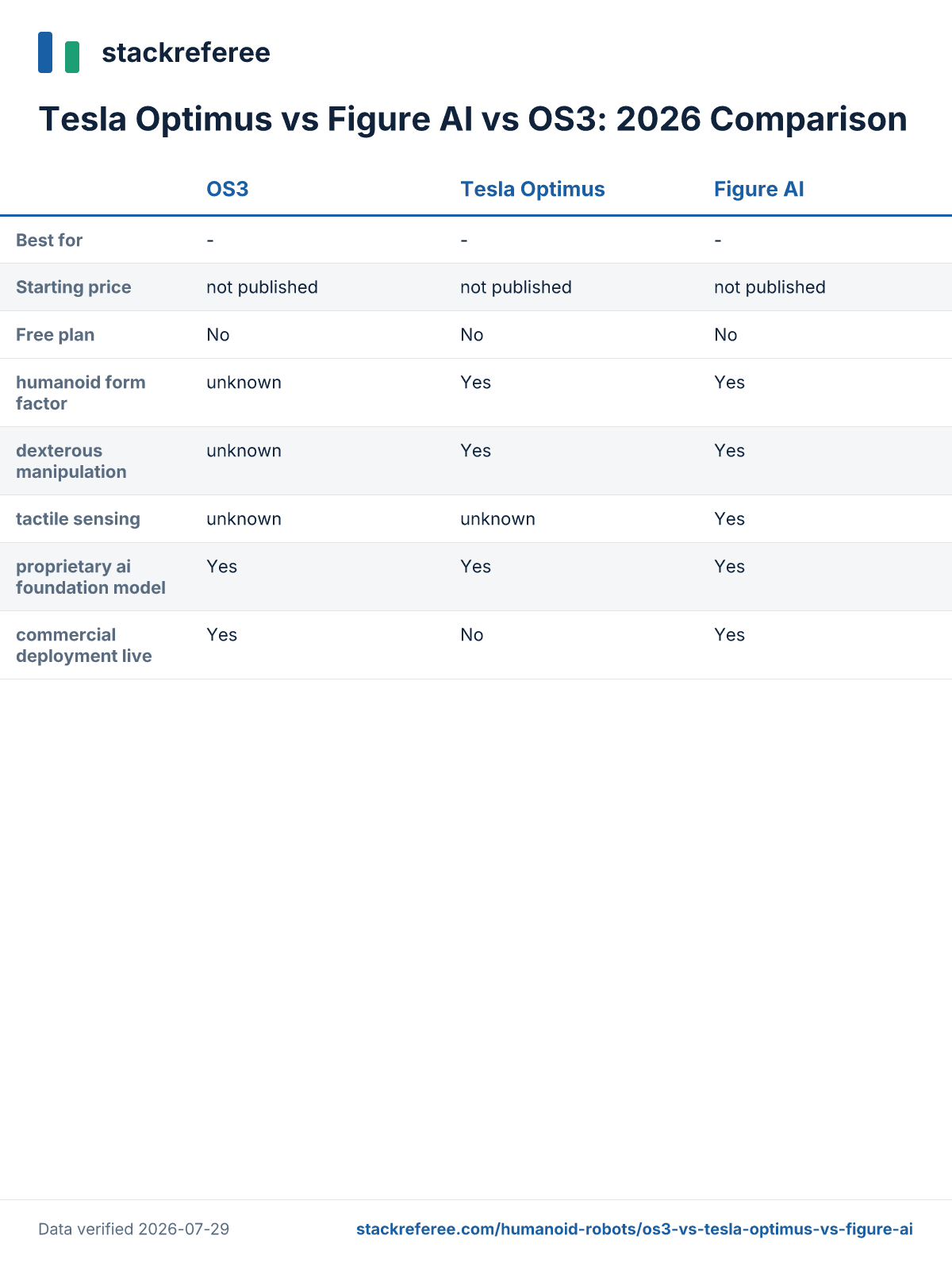
Note on the compliance row: GDPR, SOC 2, and SSO/SAML are software-industry checks that do not map cleanly onto physical humanoid-robot hardware. None of the three companies publish documentation against those specific frameworks, so the table above uses the closest available signal instead: workplace safety and third-party certification status where it was found. That substitution matters if you came to this comparison expecting SaaS-style compliance paperwork; for hardware deployed on a factory floor, safety certification and inspection history are the more relevant proxy, and only Figure AI currently has a confirmed answer on that front.
What is Tesla Optimus
Tesla Optimus is Tesla's humanoid robot program, built on the company's existing manufacturing and AI infrastructure. Tesla's official AI page confirms a humanoid form factor and dexterous manipulation as core capabilities. As of the Q2 2026 earnings call, Tesla had not disclosed an external production count; independent reporting the week of the call noted production remained at zero for outside deployment. Tesla has since reported production starting at the Fremont factory around late July or August 2026, but explicitly for internal "Optimus Academy" training use, not customer-facing deployment. Tesla leadership has repeatedly cited a long-run consumer price target of $20,000 to $30,000 on earnings calls, an aspiration rather than a published price. There is no MSRP, pre-order, or waitlist as of July 29, 2026. Optimus targets buyers who want to bet on Tesla's manufacturing scale ahead of confirmed shipping, and who are comfortable treating the Fremont training milestone as a signal of direction rather than proof of external readiness.
What is Figure AI
Figure AI builds humanoid robots aimed at everyday and industrial work, with Figure 03 as its current generation, introduced via the company's official product news. Figure's feature profile confirms a humanoid form factor, dexterous manipulation, and tactile sensing, plus third-party safety certification, the most complete verified spec set of the three companies compared here. Figure's Helix 02 update, described in the company's own changelog, adds full-body autonomy to the robot's control stack. The company's clearest deployment proof point: its prior-generation F.02 robot contributed to the production of 30,000 cars at BMW, per Figure AI's own reporting, and BMW Group's press materials describe an ongoing Figure 03 project at BMW's Spartanburg plant. Figure sells to commercial customers only; there is no consumer version. For a manufacturing buyer trying to separate marketing language from disclosed output, Figure AI is currently the easiest of the three to cross-check against an independent third party, since BMW itself has confirmed the deployment publicly.
What is OS3
OS3 describes itself as building intelligence and machines for physical labor, and is part of Y Combinator's Summer 2026 batch. Y Combinator's own listing describes the company's robot as semi-humanoid rather than confirming a full bipedal humanoid form. OS3 was founded in 2025 and, per Y Combinator, runs with a 2-person team. The company's own site claims a proprietary AI foundation model and live commercial deployment, though no technical spec sheet, unit pricing, or third-party verification of those claims was available as of this writing. This is a company at a fundamentally different stage than Tesla or Figure AI: a pre-launch startup being weighed against two multi-billion-dollar, mass-manufacturing operations. Treat any OS3 deployment claim as early-stage until independently verified, and expect the company's public information to change quickly as it moves further into its YC batch.
Pros and cons
Tesla Optimus
Backed by Tesla's existing manufacturing base. Tesla's AI page and Q2 2026 earnings materials position Optimus inside a company that already runs car factories at scale, a manufacturing and capital base most humanoid-robot companies don't have. That's an infrastructure advantage, not yet a shipped-unit advantage, and buyers should weigh it as potential rather than proof.
Stated long-run consumer price target of $20,000 to $30,000. Tesla leadership has cited this figure repeatedly on earnings calls. If Tesla hits it, Optimus would undercut every other price point discussed for humanoid robots in this comparison. It remains a target, not a confirmed price or release date, so nobody should budget against it yet.
Confirmed core hardware capability. Per the feature comparison, Optimus has a confirmed humanoid form factor and dexterous manipulation, the baseline mechanical capability buyers expect from a humanoid robot, verified from Tesla's own official materials rather than third-party estimation.
Zero confirmed external deployment as of Q2 2026. Independent reporting the week of the earnings call noted production remained at zero for outside customers. Production that started at Fremont afterward was for internal training use, not commercial delivery, per available reporting, so external buyers have nothing shipped to point to yet.
Unconfirmed tactile sensing and safety certification. Neither capability could be verified from official Tesla sources as of July 29, 2026. Buyers evaluating Optimus for delicate manipulation tasks or regulated environments have no public documentation to check against, which makes procurement conversations harder to close today.
Pricing is entirely unpublished or speculative. The frequently cited $75,000 to $150,000 enterprise estimate is analyst speculation, not a Tesla-confirmed figure. Separately, Tesla, Inc. has an OSHA inspection/violation record on file, though it is not specific to Optimus operations, so it shouldn't be read as a statement about the robot itself.
Figure AI
Live, disclosed production deployment. Figure AI's own reporting states its prior-generation F.02 robot contributed to the production of 30,000 cars at BMW. BMW Group's press materials confirm an ongoing Figure 03 project at the Spartanburg plant, giving Figure the clearest deployment evidence of the three companies here, backed by a named third-party customer.
Most complete verified spec profile. Figure is the only one of the three confirmed for tactile sensing and third-party safety certification, per the feature comparison. For buyers weighing manipulation precision or regulatory readiness, that's a meaningfully different starting point than "unknown," and it shortens the diligence checklist considerably.
Visible, ongoing product iteration. Figure's Helix 02 changelog documents the addition of full-body autonomy to its control stack. A public changelog for a hardware-plus-AI product gives buyers a way to track capability changes over time, rather than relying on marketing announcements alone or waiting for the next big-splash launch post.
No published unit pricing. Figure sells commercially only, through direct sales contact, with no price list. Smaller buyers who want a ballpark figure before engaging a sales team have nothing official to go on, which can slow down early budget conversations considerably.
No consumer or home version. Deployment is restricted to enterprise partners like BMW. Anyone hoping for a household robot from Figure AI has no confirmed product or timeline to point to, and the company's public materials give no signal of when, or whether, that might change.
No independent product reviews found. Figure AI's Trustpilot listing carries no product reviews, and no G2, Capterra, or comparable platform listing with review counts was found. Buyer confidence currently rests on Figure's and BMW's own statements, not independent user feedback, which is worth flagging to any internal stakeholder asking for third-party validation.
OS3
Proprietary AI foundation model with claimed live deployment. OS3's own site claims both a proprietary AI foundation model and a live commercial deployment, an ambitious claim set for a 2-person, pre-launch company, per Y Combinator's listing, and one that deserves direct follow-up questions before signing anything.
Y Combinator-backed (Summer 2026). Acceptance into a YC batch is a form of investor validation for OS3's "intelligence and machines for physical labor" positioning, distinct from unvetted claims made without any outside backing, even if it says nothing about product maturity.
Direct, low-overhead sales contact. OS3 lists a single contact email (hi@os3robotics.com) rather than a formal enterprise sales funnel. For an early pilot customer, that can mean faster, more flexible conversations than a large-company procurement process, though also less formal support infrastructure behind them.
Extreme scale mismatch versus Tesla and Figure AI. OS3 is a 2-person startup founded in 2025, compared against a multi-billion-dollar automaker and a well-funded robotics company with a disclosed manufacturing partner. Any comparison of deployment maturity should account for that gap explicitly rather than treating the three as peers.
No technical spec sheet. Humanoid form factor, dexterous manipulation, tactile sensing, and safety certification are all unverified for OS3 as of this writing. Y Combinator's own listing describes the robot as semi-humanoid, not confirmed fully bipedal, which is a meaningfully different claim than what Tesla and Figure AI make.
No pricing information at all. Unlike Tesla and Figure AI, which at least have third-party price estimates circulating, OS3 has no public number, range, or estimate of any kind, only a contact email, which makes early budgeting conversations entirely dependent on a direct sales call.
Use-case comparison
Automotive and industrial production lines. Figure AI is the only one of the three with a disclosed, producing deployment: its prior-generation robot contributed to 30,000 BMW vehicles, and a Figure 03 project is underway at BMW Spartanburg. If your use case is a manufacturing floor today, Figure AI has the paper trail to back that up; Tesla Optimus and OS3 don't yet.
Enterprises open to ground-floor pilot partnerships. OS3's YC backing and direct sales contact could suit a buyer who wants to shape a product early and accepts the risk of a 2-person, pre-launch vendor. This is not a fit for anyone requiring verified specs, safety certification, or a track record; none of those exist yet for OS3, so plan your pilot scope around discovery, not immediate production output.
Buyers waiting for a household or consumer humanoid robot. None of the three has a confirmed consumer version. Tesla's stated $20,000 to $30,000 long-run target is the most aggressive price signal of the three, but it comes with no confirmed release date. Figure AI and OS3 have not stated a consumer timeline at all, so anyone shopping specifically for home use should treat 2026 as too early for any of these three, regardless of marketing chatter elsewhere online.
Whichever segment you're in, check the vendor's own most recent public statement before budgeting around any of these figures; all three companies' public positions were still shifting as of July 2026, and a number that was accurate in Q1 may already be outdated by the time you read this.
Pricing
Tesla Optimus pricing
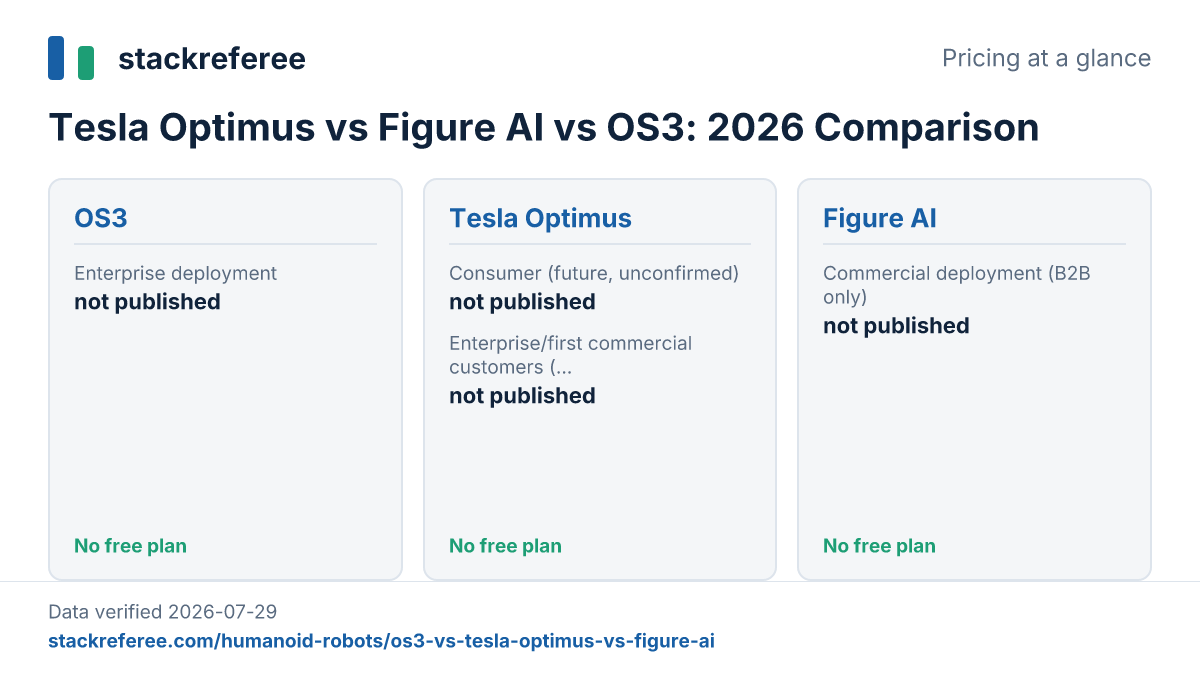
Tesla has not published an MSRP, pre-order price, or waitlist for Optimus as of July 29, 2026. Two figures circulate, and it's worth keeping them separate in any internal budgeting document:
- Consumer (future, unconfirmed): Not published. Tesla leadership has repeatedly cited a long-run target of $20,000 to $30,000 per unit on earnings calls, a stated aspiration, not a shipping price.
- Enterprise/first commercial customers (estimated): Not published. Third-party analyst estimates of $75,000 to $150,000 per unit circulate for early commercial units. Tesla has not officially confirmed this figure.
Pricing verified on July 29, 2026.
Figure AI pricing
Figure AI sells to commercial customers only, with BMW as its disclosed deployment partner. There is a single named tier, and it carries no public number attached:
- Commercial deployment (B2B only): Not published; contact sales. Widely circulated consumer figures such as $20,000 or $30,000 to $50,000 are third-party estimates with no traceable primary source on figure.ai.
Pricing verified on July 29, 2026.
OS3 pricing
OS3 has no public pricing page of any kind, which is consistent with its pre-launch stage:
- Enterprise deployment: Not published; contact sales at hi@os3robotics.com. As a pre-launch YC (Summer 2026) startup, OS3 lists no plan tiers or unit pricing anywhere on its site.
Pricing verified on July 29, 2026.
If you're budgeting for any of these three, treat every number above as directional at best; none of them is a confirmed, published list price today, and the gap between "cited target" and "confirmed price" is exactly where a lot of humanoid-robot marketing gets ahead of the underlying facts.
What users say
This is the one section where honesty means saying less, not more. No G2, Capterra, Trustpilot, GetApp, or ProductHunt listing with a review count or rating exists for Tesla Optimus, Figure AI, or OS3. Figure AI's Trustpilot listing carries no product reviews. Tesla's Trustpilot listing covers vehicles and dealership service, not Optimus specifically. No independently sourced, literally quotable customer or reviewer statement was found for any of the three companies, expected given their hardware and B2B-pilot nature, and OS3's pre-launch status. BMW Group's press materials about Figure 02 and Figure 03 contain company statements, not independent reviewer quotes, so they aren't presented here as user feedback.
If independent user reviews matter to your buying process, that data doesn't exist yet for any of these three; you'll be relying on vendor and partner statements alone for now. That's a meaningfully different diligence process than evaluating SaaS tools with thousands of G2 reviews behind them, and it's worth setting that expectation with any stakeholder involved in the purchase decision before the conversation goes further.
Verdict by use case
Choose Tesla Optimus if you're evaluating a longer-term bet on manufacturing scale and a stated (not yet confirmed) low consumer price target, and you can tolerate zero confirmed external deployment today.
Choose Figure AI if you need the most evidence-backed option available now: a disclosed production deployment at BMW, confirmed tactile sensing, and third-party safety certification, with the tradeoff of unpublished, contact-sales-only pricing and no consumer version.
Choose OS3 if you're an early-stage pilot partner willing to work with a 2-person, pre-launch, YC-backed startup and want a direct line to its founders, while accepting that no spec sheet, certification, or pricing exists yet to verify its claims.
None of the three is the obvious pick for a household buyer in 2026; that use case isn't served yet by any of them, and any vendor implying otherwise is getting ahead of its own public disclosures.
Recap table
| Price | Best for | Core differentiator | |
|---|---|---|---|
| Tesla Optimus | Not published; $20,000-$30,000 cited as a long-run target | Buyers betting on Tesla's manufacturing scale | In-house manufacturing base plus stated long-run price target |
| Figure AI | Not published; B2B contact-sales only | Enterprises wanting a live, disclosed deployment | Confirmed tactile sensing, safety certification, and BMW production output |
| OS3 | Not published; contact-sales only | Early pilot partners open to pre-launch startups | YC-backed proprietary AI foundation model, unverified elsewhere |
For more comparisons in this category, see our Humanoid Robots comparisons hub, and check our editorial policy for how we verify vendor claims like the ones in this article. If your evaluation also touches the compute side of physical AI, our NVIDIA vs AMD vs Baud: Data Center AI Chip Comparison 2026 guide covers the chip layer these robots' AI foundation models run on. And if part of your due diligence extends to the software and fleet-management tooling that will eventually sit alongside a humanoid robot deployment, our Skydio vs DroneDeploy vs Degla Inc: 2026 Comparison covers a related fleet-operations category worth cross-referencing before you commit budget to any physical-AI hardware vendor.
Frequently asked questions
Is Tesla Optimus in production yet in 2026?
Not for external customers. Tesla's Q2 2026 earnings call and independent reporting indicate production at the Fremont factory started around late July or August 2026, but for internal 'Optimus Academy' training use only. No external commercial deployment or consumer unit has been confirmed by Tesla as of July 29, 2026. Independent reporting the week of the earnings call had explicitly noted the external production count still sat at zero, so treat the Fremont ramp as a training milestone, not a shipping event.
How much does Figure AI's robot cost?
Figure AI has not published a unit price. It sells only to commercial customers like BMW through direct sales contact, not a public price list. Figures like $20,000 or $30,000 to $50,000 that circulate online are third-party estimates with no traceable source on figure.ai. Anyone quoting a firm number for a Figure robot today is speculating, not citing an official Figure AI source.
What is OS3 robotics?
OS3 is a Y Combinator Summer 2026 startup, founded in 2025, building AI and machines for physical labor. Y Combinator lists its robot as semi-humanoid. It is a 2-person, pre-launch company with no public technical spec sheet or pricing page as of this writing, so most of its product claims still rest on the company's own site rather than independent verification.
Does Figure AI sell to consumers?
No. Figure AI's commercial deployment is B2B only, with BMW as its disclosed production partner. There is no confirmed consumer or home version of Figure's robots available, and no published release date for one. Anyone shopping for a household robot from Figure AI in 2026 has no product or waitlist to look at yet.
What is the difference between Tesla Optimus and Figure 03?
Figure 03 has a confirmed live production deployment at BMW and third-party safety certification, per Figure AI's own materials. Tesla Optimus has confirmed dexterous manipulation and a humanoid form factor, but no confirmed external commercial deployment or safety certification as of July 2026. Figure AI is further along on evidence; Tesla is further along on manufacturing scale and capital.
Is there a humanoid robot available for home use in 2026?
No. None of Tesla Optimus, Figure AI's robots, or OS3 has a confirmed consumer or home version available as of July 29, 2026. Tesla has cited a long-run consumer price target, but this is a stated goal, not a shipping product or confirmed release date. Budget around none of these figures until a vendor publishes an actual price and ship date.
Which humanoid robot company has third-party safety certification?
Figure AI is the only one of the three with confirmed third-party safety certification, per its published feature information. Third-party safety certification status for Tesla Optimus and OS3 could not be verified from public sources as of July 29, 2026, which matters if your use case sits inside a regulated or shared-floor work environment.
Is OS3 a real competitor to Tesla and Figure AI?
OS3 is a real, YC-backed startup, but it is a 2-person, pre-launch company founded in 2025. Tesla and Figure AI are multi-billion-dollar operations with disclosed manufacturing partners. Treat any direct comparison of scale or deployment maturity with that gap in mind, and weigh OS3 as an early-stage bet rather than an apples-to-apples alternative.
Comments
No comments yet.