Hemlock vs Manus vs Xsens: Motion Capture Gloves 2026
Shopping for motion capture gloves in 2026 means wading through hardware that looks similar on a spec sheet but solves different problems. Manus and Xsens both sell finger-tracking gloves that plug into VR and animation pipelines. Hemlock doesn't sell a glove at all, it sells a wrist-worn sensor aimed at a narrower robotics use case, and conflating the three risks buying the wrong device for your project. Here's what the published record actually supports for each, including where that record runs out.
Before you commit budget, it's worth checking our editorial policy so you know how this comparison was put together and where our incentives sit.
Comparison at a glance
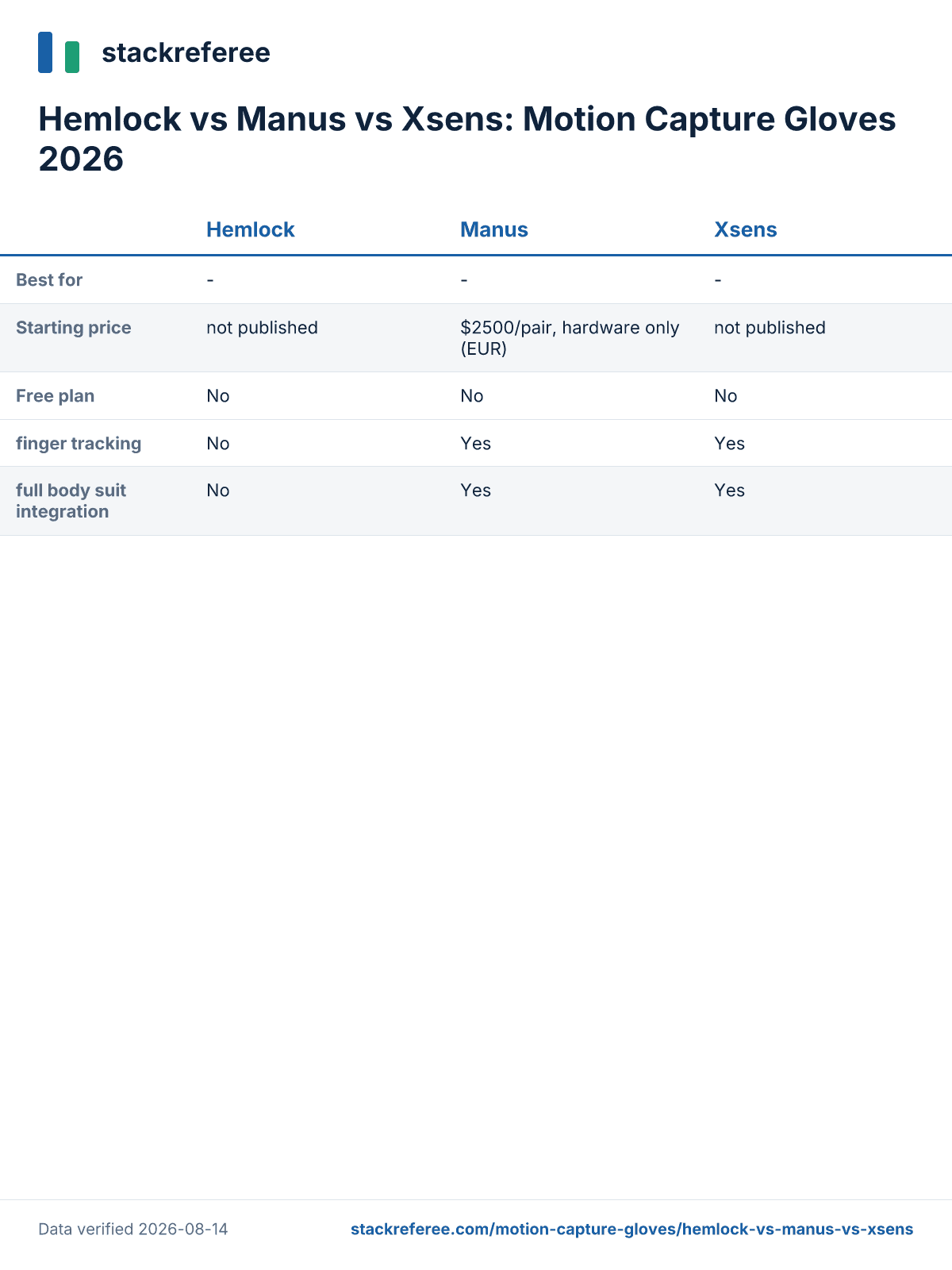
| Hemlock | Manus | Xsens | |
|---|---|---|---|
| Best for | Robotics/embodied-AI teams collecting muscle-activity data (beta) | VR studios and robotics teams needing finger tracking plus haptic feedback | Teams already running Xsens MVN Animate/Analyze who need finger tracking added |
| Starting price | Not published (beta signup only) | €2,500/pair (Quantum Metagloves, hardware only) | Not published (contact sales) |
| Free plan | No free plan (hardware) | No free plan (hardware) | No free plan (hardware) |
| Core differentiator | Wrist EMG/force sensing for robotics training data, not hand tracking | Drift-free finger tracking with haptic feedback and a robotics SDK, standalone or suit-integrated | Manus-made gloves bundled into the Xsens MVN body-suit ecosystem |
| Compliance (GDPR/SOC 2) | Unknown / Unknown | GDPR yes / SOC 2 unknown | GDPR yes (per Movella privacy policy) / SOC 2 unknown |
| SSO/SAML | Unknown (not applicable to hardware) | Unknown (not applicable to hardware) | Unknown (not applicable to hardware) |
What is Hemlock
Hemlock markets itself as "Muscle Memory For Machines" and its product is the Bracelet, a wrist-worn device that uses EMG and force sensing rather than finger-joint tracking. It's built to capture human movement data for training robotics and embodied-AI systems, not to reproduce hand poses in a VR headset or animation rig. That distinction matters more than it sounds: a glove reconstructs joint angles so a character or robot hand can mimic a pose, while an EMG wristband records the electrical signal your muscles send before the movement even happens, a different data type aimed at a different downstream model.
As of August 14, 2026, the Bracelet is in a limited beta signup with no public pricing, plans, or published compliance documentation. That makes Hemlock structurally different from Manus and Xsens: it has no finger-tracking, haptic-feedback, or full-body-suit-integration capability listed, but it does share one thing with Manus, a stated focus on robotics training data pipelines. Treat it as an early-stage alternative to a glove-based approach, not a like-for-like substitute, and expect to wait on a sales conversation or beta invite before any commercial terms exist.
What is Manus
Manus sells data gloves aimed at robotics, VR, and motion capture, positioning its hardware as high-precision finger tracking that works standalone or as part of a larger mocap rig. Its current catalog spans the Metagloves Pro, an haptic-feedback variant, and the lower-cost Quantum Metagloves, all sold as hardware with software and SDK licensing handled separately. The published feature set covers finger tracking, wireless operation, drift-free absolute tracking, VR engine integration, a swappable battery, full-body suit integration, and a robotics training data SDK, the broadest published list of the three tools here.
Manus also publishes an official Xsens integration path, and its privacy statement addresses GDPR. It's the most fully specified hardware line in this comparison, provided you can pin down which price applies to your order, since the homepage figure, the quote-only product page, and a US reseller's listing don't agree. Buyers evaluating Manus for a production pipeline should treat the published €4,500 and €2,500 figures as a starting reference point for a sales conversation rather than a final invoice number.
What is Xsens
Xsens is best known for its MVN Animate and Analyze motion capture suits, and its glove offering, marketed as Xsens Metagloves by Manus, is built by Manus under an official partnership rather than manufactured in-house. The published feature list mirrors Manus's core kinematic capabilities: finger tracking, wireless operation, drift-free absolute tracking, VR engine integration, a swappable battery, and full-body suit integration.
Xsens directs buyers to its sales team for pricing rather than listing figures on its site, and a support article walks customers through pairing the Metagloves Pro by Manus with Xsens MVN software, evidence that this is a maintained, documented partnership rather than a one-off bundle. The practical read is that you're evaluating the Xsens software ecosystem and support relationship more than a distinct piece of hand-tracking hardware, since the gloves themselves come from Manus either way. If your existing capture pipeline is already built around MVN, that ecosystem lock-in is likely a feature, not a drawback.
Sensing approach: EMG versus kinematic tracking
It's worth pausing on why these three products are hard to line up feature-for-feature. Manus and Xsens both use finger-joint kinematic tracking, an approach built to answer "what pose is the hand in right now," which is exactly the question a VR avatar or an animated character needs answered many times per second. Hemlock's EMG and force sensing at the wrist answers a different question: what muscle activation pattern preceded a movement, which is closer to what a robotics model needs when it's learning to reproduce a motion rather than simply display one.
That difference is why several feature_matrix categories, like wireless operation or VR-engine integration, simply don't have a confirmed answer for Hemlock in the published record. It's not a gap in Hemlock's marketing, it's a mismatch between the categories that make sense for a glove and the categories that make sense for a wrist-worn EMG sensor. If your buying criteria are built around "does it track fingers," Hemlock will fail every one of them by design, not by shortfall. If your criteria are built around "does it capture the muscle signal behind a motion for robot training," it's the only one of the three built for that question specifically.
Pros and cons
Hemlock
Purpose-built for robotics training data. Hemlock's feature set flags a dedicated robotics training data SDK, the same category Manus targets, giving it a narrow but clear use case in embodied-AI data collection rather than general VR or animation work.
Wrist-worn form factor. The product site describes the Bracelet as a wrist-worn device rather than an instrumented glove, which may suit data-collection workflows where a lighter, less encumbering wearable is preferable to a full glove.
Clear positioning. The "Muscle Memory For Machines" framing signals a specific bet on machine-learning-from-movement rather than trying to compete as a general-purpose VR or mocap glove, which helps buyers self-select quickly.
No finger tracking or haptic feedback. The feature matrix lists finger tracking, haptic feedback, and full-body suit integration as all absent, meaning Hemlock can't substitute for a glove anywhere hand-pose fidelity or suit integration matters.
No published pricing or plans. The Bracelet is in a beta signup as of this writing, with no commercial tiers, so there's nothing concrete to budget against or compare to Manus's list prices.
No reviews or customer record. Nothing on major review platforms or elsewhere documents real-world performance, so any claim about accuracy or reliability would be unverifiable at this stage.
Manus
The broadest published feature set. Finger tracking, wireless operation, drift-free absolute tracking, haptic feedback, VR engine integration, a swappable battery, full-body suit integration, and a robotics SDK are all listed for Manus, more than either competitor.
GDPR-documented privacy statement. Manus publishes a privacy statement addressing GDPR, giving EU-based buyers at least a documented starting point for a data-protection review before purchase.
Tiered hardware options. Choosing between Metagloves Pro (€4,500/pair), the haptic variant (€4,500/pair), and Quantum Metagloves (€2,500/pair) lets buyers trade features for budget within one product line.
Inconsistent pricing across channels. The homepage lists €4,500 for Metagloves Pro, the dedicated product page requires a quote instead, and a US reseller lists the same hardware at $6,315, well above a straight currency conversion.
No published SOC 2 status. Enterprise buyers who need compliance documentation beyond privacy policy language get no public answer either way from Manus's materials.
Software and SDK sold separately. Hardware-only pricing means the total cost of a working setup extends beyond the sticker price once licensing is added.
Xsens
Kinematic feature parity with Manus. Because the gloves are Manus-made, Xsens ships the same core capabilities: finger tracking, wireless operation, drift-free absolute tracking, VR engine integration, and a swappable battery.
Documented integration path. Xsens publishes a support article walking through setting up the Metagloves Pro by Manus with Xsens software, evidence of an official, maintained partnership rather than an ad hoc bridge.
Established body-suit ecosystem. Buyers get finger tracking layered onto MVN Animate or Analyze rather than having to stitch a separate glove vendor into an existing full-body pipeline themselves.
No published pricing anywhere. Xsens directs every buyer to a sales conversation with no list price to anchor a budget against, unlike Manus which at least publishes homepage figures.
No haptic feedback listed. Unlike the Manus Metagloves Pro Haptic, Xsens's published feature set for its Manus-made gloves doesn't include haptic feedback.
No robotics training data SDK flagged. Xsens's feature matrix doesn't list a robotics-specific SDK the way Manus and Hemlock do, reflecting its focus on animation and analysis workflows over robotics data pipelines.
Use-case comparison
Robotics and embodied-AI training data teams. If your project is about capturing human movement to train a model or a machine, not to animate a character, compare Manus's robotics SDK against Hemlock's beta program directly. Manus has a shipping, priced product with a documented SDK; Hemlock is earlier-stage and wrist-based rather than hand-based, so it fits teams specifically interested in EMG/force data rather than finger kinematics. Teams with a hard deadline should lean Manus; teams with room to pilot an emerging sensing approach might get more relevant data from Hemlock's EMG signal.
VR studios and standalone mocap buyers. If you need finger tracking with haptic feedback and don't already own a body-suit ecosystem, Manus is the more complete standalone option based on the published feature list, provided you nail down the real price through a direct quote given the homepage-versus-reseller discrepancy. Budget for a sales call before you budget a dollar figure.
Existing Xsens MVN customers. If you already run Xsens MVN Animate or Analyze for full-body capture, adding Xsens Metagloves by Manus keeps you inside one support relationship and one documented setup path, even though you'll pay for that convenience through a sales conversation rather than a list price. Studios standardizing on one vendor relationship for support and firmware updates will find that consolidation worth the pricing opacity.
Match the use case first, then the hardware. A glove that scores well on paper is the wrong purchase if your actual need is wrist-level training data, or vice versa.
Pricing
Hemlock pricing
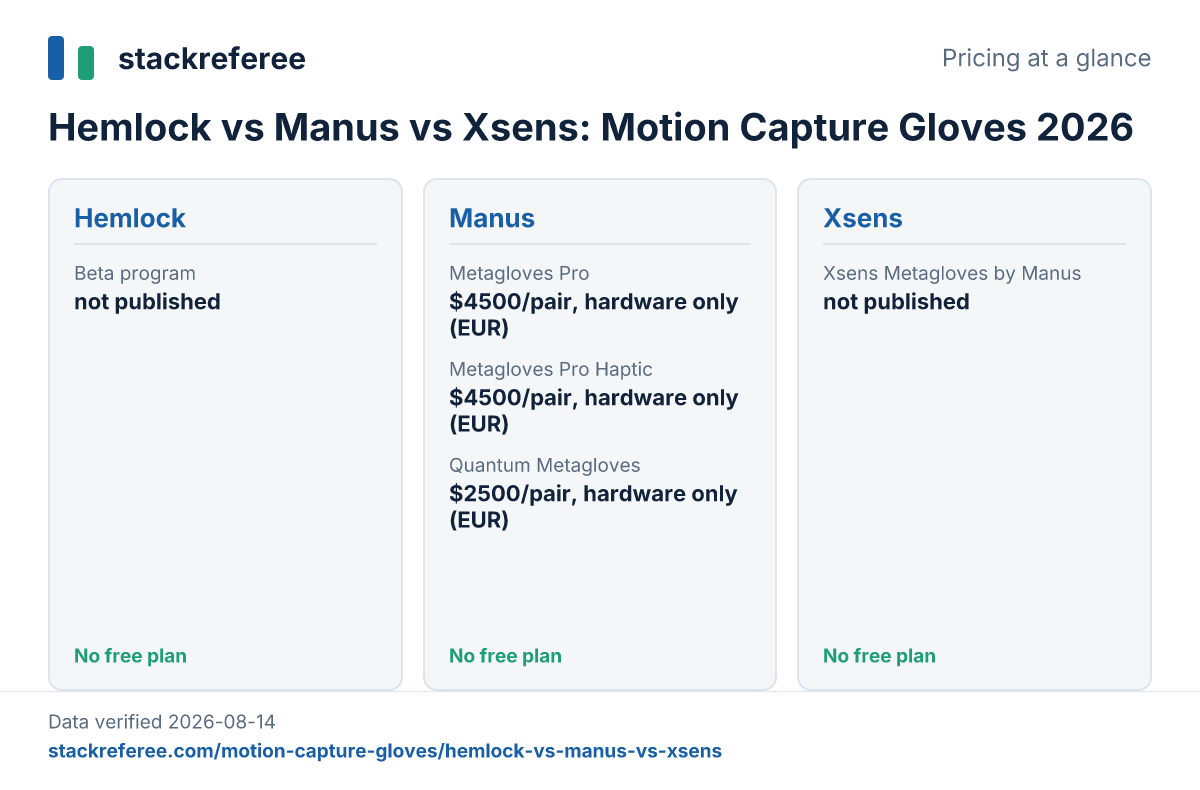
Hemlock has not published any commercial plans, tiers, or prices. The Bracelet is available only through a beta program signup on the product site, with no published cost to reference. Anyone budgeting around Hemlock right now should treat it as a pilot conversation, not a line item. Pricing verified on August 14, 2026.
Manus pricing
| Plan | Price | Notes |
|---|---|---|
| Metagloves Pro | €4,500/pair (hardware only) | Listed on the manus-meta.com homepage lineup; the dedicated product page requires a quote instead. A US reseller (Knoxlabs) lists the same hardware at $6,315, unconfirmed as official MSRP. |
| Metagloves Pro Haptic | €4,500/pair (hardware only) | Adds a tactile/haptic feedback module to the Pro line. |
| Quantum Metagloves | €2,500/pair (hardware only) | Current-catalog model. Distinct from a 2022 hardware revision of the same name that launched at $9,000 and is now discontinued/sold out through resellers. |
Software and SDK licenses are sold separately from the hardware in all three cases, so a working deployment costs more than the hardware line alone. Pricing verified on August 14, 2026.
Xsens pricing
Xsens does not publish a list price for Metagloves by Manus; the product page routes buyers to a sales team for a configured quote. Third-party integrator listings put the related Xsens MVN Animate Pro body-suit software at roughly $3,500 to $5,000 per year, but that figure is unconfirmed on official Xsens pricing pages and describes the suit software, not the glove hardware itself. Don't use that figure as a glove-hardware estimate; ask sales for a line-itemized quote instead. Pricing verified on August 14, 2026.
What users say
We looked for verified customer quotes on G2, Capterra, GetApp, ProductHunt, Trustpilot, and Google reviews for all three tools. None turned up usable, verbatim, attributable quotes.
Hemlock: as a pre-launch beta product, Hemlock has no reviews, customers, or case studies on any platform we checked. There's simply no public record yet to draw from.
Manus: no listings on G2, Capterra, GetApp, or ProductHunt were found for the Manus glove hardware. A search snippet referenced a critical Trustpilot review on the manus-meta.com domain from November 2022 about calibration accuracy and pricing, but the page itself returned an access error on direct fetch, so the text couldn't be verified and isn't quoted here. Separately, note that Trustpilot listings under "manus.im" belong to an unrelated AI-agent product with no connection to these motion-capture gloves; don't mistake that data for this Manus.
Xsens: no listings on G2, Capterra, GetApp, or ProductHunt were found for Xsens's glove hardware either. This professional mocap-hardware category appears largely uncovered by mainstream B2B software review sites.
If public reviews matter to your due diligence, ask each vendor directly for reference customers or case studies before ordering hardware at this price point; none of the three have a public review trail to lean on yet.
Verdict per use case
Choose Manus if you need finger tracking with haptic feedback and a robotics SDK in one line, and you're prepared to confirm the exact price through a direct quote rather than trusting the homepage figure alone.
Choose Xsens if you're already running Xsens MVN Animate or Analyze and want finger tracking folded into that existing pipeline and support relationship, accepting that you'll need a sales call for pricing.
Choose Hemlock if your actual need is wrist-level EMG or force data for robotics/embodied-AI training rather than finger-pose motion capture, and you're comfortable joining a beta program with no published pricing or track record yet.
None of the three is a universal winner. The right pick depends on whether you need hand kinematics at all, and how much risk you can absorb on an unproven beta product versus an established but pricing-inconsistent hardware line. When in doubt, start with the sensing question, EMG versus kinematic, before you compare a single spec sheet.
Recap
| Hemlock | Manus | Xsens | |
|---|---|---|---|
| Price | Not published (beta) | €2,500-€4,500/pair (hardware only) | Not published (contact sales) |
| Best-fit audience | Robotics/embodied-AI teams evaluating wrist EMG data collection | VR studios and robotics teams needing standalone finger tracking | Studios already on Xsens MVN adding finger tracking |
| Core differentiator | Wrist-worn EMG/force sensing, not hand tracking | Broadest published feature set, including haptic feedback and a robotics SDK | Manus-made gloves inside the Xsens MVN software ecosystem |
For more hardware in this space, browse our full set of Motion Capture Gloves comparisons. If your evaluation extends into the broader embodied-AI and robotics training stack, our NVIDIA vs AMD vs Baud data center AI chip comparison covers the compute side of that pipeline. And if you're building out a wider AI-agent evaluation alongside hardware procurement, see how buyers approach adjacent decisions in our compliance automation guide covering TrustAI, Vanta, Drata, and Secureframe.
Frequently asked questions
Is Hemlock a motion capture glove?
No. Hemlock makes the Bracelet, a wrist-worn EMG and force-sensing device for collecting muscle-movement training data for robotics and embodied AI. It does not do finger-level hand tracking the way Manus or Xsens gloves do, and it has no haptic feedback or full-body suit integration. As of August 2026 it's in a limited beta with no public pricing.
How much do Manus Metagloves cost?
Manus lists Metagloves Pro and Metagloves Pro Haptic at €4,500 per pair, and the legacy Quantum Metagloves at €2,500 per pair, both hardware only. These are homepage list prices; the dedicated product pages require a sales quote instead, and a US reseller lists the Pro model at $6,315, so confirm the exact figure with sales before budgeting.
Are Xsens gloves made by Manus?
Yes. The product sold as Xsens Metagloves by Manus is manufactured by Manus under an official partnership and marketed as the finger-tracking add-on for Xsens MVN Animate and Analyze. The underlying glove hardware is the same as Manus sells directly; the difference is the software ecosystem it plugs into.
Which motion capture glove is best for robotics training data?
Manus is the only one of the three with both a published robotics training data SDK and full finger tracking. Hemlock also targets robotics training data but through wrist EMG rather than hand tracking, and it's still in beta with no SDK pricing or customer record yet.
Does Manus support haptic feedback?
Yes, through the Metagloves Pro Haptic variant, listed at €4,500 per pair alongside the standard Metagloves Pro. Xsens Metagloves by Manus and Hemlock's Bracelet are not listed with haptic feedback in their published feature sets.
Is Xsens GDPR compliant?
Manus publishes a privacy statement addressing GDPR. For Xsens, parent company Movella's privacy policy (hosted on xsens.com) explicitly references the GDPR, so both established vendors document a GDPR-aware privacy posture. Neither company publishes a SOC 2 report, and Hemlock's compliance posture is undocumented since it's still pre-launch.
What is the difference between Manus Metagloves Pro and Quantum Metagloves?
Metagloves Pro (€4,500/pair) is the current flagship, also available with haptic feedback. Quantum Metagloves (€2,500/pair) is a lower-cost current-catalog model, distinct from a discontinued 2022 hardware revision of the same name that launched at $9,000 and is now sold out through resellers.
Can I use Manus gloves with Xsens software?
Yes. Xsens publishes a setup guide for running the Metagloves Pro by Manus with Xsens MVN software, and Manus separately documents an Xsens integration on its own site. The two companies have an official partnership rather than an unofficial workaround.
Comments
No comments yet.