Talos vs GE Vernova vs Vaisala: 2026 Transformer Guide
Choosing a transformer condition monitoring system usually comes down to one question first: do you want oil chemistry data or sensor-based mechanical and electrical signals? That single decision splits Talos, GE Vernova, and Vaisala into two camps before you even get to pricing or compliance. Get the installation method wrong for your asset fleet and you end up retrofitting hardware twice. This guide compares all three against the same 16-point feature checklist so you can see exactly where each one fits, and where the public record runs out. For the full set of vendors we track in this category, see our Transformer Condition Monitoring comparisons hub.
In short: Talos is strongest for non-invasive, sensor-based monitoring of transformers and motors, with 3D fault localization and a machine-specific ML baseline, but publishes no dissolved gas analysis capability or compliance certifications. GE Vernova is strongest for utilities that need full dissolved gas analysis plus bushing, partial discharge, and OLTC monitoring on one platform, backed by IEC 62443-2-4 certification and SSO/SAML support. Vaisala sits between the two on gas analysis depth and adds air leak detection that neither competitor offers, with ISO 27001 certification but fewer published cybersecurity specifics than GE Vernova. None of the three publishes list pricing.
Compare at a glance
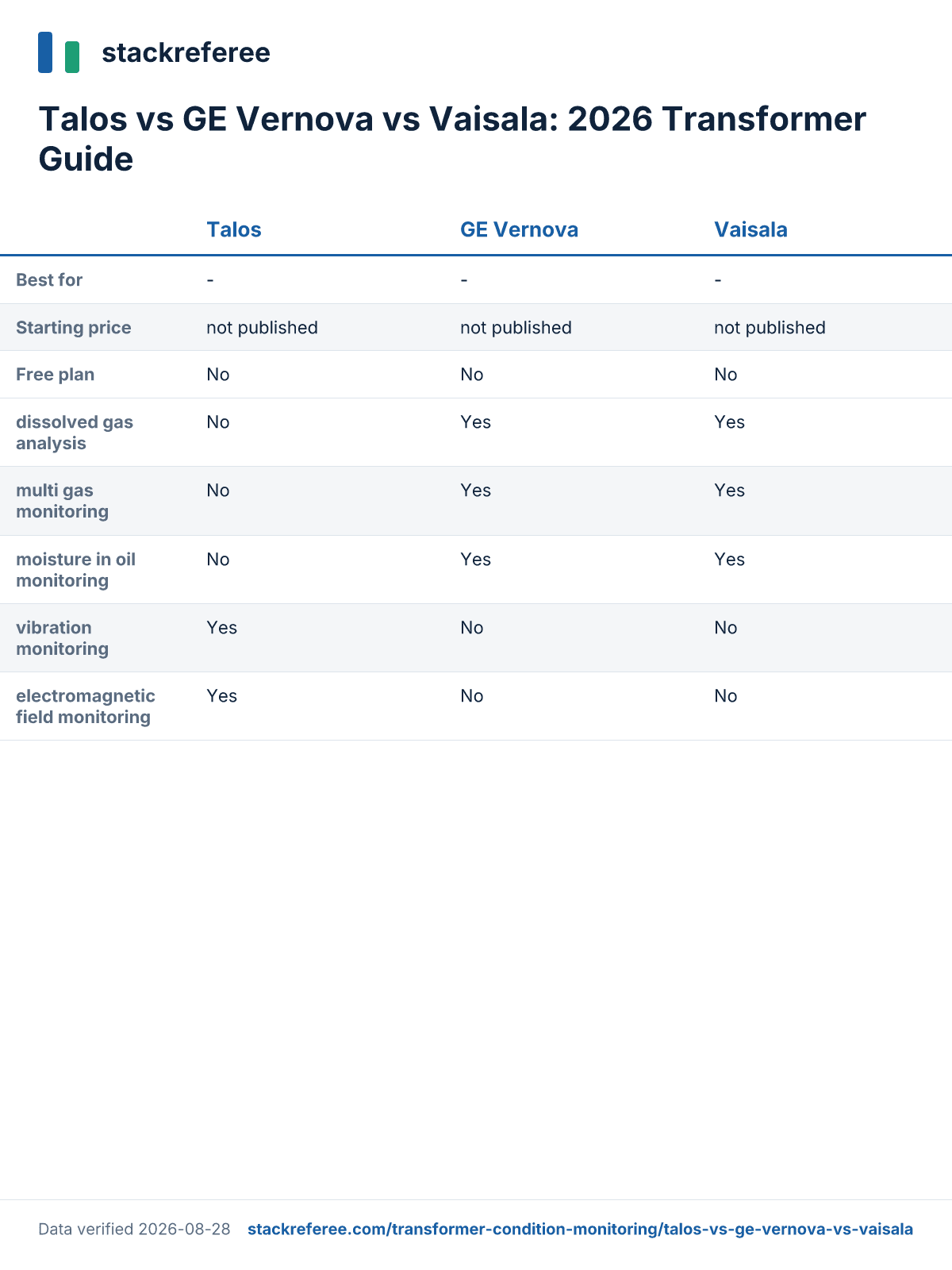
| Talos | GE Vernova (Kelman DGA 900 PLUS) | Vaisala (Optimus OPT100) | |
|---|---|---|---|
| Best for | Non-invasive sensor monitoring of transformers and motors | Full DGA plus bushing/PD/OLTC add-ons for large fleets | DGA and moisture monitoring with air leak detection |
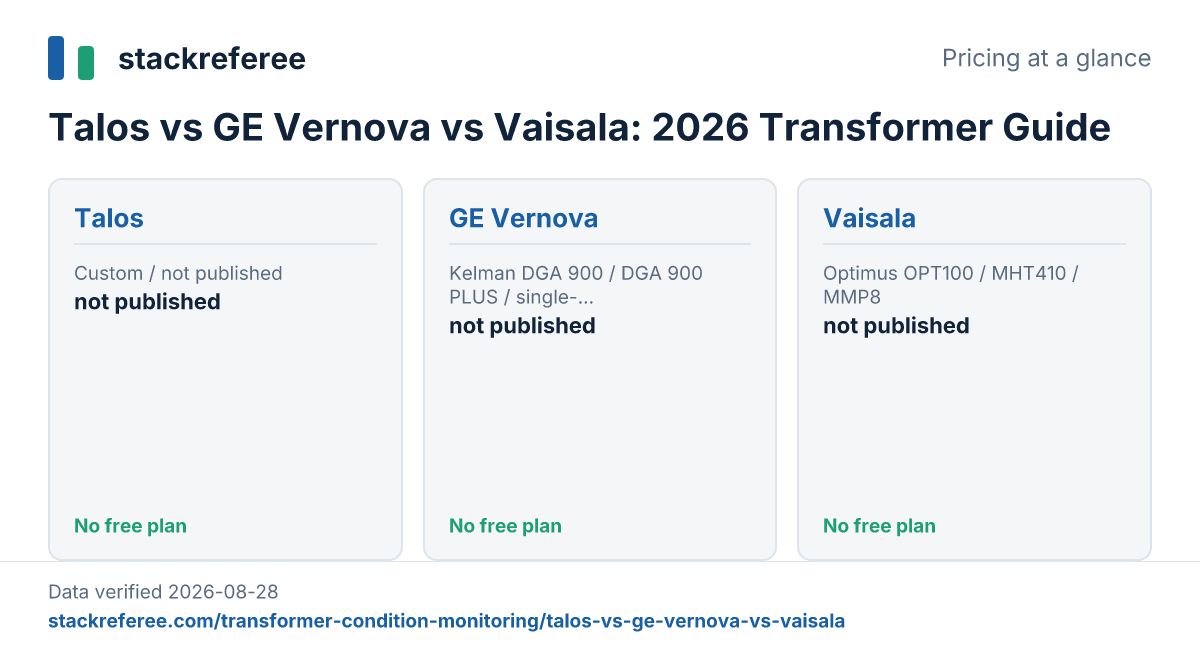
| Starting price | Not published; contact sales | Not published; contact sales | Not published; contact sales |
| Free plan | None published | None published | None published |
| Core differentiator | Vibration, EM field, and temperature/humidity sensing with 3D fault localization | Modular DGA 900 PLUS sensor cards (bushing, PD, OLTC, cooling, thermal model) | Air leak detection plus DGA and moisture-in-oil in one device |
| GDPR | Unknown | Yes | Yes |
| SOC 2 | Unknown | Unknown | Unknown |
| SSO/SAML | Unknown | Yes | Unknown |
| Other certifications | Unknown | IEC 62443-2-4, ISO 27001 (business-unit level) | IEC 61010, ISO 27001 |
What Is Talos?
Talos is a Y Combinator-backed startup (F26 batch per YC's monitoring industry listing) founded by Amitav Kohli, Kevin Hwang, and Himani Musku. It positions itself around "transformer and motor condition intelligence" rather than transformers alone, which sets it apart from the two established industrial vendors in this comparison. The product installs non-invasive sensors that track vibration, electromagnetic field signatures, and temperature/humidity continuously, then applies a machine-specific ML baseline to flag deviations. Its 3D fault localization aims to tell technicians not just that something changed, but roughly where inside the asset to look. Talos does not publish dissolved gas analysis capability, funding figures beyond its YC listing, or compliance certifications, so treat its scale and enterprise-readiness claims as unverified until you ask directly.
What Is GE Vernova?
GE Vernova sells transformer monitoring hardware through its Grid Solutions business, most visibly the Kelman DGA 900 nine-gas monitor and its extended Kelman DGA 900 PLUS variant. The PLUS version adds optional sensor cards for bushing condition, partial discharge, on-load tap changer (OLTC) monitoring, and thermal modeling, letting a single platform scale from basic gas tracking to a fuller diagnostic picture. Fleet-level data rolls up into GridBeats APM, GE Vernova's cloud software for asset performance management, which supports SSO/SAML. Grid Solutions holds an IEC 62443-2-4 Secure Service Provider Process certification and ISO 27001 status, though both apply at the business-unit or manufacturing-site level rather than confirmed specifically for the Kelman device line.
What Is Vaisala?
Vaisala is an established measurement instruments company whose transformer offering centers on the Optimus OPT100 dissolved gas analysis monitor, alongside the MHT410 and MMP8 devices referenced in its product pricing pages. The OPT100 measures dissolved gases and moisture in oil, and Vaisala added an optional O2+N2 sensor module with deliveries starting summer 2025 per its April 2025 press release. Fleet data feeds into Jade Smart Cloud for Power, a cloud dashboard for tracking DGA readings across multiple transformers. Vaisala holds ISO 27001 certification for information security and IEC 61010 for the OPT100's electrical safety, but has not published IEC 62443 industrial cybersecurity status or SSO/SAML support for its monitoring line.
Talos: Pros and Cons
Pros
Non-invasive installation with continuous monitoring. Talos sensors attach externally rather than requiring oil sampling connections, which matters if you need to instrument in-service assets without an outage window. Combined with continuous online monitoring, this lowers the operational cost of getting a fleet instrumented in the first place.
3D fault localization paired with a machine-specific ML baseline. Rather than a generic threshold alert, Talos aims to tell you roughly where in the asset a fault is developing, calibrated against a baseline built for that specific machine. That combination is not listed for either GE Vernova or Vaisala in the current feature set.
Coverage spans transformers and motors. The product site frames Talos as condition intelligence for both asset classes, which is useful for sites running mixed static and rotating equipment under one monitoring contract instead of two separate vendor relationships.
Cons
No dissolved gas analysis. Talos cannot detect the gas signatures, such as acetylene or methane buildup, that GE Vernova and Vaisala use as primary indicators of insulation faults. If your maintenance program is built around gas-in-oil trending, Talos does not replace that workflow.
No published compliance certifications. GDPR, SOC 2, SSO/SAML, IEC 62443, and ISO 27001 status are all unknown for Talos as of August 2026. That is not evidence of non-compliance, but it means procurement teams with security checklists have nothing public to verify against.
No public pricing or scale figures. As a YC-backed startup, Talos has not published pricing tiers, funding totals, or deployment counts. That makes it harder to size up against GE Vernova's and Vaisala's decades of installed base for a large utility RFP.
GE Vernova: Pros and Cons
Pros
Full nine-gas DGA plus modular add-ons. The Kelman DGA 900 PLUS extends base gas monitoring with optional bushing, partial discharge, OLTC, cooling, and thermal-model sensor cards, so one hardware platform can grow with your diagnostic needs instead of forcing a new purchase.
Cloud fleet software with confirmed enterprise access controls. GridBeats APM supports SSO/SAML, and Grid Solutions holds an IEC 62443-2-4 Secure Service Provider Process certification, giving security teams a concrete certification to check rather than a vendor claim alone.
Maintenance-free operation with no consumables. The monitoring line is built to run without replaceable consumable parts, which reduces the recurring field-service visits that some DGA hardware requires.
Cons
Not non-invasive. Installing the Kelman DGA 900 line means tapping into the transformer's oil system, unlike Talos's external sensor approach. That typically means more planning around outage windows for retrofits.
No vibration, electromagnetic field, or temperature/humidity sensing. All three are marked false in GE Vernova's feature set, so mechanical and electrical anomaly signals that Talos's sensor suite captures fall outside what Kelman devices report.
Certifications are confirmed at the business-unit level, not the device level. IEC 62443-2-4 and ISO 27001 apply to Grid Solutions broadly; SOC 2 status for the Kelman product line or GridBeats APM specifically is not published.
Vaisala: Pros and Cons
Pros
DGA, multi-gas, and moisture-in-oil coverage comparable to GE Vernova. The Optimus OPT100 measures the same core categories of oil chemistry data, giving fleets a second credible option for gas-based diagnostics.
Air leak detection unavailable from the other two. This is the one feature in the matrix unique to Vaisala, useful for identifying seal or gasket failures that pure gas-analysis or vibration monitoring would miss.
Cloud fleet software plus ISO 27001 certification. Jade Smart Cloud for Power aggregates DGA readings across a fleet, and Vaisala's ISO 27001 certification gives buyers a verifiable information-security credential to point to.
Cons
Not non-invasive. Like the Kelman line, the OPT100 requires an oil-based installation rather than external sensors, so retrofit planning looks closer to GE Vernova's than to Talos's.
No bushing, partial discharge, OLTC, or thermal-model add-ons. Vaisala's published feature set stops at core DGA and moisture monitoring; it does not extend into the additional diagnostic layers GE Vernova's DGA 900 PLUS offers.
SSO/SAML and IEC 62443 status are unpublished. Vaisala confirms ISO 27001 and IEC 61010 electrical safety, but has not published industrial cybersecurity or single sign-on details, leaving less to verify than GE Vernova on that front.
Use Case Comparison
Utilities running large power transformer fleets that need deep oil diagnostics. GE Vernova and Vaisala both fit here, since both offer dissolved gas analysis and moisture-in-oil monitoring. Choose GE Vernova if you also need bushing, partial discharge, or OLTC monitoring bundled into the same hardware. Choose Vaisala if air leak detection matters more to your maintenance program than those add-on sensor cards.
Sites that want retrofit monitoring without an oil-system outage. Talos is the only one of the three built around non-invasive sensor installation, which makes it the practical fit for distribution transformers, motors, or any asset where scheduling a tap-in installation is difficult. If your assets already have oil sampling ports installed, this advantage matters less.
Organizations with strict cybersecurity procurement checklists. GE Vernova is the clearer fit, with a confirmed IEC 62443-2-4 Secure Service Provider Process certification and SSO/SAML support on GridBeats APM. Vaisala offers ISO 27001 but has not published IEC 62443 or SSO details, and Talos has no published compliance information at all as of this writing. For a broader look at how compliance-focused vendors document certifications, see our TrustAI vs Vanta vs Drata vs Secureframe: 2026 guide.
Pricing
Talos Pricing
Talos does not publish a pricing page. The site directs prospects to request a demo or contact sales directly, with no published plan names, per-sensor rates, or subscription tiers. As a hardware-plus-software startup, a per-asset or per-sensor subscription model is plausible, but no figures are published to confirm that structure.
Pricing verified on August 28, 2026.
GE Vernova Pricing
The Kelman DGA 900, DGA 900 PLUS, and single-gas monitor line are sold through direct quote or tender, standard for industrial hardware at this scale. DGA 900 PLUS pricing varies with which optional sensor cards you add (bushing, partial discharge, OLTC, cooling, thermal model), so no single list price applies across configurations.
Pricing verified on August 28, 2026.
Vaisala Pricing
Vaisala's Optimus OPT100, MHT410, and MMP8 devices are sold through regional sales teams and distributors with no published list pricing. The optional O2+N2 sensor module for the OPT100, shipping from summer 2025, is priced separately with no public figure available.
Pricing verified on August 28, 2026.
None of the three vendors in this comparison publish list prices, which is typical for direct-sales industrial monitoring hardware. Budget for a quote cycle rather than a self-serve checkout; see our editorial policy for how we source and verify vendor claims.
What Users Say
We could not locate published customer reviews for any of the three products on G2, Capterra, Trustpilot, GetApp, ProductHunt, or TrustRadius. That is not unusual for industrial hardware sold through direct sales and tender processes rather than self-serve SaaS purchasing, and it applies equally to Talos, GE Vernova's Kelman line, and Vaisala's Optimus line. Rather than fabricate quotes or estimate sentiment, we are flagging the gap directly, consistent with our editorial policy. If you have deployed any of these systems and want to share feedback, we will update this section with attributed, sourced quotes rather than paraphrased impressions.
Verdict: Which Should You Choose?
Choose Talos if you need non-invasive retrofit monitoring across transformers and motors, value 3D fault localization and a machine-specific ML baseline over gas chemistry data, and can accept unverified compliance status while the company is early-stage.
Choose GE Vernova if you run a large power transformer fleet that needs full dissolved gas analysis plus optional bushing, partial discharge, OLTC, and thermal-model monitoring on one platform, and your procurement process requires a confirmed IEC 62443-2-4 certification with SSO/SAML support.
Choose Vaisala if you want dissolved gas analysis and moisture-in-oil monitoring with the added benefit of air leak detection, are comfortable with ISO 27001 as your primary published security credential, and don't need GE Vernova's bushing/PD/OLTC add-on sensors.
There is no way to rank these three on price today; none publish figures, so request quotes from all three before you commit to an installation method.
Recap
| Talos | GE Vernova | Vaisala | |
|---|---|---|---|
| Price | Not published; contact sales | Not published; contact sales | Not published; contact sales |
| Best-fit audience | Sites needing non-invasive sensor retrofits on transformers and motors | Utilities needing full DGA plus bushing/PD/OLTC add-ons | Fleets needing DGA, moisture monitoring, and air leak detection |
| Core differentiator | Vibration/EM field/temperature sensing with 3D fault localization | Modular Kelman DGA 900 PLUS sensor cards | Air leak detection unique among the three |
FAQ
What is the best alternative to Talos for transformer monitoring?
If you need dissolved gas analysis rather than sensor-based vibration and electromagnetic monitoring, GE Vernova's Kelman DGA 900 PLUS and Vaisala's Optimus OPT100 are the closest alternatives. Both measure oil chemistry directly; Talos does not perform DGA at all, so the choice depends on whether your maintenance program is built around gas-in-oil data.
Is Vaisala cheaper than GE Vernova?
There is no public way to answer this. Neither vendor publishes list prices for its transformer monitors; both sell through direct quotes or regional distributors. Talos, a YC-backed startup, also has no published pricing. You need to request quotes from all three to compare actual cost.
Does Talos perform dissolved gas analysis (DGA)?
No. Talos's feature set covers vibration monitoring, electromagnetic field monitoring, and temperature/humidity monitoring with non-invasive sensors. It does not offer dissolved gas analysis, multi-gas monitoring, or moisture-in-oil monitoring, which are core to GE Vernova's and Vaisala's product lines.
Which transformer monitoring vendor supports SSO/SAML?
GE Vernova confirms SSO/SAML support alongside its IEC 62443-2-4 Secure Service Provider certification. Vaisala's SSO/SAML status is not published for its Optimus line or Jade Smart Cloud for Power platform. Talos publishes no compliance information at all, so treat its status as unverified rather than absent.
Is GE Vernova's Kelman DGA 900 non-invasive?
No. The Kelman DGA 900 and DGA 900 PLUS install using oil-based sampling connections rather than external, non-invasive sensors. Vaisala's Optimus OPT100 uses a similar invasive installation approach. Talos is the only one of the three built around non-invasive sensor installation.
What makes Talos different from GE Vernova and Vaisala?
Talos monitors transformers and motors through external vibration, electromagnetic field, and temperature/humidity sensors with 3D fault localization and a machine-specific ML baseline. GE Vernova and Vaisala both center on dissolved gas analysis of the insulating oil instead, which requires a different installation method entirely.
Does Vaisala offer air leak detection?
Yes. Air leak detection is a feature unique to Vaisala among the three vendors compared here; neither Talos nor GE Vernova lists this capability in their published feature sets. It complements Vaisala's DGA and moisture-in-oil monitoring on the Optimus line.
Are Talos, GE Vernova, and Vaisala GDPR compliant?
GE Vernova and Vaisala both confirm GDPR compliance on their corporate privacy pages. Talos has no published GDPR statement as of August 2026, which does not mean it is non-compliant, only that the claim cannot be verified from public sources.
Frequently asked questions
What is the best alternative to Talos for transformer monitoring?
If you need dissolved gas analysis (DGA) rather than sensor-based vibration and electromagnetic monitoring, GE Vernova's Kelman DGA 900 PLUS and Vaisala's Optimus OPT100 are the closest alternatives. Both measure oil chemistry directly; Talos does not perform DGA at all, so the choice depends on whether your maintenance program is built around gas-in-oil data.
Is Vaisala cheaper than GE Vernova?
There is no public way to answer this. Neither vendor publishes list prices for its transformer monitors; both sell through direct quotes or regional distributors. Talos, a YC-backed startup, also has no published pricing. You need to request quotes from all three to compare actual cost.
Does Talos perform dissolved gas analysis (DGA)?
No. Talos's feature set covers vibration monitoring, electromagnetic field monitoring, and temperature/humidity monitoring with non-invasive sensors. It does not offer dissolved gas analysis, multi-gas monitoring, or moisture-in-oil monitoring, which are core to GE Vernova's and Vaisala's product lines.
Which transformer monitoring vendor supports SSO/SAML?
GE Vernova confirms SSO/SAML support alongside its IEC 62443-2-4 Secure Service Provider certification. Vaisala's SSO/SAML status is not published for its Optimus line or Jade Smart Cloud for Power platform. Talos publishes no compliance information at all, so treat its status as unverified rather than absent.
Is GE Vernova's Kelman DGA 900 non-invasive?
No. The Kelman DGA 900 and DGA 900 PLUS install using oil-based sampling connections rather than external, non-invasive sensors. Vaisala's Optimus OPT100 uses a similar invasive installation approach. Talos is the only one of the three built around non-invasive sensor installation.
What makes Talos different from GE Vernova and Vaisala?
Talos monitors transformers and motors through external vibration, electromagnetic field, and temperature/humidity sensors with 3D fault localization and a machine-specific ML baseline. GE Vernova and Vaisala both center on dissolved gas analysis of the insulating oil instead, which requires a different installation method entirely.
Does Vaisala offer air leak detection?
Yes. Air leak detection is a feature unique to Vaisala among the three vendors compared here; neither Talos nor GE Vernova lists this capability in their published feature sets. It complements Vaisala's DGA and moisture-in-oil monitoring on the Optimus line.
Are Talos, GE Vernova, and Vaisala GDPR compliant?
GE Vernova and Vaisala both confirm GDPR compliance on their corporate privacy pages. Talos has no published GDPR statement as of August 2026, which does not mean it is non-compliant, only that the claim cannot be verified from public sources.
Comments
No comments yet.