COSMOS vs Orca Aerospace vs STK: Which Fits in 2026?
Picking software to plan, launch, and operate a satellite mission means picking for three very different jobs at once: pre-launch analysis, ground-based command and control, and increasingly, autonomous decisions made onboard the spacecraft itself. COSMOS, Orca Aerospace, and STK each answer one of those jobs more directly than the other two, and conflating them leads to costly procurement mistakes. Teams that buy STK expecting a ground-ops console, or buy COSMOS expecting orbital-analysis tooling, end up needing a second vendor within a budget cycle anyway. This comparison walks through what each tool actually documents, what it doesn't, and where the evidence runs out, so you can scope a procurement decision instead of a wish list.
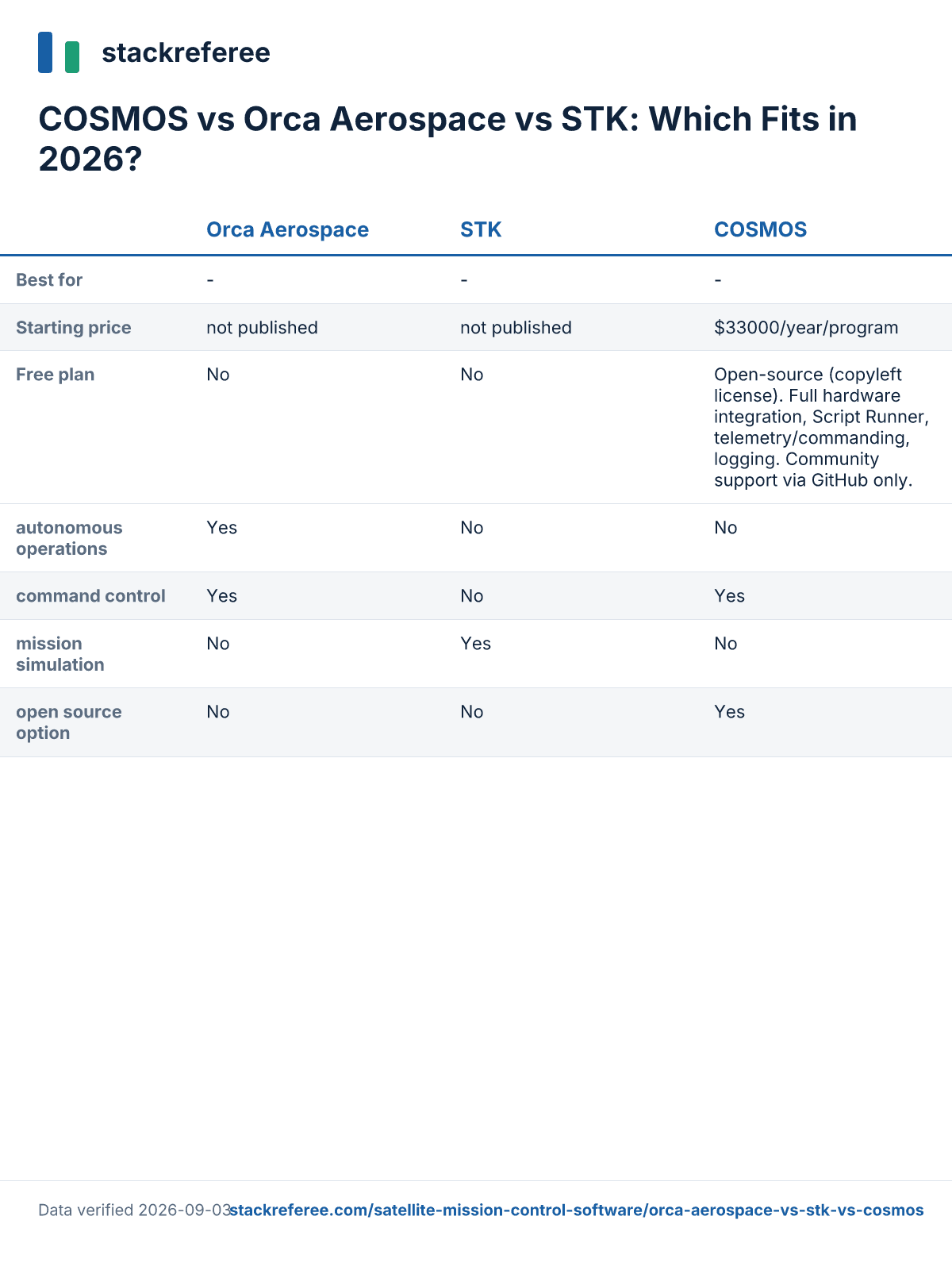
| COSMOS | Orca Aerospace | STK | |
|---|---|---|---|
| Best for | Multi-vendor command and control with an open-source core | Onboard autonomous AI decisioning for flight software | Pre-mission simulation and orbital analysis |
| Starting price | Free (COSMOS Core); $33,000/year for Enterprise Single Purpose | Not published; contact sales | Not published; contact sales |
| Free plan | Yes, COSMOS Core (full feature set, GitHub community support) | No | No (free trial via licensing portal) |
| Core differentiator | Multi-vendor hardware support plus an open-source foundation | Autonomous operations running onboard the spacecraft | Depth of orbital analysis and mission simulation |
| GDPR / SOC 2 | GDPR: yes; SOC 2: unknown | Both unknown | GDPR: unknown; SOC 2: referenced only at the parent Ansys company level |
| SSO/SAML | Yes, Enterprise tier only (LDAP/Keycloak) | Unknown | Unknown |
What is COSMOS
COSMOS is command and control software built by OpenC3 for, in the vendor's own framing, "anything with hardware." The product ships as an open-source core (COSMOS Core) under a copyleft license, covering hardware integration, Script Runner automation, telemetry and commanding, and logging at no cost. COSMOS Enterprise sits on top of that same core and adds SSO/SAML, RBAC, and audit logging through LDAP/Keycloak integration, along with per-program licensing instead of seat-based pricing. OpenC3 ships quarterly releases starting from version 7.2+. The multi-vendor hardware support is the headline differentiator: teams running mixed fleets, from a single satellite constellation to a drone fleet, use one system instead of stitching together vendor-specific ground software. Because the licensing model counts operational units and named projects rather than seats or nodes, a program can add engineers to a mission without triggering a new negotiation every time headcount changes.
What is Orca Aerospace
Orca Aerospace builds mission control software designed to run onboard the spacecraft rather than on the ground. The company is part of Y Combinator's Fall 2026 batch, which puts it at the earliest stage of the three tools covered here. Its feature set centers on autonomous operations and onboard AI decisioning, alongside command and control and telemetry monitoring capabilities. That combination suggests a product meant to replace parts of a traditional ground-station loop rather than sit alongside it, though the company hasn't published architecture documentation detailed enough to confirm exactly how much ground involvement remains. Orca Aerospace states it is registered for US government and defense contract work via a CAGE code, but no specific certifications such as ITAR handling or CMMC are documented publicly. No pricing, plans, or tiers appear on the product site or its Y Combinator profile; interested teams need to contact founders@orcaaerospace.com directly.
What is STK
STK (Systems Tool Kit) is AGI/Ansys's mission analysis platform, built around mission simulation, orbital analysis, API integration, and scripting automation. It ships in four editions: STK Pro as the entry point, STK Premium (Space) and STK Premium (Air) for higher-fidelity domain-specific modeling, and STK Enterprise as the most comprehensive tier. AGI's release notes show active development through version 12.9.0, and the AWS Marketplace listing and Ansys's own corporate security program documentation both confirm the product sits within the Ansys family alongside its broader engineering-simulation lineup. STK is built specifically for orbital mechanics and mission analysis workloads rather than general-purpose ground software, and its four-edition structure points to a mature, actively maintained product line rather than a single fixed release. Whether it extends into live ground operations rather than pre-mission planning is not something AGI's own product pages confirm one way or the other, which matters if you're scoping it as an operations tool rather than an analysis tool.
Pros and cons: COSMOS
Free, full-featured open-source core
COSMOS Core costs $0 forever and still includes hardware integration, Script Runner, telemetry and commanding, and logging. Teams can run a complete command-and-control stack without a procurement cycle, then decide later whether Enterprise features are worth paying for.
Multi-vendor hardware support built into the product
COSMOS is explicitly designed to work across hardware vendors, with feature-matrix confirmation for multi-vendor hardware support, API integration, and scripting automation. That matters for programs mixing components or vehicles from different suppliers rather than standardizing on one vendor's stack.
Enterprise tier adds real compliance controls
COSMOS Enterprise layers SSO/SAML, RBAC, and audit logging on top of the free core through LDAP/Keycloak integration. For regulated ground-ops teams, that's a documented, direct upgrade path rather than a rebuild, since the underlying scripting and telemetry layer doesn't change between tiers.
Enterprise features are gated behind a paid tier
SSO/SAML, RBAC, and audit logging exist only in COSMOS Enterprise, not in the free Core tier. Teams that need those controls from day one should budget for the $33,000/year Single Purpose license before assuming the free option covers them.
No mission simulation or orbital analysis capability
The feature matrix marks mission_simulation as false for COSMOS. It's a command-and-control and telemetry tool, not a pre-launch planning tool, so programs still need something like STK upstream of it.
SOC 2 status is unconfirmed
OpenC3 markets COSMOS Enterprise as "FIPS-ready," but no linked audit report or certificate was found. Treat SOC 2 as unknown rather than assumed, and ask OpenC3 directly for documentation if that's a procurement requirement.
Pros and cons: Orca Aerospace
Purpose-built for onboard autonomous decisioning
Orca Aerospace's feature set centers on autonomous_operations and onboard_ai_decisioning, a category distinct from both COSMOS and STK. For programs that need decisions made without a ground-station round trip, that's the specific gap it targets.
Covers command and control plus telemetry monitoring
Beyond autonomy, the feature matrix also confirms command_control and telemetry_monitoring support, suggesting the product handles more than just the AI-decisioning layer on its own, though public documentation doesn't spell out how those pieces integrate with existing ground infrastructure.
Backed by Y Combinator with a defense-market registration
Being part of the YC Fall 2026 batch and holding a CAGE code for US government and defense contracts signals intent to serve that market, even without certifications to back it up yet. That combination tends to attract early defense-adjacent pilot programs willing to move before a vendor's compliance paperwork catches up.
No published pricing anywhere
There's no price list, plan structure, or tier breakdown on the product site or the Y Combinator profile. Every prospective buyer has to start a sales conversation at founders@orcaaerospace.com before knowing what a program would cost.
No mission simulation capability
The feature matrix marks mission_simulation as false. Programs still need a separate tool, such as STK, for pre-launch orbital analysis before Orca Aerospace's onboard software takes over in flight.
No documented compliance posture
GDPR, SOC 2, and SSO/SAML are all marked unknown. Combined with the company's early stage, procurement teams with strict compliance gates should expect a longer diligence process before signing, and should ask directly rather than assuming any certification is in progress.
Pros and cons: STK
Deep mission simulation and orbital analysis
Mission simulation and orbital analysis are the two categories STK's own product pages describe most thoroughly, and they're the two capabilities missing from both COSMOS and Orca Aerospace. That makes it the pre-launch planning tool of the three.
API integration and scripting automation
STK supports API integration and scripting automation per its feature matrix, letting teams build repeatable analysis pipelines rather than running scenarios manually each time a mission parameter changes.
Four editions to match fidelity to budget
STK Pro, Premium (Space), Premium (Air), and Enterprise let a team scale up modeling fidelity as a program matures, and a free trial is available through AGI's licensing portal before committing to any edition.
No published pricing for any edition
None of the four editions have public prices. Both AGI's own licensing portal and the AWS Marketplace listing confirm pricing runs through a direct sales relationship, so every quote requires a conversation with info@agi.com.
Live command and control is unconfirmed
AGI's comprehensive feature descriptions don't document real-time telemetry monitoring or live command-and-control functionality the way COSMOS and Orca Aerospace do. That capability may exist through add-on modules like STK Connect or third-party ground-system integration, but it isn't something the vendor's own materials confirm directly, so verify with AGI/Ansys before assuming either way.
Compliance claims sit at the company level, not the product level
The SOC 2 reference for STK traces back to a third-party reseller page describing Ansys's broader corporate security program, not a primary AGI page specific to STK. GDPR and SSO/SAML support aren't documented for the STK product at all, which is worth flagging early if a program has a hard compliance checklist.
Use-case comparison
Open-source, budget-conscious ground operations teams with mixed hardware. COSMOS is the direct fit: the Core tier is free and covers hardware integration, telemetry, commanding, and logging out of the box, and the Enterprise Multi Product tier ($165,000/year) is explicitly built for unlimited operational units across hardware vendors within one named project. A small team can start on Core, prove the architecture on real hardware, and only negotiate an Enterprise license once compliance or scale requirements show up.
Pre-launch mission planning and orbital analysis. STK covers this ground more thoroughly than the other two, with dedicated editions for space and air domain modeling plus scripting automation for repeatable analysis. Neither COSMOS nor Orca Aerospace documents mission simulation at all, so STK effectively sits upstream of both, feeding trajectory and coverage analysis into whichever operations tool a program picks next.
Autonomous, onboard decisioning for defense-adjacent programs. Orca Aerospace is the only one of the three built around onboard AI decisioning rather than ground-station operations. It fits early-stage constellations or defense programs willing to work with a Y Combinator-stage vendor and negotiate pricing directly, but it isn't a substitute for pre-launch simulation or a mature compliance program, so treat it as a complement to, not a replacement for, the other two categories.
Pricing
COSMOS pricing
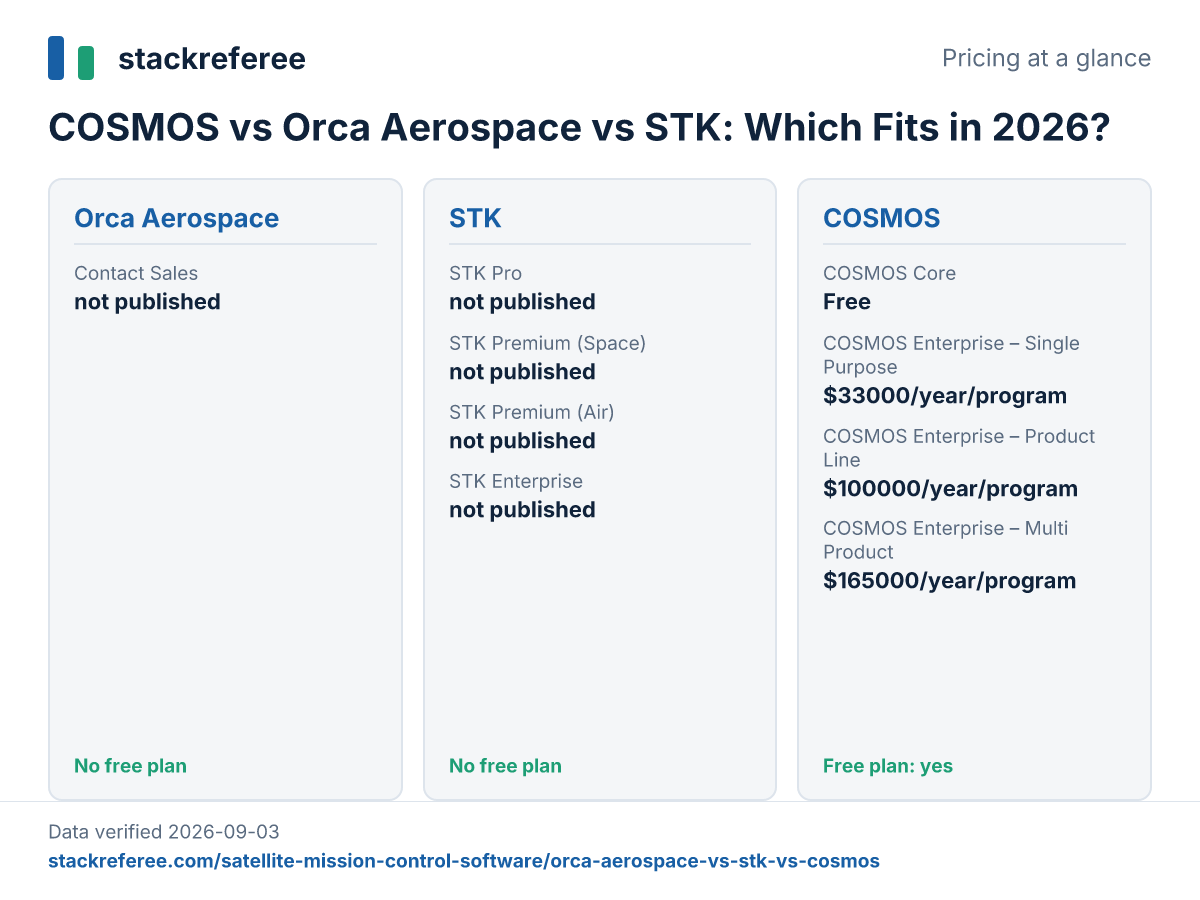
COSMOS Core is free forever, with full hardware integration, Script Runner, telemetry and commanding, and logging, supported through GitHub only. COSMOS Enterprise is licensed per program rather than by seat or node: the Single Purpose tier runs $33,000/year for up to 5 operational units or one named non-operational project, with prepaid and perpetual-license options available. The Product Line tier runs $100,000/year for unlimited operational units within a single product line, such as one satellite constellation or drone fleet. The Multi Product tier runs $165,000/year for unlimited operational units from any hardware vendor within one named mission-operations project. Because none of the three tiers charge per seat, a program's cost stays flat even as its engineering team grows, which is worth factoring into a multi-year budget comparison against per-seat competitors.
Pricing verified on September 3, 2026.
Orca Aerospace pricing
Orca Aerospace has not published pricing, plans, or tiers on its product site or its Y Combinator profile. Given the company's early stage (Y Combinator Fall 2026 batch) and its focus on onboard flight software for defense-adjacent programs, pricing is almost certainly negotiated per contract rather than sold as a subscription. Contact founders@orcaaerospace.com for a quote, and expect a scoping conversation before receiving a number, since the product's stage means most deals will likely be structured around a specific mission or pilot program rather than an off-the-shelf plan.
Pricing verified on September 3, 2026.
STK pricing
STK Pro, the entry edition, has no published price; the AWS Marketplace listing notes that "pricing and entitlements... managed through an external billing relationship between you and the vendor." STK Premium (Space) and STK Premium (Air) add higher-fidelity domain-specific modeling, also without published pricing. STK Enterprise, the most comprehensive edition, likewise requires a sales conversation, though a free trial is available through AGI's licensing portal. Contact info@agi.com for a quote on any edition, and use the trial period to validate that the fidelity level you need is actually included in the edition you're being quoted, rather than assuming Enterprise-level modeling ships in Pro.
Pricing verified on September 3, 2026.
What users say
None of the three tools have listings or reviews on G2, Capterra, Trustpilot, GetApp, ProductHunt, or TrustRadius as of September 2026, which is common for niche aerospace and defense B2B software that mainstream SaaS review sites don't cover. STK does appear on AWS Marketplace, but that listing shows 0 star ratings and 0 reviews, checked explicitly rather than assumed absent. OpenC3's own cosmos-enterprise page includes a quote from its COO about the licensing model, but that's vendor-supplied marketing copy rather than an independent reviewer quote from a review platform, so it's excluded here rather than presented as third-party validation. The absence of public reviews isn't unusual for this category, but it does mean you can't shortcut diligence with review-site star ratings the way you might for horizontal SaaS. If you need social proof before buying any of these three, plan to ask each vendor for reference customers directly rather than relying on public review sites, and treat any case study a vendor supplies as a starting point for your own reference calls, not as independent confirmation.
Verdict per use case
Choose COSMOS if you need command and control across mixed hardware vendors, want to start on a free open-source tier, and can pay $33,000/year and up once you need SSO/SAML, RBAC, or audit logging. It's the strongest documented option for ground-based, multi-vendor operations among the three, and the free Core tier gives you a real way to prototype before any money changes hands.
Choose Orca Aerospace if you're building an early-stage or defense-adjacent program that needs onboard autonomous decisioning rather than ground-station control, and you're comfortable negotiating pricing directly with a Y Combinator-stage company that hasn't published compliance certifications yet. Weigh that flexibility against the diligence work you'll need to do yourself, since the vendor hasn't done it publicly.
Choose STK if your immediate need is pre-launch mission simulation and orbital analysis rather than live operations, and you want an established four-tier product line to match fidelity to your budget, keeping in mind that live command-and-control support isn't documented and pricing requires a sales call either way. Use the free trial to confirm fidelity before you negotiate an edition.
None of the three covers all three jobs. Most real programs will end up pairing STK for pre-launch analysis with either COSMOS or Orca Aerospace for the operational phase, depending on whether operations run from the ground or onboard, and budgeting for two vendors from the start avoids a mid-program scramble.
Recap table
| COSMOS | Orca Aerospace | STK | |
|---|---|---|---|
| Price | Free (Core); $33,000-$165,000/year (Enterprise) | Not published; contact sales | Not published; contact sales |
| Best for | Multi-vendor ground command and control | Onboard autonomous AI decisioning | Pre-mission simulation and orbital analysis |
| Core differentiator | Open-source foundation with paid compliance add-ons | Onboard autonomy for defense-adjacent programs | Depth of orbital analysis across four editions |
Where to go next
If you're still narrowing down the right category of tool, browse the full set of Satellite Mission Control Software comparisons for other vendors in this space. Programs that also touch broader engineering simulation work may find the Vorelios vs Ansys vs COMSOL Multiphysics: 2026 Guide useful, since Ansys owns AGI and STK, and the modeling concepts carry over between the two categories. Defense-adjacent teams evaluating Orca Aerospace's government contract positioning might also want the GovSpend vs Capveon vs GovTribe: 2026 Buyer's Guide for adjacent procurement tooling, and programs running mixed-hardware fleets similar to COSMOS's drone-fleet use case can compare ground options in the Skydio vs DroneDeploy vs Degla Inc: 2026 Comparison. For more on how listings are chosen, see our editorial policy.
Frequently asked questions
Is COSMOS free to use for satellite mission control?
The core product, COSMOS Core, is free and open source, with full hardware integration, Script Runner, telemetry and commanding, and logging. Support is community-based through GitHub only. COSMOS Enterprise, which adds SSO/SAML, RBAC, and audit logging, starts at $33,000/year per program for the Single Purpose tier.
How much does STK cost?
AGI/Ansys does not publish pricing for any STK edition (Pro, Premium Air, Premium Space, or Enterprise). The AWS Marketplace listing confirms pricing runs through a direct billing relationship with the vendor. Contact info@agi.com for a quote, or use the free trial available through AGI's licensing portal.
What is Orca Aerospace used for?
Orca Aerospace builds onboard mission control software focused on autonomous operations and onboard AI decisioning, rather than ground-based simulation or command centers. It's an early-stage company (Y Combinator Fall 2026 batch) registered for US government and defense contracts, with no published pricing yet.
Does COSMOS support SSO and SAML?
Only on COSMOS Enterprise, via LDAP/Keycloak integration. The free COSMOS Core tier does not include SSO/SAML, RBAC, or audit logging; those are Enterprise-only capabilities layered on top of the open-source foundation.
Can STK handle live command and control, or only simulation?
STK's own product pages describe mission simulation, orbital analysis, API integration, and scripting automation. Live command-and-control and real-time telemetry monitoring aren't documented in AGI's comprehensive feature descriptions, so treat that as an open question to confirm directly with Ansys/AGI before assuming either way.
Is Orca Aerospace GDPR or SOC 2 compliant?
No compliance certifications are documented publicly. Orca Aerospace states it's registered for US government and defense contract work (CAGE code), but no ITAR, CMMC, GDPR, or SOC 2 specifics are verifiable from public sources as of September 2026.
What's the difference between COSMOS Core and COSMOS Enterprise?
COSMOS Core is the free, open-source foundation: hardware integration, scripting, telemetry, commanding, and logging, with GitHub-only support. COSMOS Enterprise adds SSO/SAML, RBAC, and audit logging, plus per-program licensing that starts at $33,000/year rather than per-seat pricing.
Which tool is best for a satellite constellation with mixed hardware vendors?
COSMOS is built around multi-vendor hardware support, and its Enterprise Multi Product tier ($165,000/year) explicitly covers unlimited operational units from any hardware vendor within one named mission-operations project, which fits mixed-vendor constellations better than STK or Orca Aerospace's current scope.
Comments
No comments yet.