Libra Robotics vs Dusty Robotics vs Built Robotics (2026)
Before comparing features and pricing, it's worth naming the elephant in the room. "Construction robotics" is a wide category, and these three vendors occupy different corners of it. Libra Robotics installs solar panels. Dusty Robotics prints interior layouts. Built Robotics retrofits excavators. Treat this as a guide to three adjacent options rather than a head-to-head shootout between rivals fighting for the same budget line.
That framing matters for how you read the rest of this article. If you already know which job you need solved, solar install, interior layout, or earthwork retrofit, you can skip straight to the relevant pros and cons section. If you are scoping construction robotics broadly for the first time, the use-case comparison further down maps each vendor to the contractor profile it actually serves, rather than forcing a single winner across three unrelated jobs.
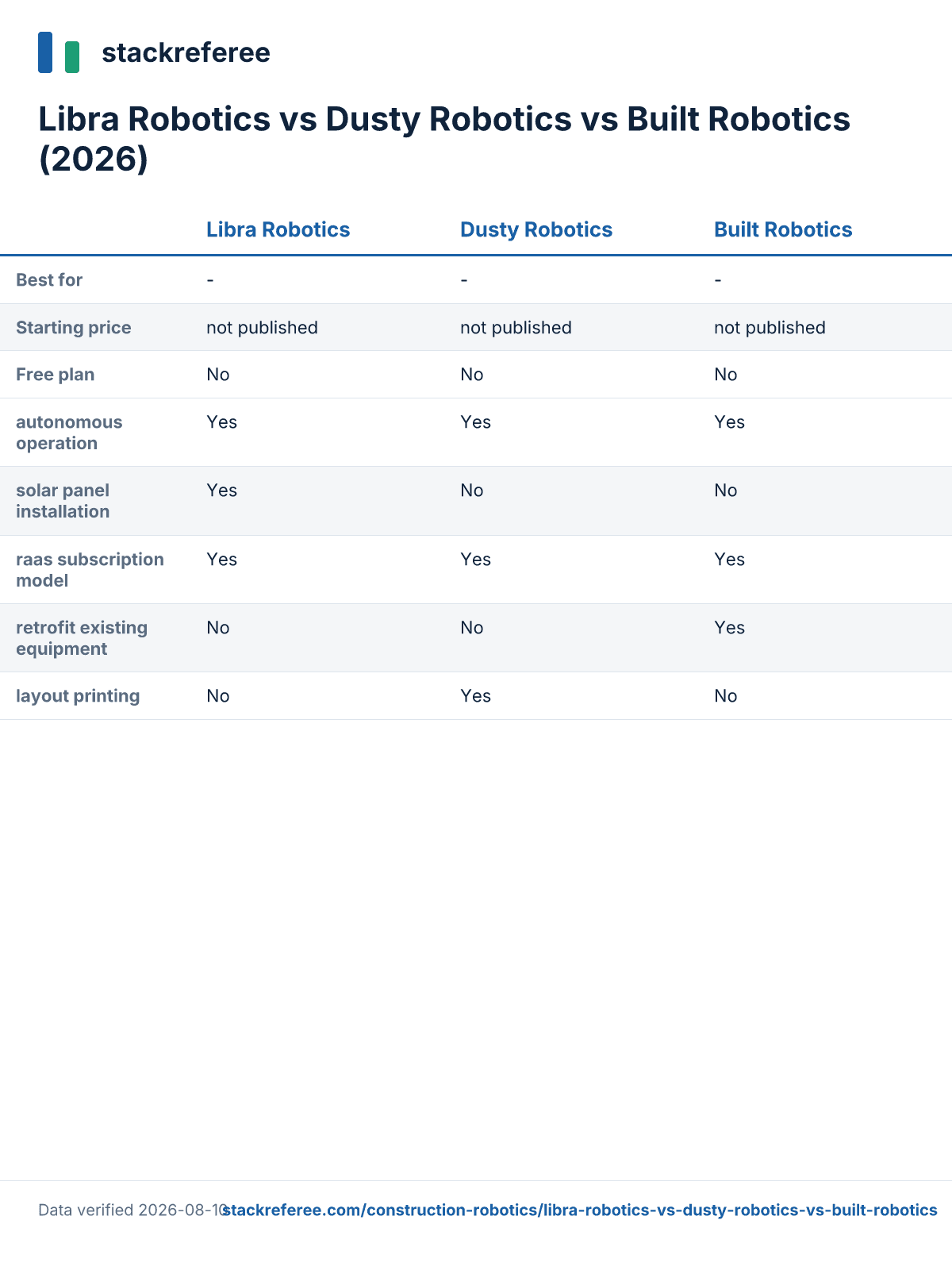
| Libra Robotics | Dusty Robotics | Built Robotics | |
|---|---|---|---|
| Best for | Autonomous solar panel installation on utility-scale farms | BIM-driven interior layout printing across multiple trades | Retrofitting excavators for autonomous trenching and grading |
| Starting price | Not published; custom Robotics-as-a-Service quote | Not published; usage-based, billed per day of layout use | Not published; vendor site did not disclose a pricing page |
| Free plan | None disclosed | None disclosed | None disclosed |
| Core differentiator | Night operation plus remote supervision, no upfront capital | FieldPrinter marks full-scale BIM layouts at 1/16-inch accuracy | Exosystem retrofit kit works on equipment you already own |
| Compliance (GDPR/SOC 2) | Not publicly disclosed | Not publicly disclosed | Not publicly disclosed |
| SSO/SAML | Not publicly disclosed | Not publicly disclosed | Not publicly disclosed |
What is Libra Robotics
Libra Robotics builds autonomous robots for installing solar panels on utility-scale solar farms, including at night, with remote human supervision rather than constant on-site operators. The company runs on a Robotics-as-a-Service model that its Y Combinator profile describes as requiring no upfront capital investment from the customer, which lowers the barrier for solar EPC firms to test autonomous install crews without buying equipment outright. Libra Robotics is very early stage: it is part of the Y Combinator Summer 2026 batch, and as of August 4, 2026 its own YC profile listed one paid project in execution and five more in the pipeline. Its target buyer is solar EPC and installation contractors racing to hit panel-count deadlines with fewer bodies on site during off-hours. Note that Libra Robotics, the robotics company, is unrelated to the similarly named Libra Solar utility project in Nevada; do not conflate the two when researching further.
What is Dusty Robotics
Dusty Robotics builds the FieldPrinter, an autonomous robot that takes BIM data and prints full-scale layout marks directly onto a job site's concrete slab, accurate to 1/16 of an inch according to its own pricing page. The system pairs the robot with a Dusty Portal software layer, a laser tracker, and an iPad plus joystick for on-site control, and it supports multiple trades working from the same layout rather than a single specialty. General contractors including Skanska and Turner Construction have documented their use of Dusty Robotics in customer case studies published on Dusty's own site and Turner's insights page. Availability is North America only, so international general contractors should confirm coverage before assuming the FieldPrinter is deployable on an overseas job.
What is Built Robotics
Built Robotics makes autonomy retrofit kits, marketed as the Exosystem, that turn excavators and other heavy equipment into autonomous machines rather than replacing the fleet with new purpose-built robots. Its technology page emphasizes GPS RTK positioning and obstacle detection for safety, and its trenching solutions page describes what it calls the industry's first fully autonomous trenching offering. Built Robotics raised $64 million specifically for construction vehicle autonomy kits, according to its own press release, which points to more capital behind the company than Libra Robotics has disclosed. Its target buyer is earthwork, utility, and grading contractors that want to automate machines they already operate rather than commit to an entirely new robotic fleet.
Libra Robotics: pros and cons
Pros
Robotics-as-a-Service removes the upfront capital hurdle. Libra Robotics' own Y Combinator profile describes a RaaS model that requires no upfront capital investment from the customer. For a solar EPC firm deciding whether to test autonomous installation, that structure turns a capex decision into an opex trial, which lowers the barrier to a first pilot project without tying up a balance sheet.
Night operation opens a second shift without new headcount. The feature matrix confirms night_operation support, meaning panel installation can continue after daylight hours under remote supervision. On a schedule-driven solar build where panel count against deadline is the metric that matters, that is extra install capacity without adding a full night crew of human installers.
Remote supervision reduces on-site staffing needs. With remote_supervision confirmed in the feature set, a smaller on-site team can oversee multiple robots working a farm simultaneously, rather than pairing one operator to one machine at all times. That ratio is worth asking about directly, since the public record does not state how many robots one supervisor can manage.
Cons
The company has almost no track record yet. As of August 4, 2026, Libra Robotics' own YC profile listed a single paid project in execution and five in the pipeline. That is a real gap against Dusty Robotics and Built Robotics, both of which have multi-year vendor case studies to point to, and it means reference checks will be thin for now.
Independent safety certification is unconfirmed. Libra Robotics has stated it carries product liability insurance, per its YC profile, but no independent safety audit or third-party certification of the robots themselves was found. For utility-scale sites with strict safety sign-off requirements, that is worth raising directly with the vendor before a contract is signed.
The scope is narrow by design. The feature matrix shows retrofit_existing_equipment, layout_printing, and excavation_grading all marked false. Libra Robotics does one job, solar panel installation, and nothing in the public record suggests it is expanding beyond that scope soon, so it will not consolidate other robotics needs on the same project.
Dusty Robotics: pros and cons
Pros
BIM-to-slab printing removes manual layout steps. With bim_integration and layout_printing both confirmed, the FieldPrinter takes coordinates straight from the model and marks them on the ground at 1/16-inch accuracy, per Dusty's own pricing page. That precision figure is one of the few hard numbers either vendor discloses, and it directly replaces a manual chalk-line process prone to cumulative error.
Multi-trade support spreads the value across a project. The feature matrix confirms multi_trade_support, meaning framing, MEP, and other trades can work from one printed layout instead of each trade re-measuring independently. Skanska's published case study with Dusty Robotics is one documented example of this in practice, and it reduces the rework that comes from mismatched trade-by-trade layout marks.
Tablet and joystick control keeps the learning curve manageable. The system ships with an iPad tablet plus joystick for on-site operation, according to Dusty's pricing page, rather than requiring specialized robotics training for the crew running it day to day. That matters for GCs rotating field staff across projects.
Cons
Coverage stops at the North American border. The feature matrix flags north_america_only, so contractors running international projects cannot currently deploy Dusty Robotics on those sites without a separate solution, and no public timeline for expansion was found.
The scope is interior layout, not site work. retrofit_existing_equipment, solar_panel_installation, and excavation_grading are all marked false in the feature matrix. Dusty Robotics solves layout printing well but has no answer for earthwork or solar installation needs on the same project, so a contractor running both scopes needs a second vendor regardless.
Pricing is usage-based and opaque until you call sales. Dusty's own pricing page describes billing per day of layout usage plus a separate high-volume enterprise tier, but no rates are published. Budgeting a multi-floor project means requesting a custom quote before you can compare costs against alternatives on a dollar basis.
Built Robotics: pros and cons
Pros
Retrofitting existing machines avoids a fleet replacement. retrofit_existing_equipment is confirmed true, and the Exosystem is built to upgrade excavators a contractor already owns. That is a materially different capital story than Libra Robotics or Dusty Robotics, both of which deploy their own dedicated robots, and it can be the deciding factor for a contractor with a young excavator fleet already paid down.
Excavation and grading autonomy comes with safety features built in. The feature matrix confirms excavation_grading, safety_obstacle_detection, and gps_rtk_positioning together, which Built Robotics' technology page frames as the core of its autonomy stack for trenching and grading work on active sites.
The company has meaningfully more capital behind it than Libra Robotics. Built Robotics' own press release states it raised $64 million for construction vehicle autonomy kits. That is a concrete, sourced figure that suggests more runway and scale than Libra Robotics has disclosed to date, which matters if you are weighing long-term vendor viability over a multi-year contract.
Cons
Layout printing and solar installation are both out of scope. layout_printing and solar_panel_installation are marked false in the feature matrix. If a project needs interior layout or panel installation alongside earthwork, Built Robotics does not cover those needs on its own, so a general contractor running mixed scopes should plan for multiple vendors.
Pricing is not on the vendor's own site at all. Automated attempts to fetch a pricing page from builtrobotics.com returned an HTTP 403 response. Third-party estimates exist, but they are unverified against Built Robotics' own numbers, so treat any dollar figure you see elsewhere as a starting point for a sales conversation, not a quote you can budget against.
International availability of the Exosystem is unconfirmed. No public source confirms whether Built Robotics currently supports jobs outside North America, so contractors bidding overseas work should ask directly before assuming coverage, rather than discovering a gap mid-procurement.
Use-case comparison
Utility-scale solar EPC contractors. If the job is installing panels across acres of farmland on a tight schedule, Libra Robotics is the only one of the three built for that task, with night operation and remote supervision as its stated differentiators. Weigh its early-stage track record, one paid project in execution as of early August 2026, against that fit before committing a large farm to it, and consider starting with a smaller pilot block rather than a full farm rollout.
General contractors coordinating multiple trades on one floor plate. Dusty Robotics is the fit when framing, MEP, and other trades all need to work from one BIM-accurate layout instead of independent chalk lines. Skanska and Turner Construction have both documented using it this way. Confirm the project is in North America first, and request a usage-based quote scoped to your floor count before committing to a schedule.
Earthwork and utility contractors with an existing excavator fleet. Built Robotics is built for exactly this: keep the machines you own, add the Exosystem, and get autonomous trenching and grading with obstacle detection. It is the strongest choice when the capital case for a whole new robot fleet does not pencil out, though you should push the vendor for a written quote since public pricing does not exist.
Pricing
Libra Robotics pricing
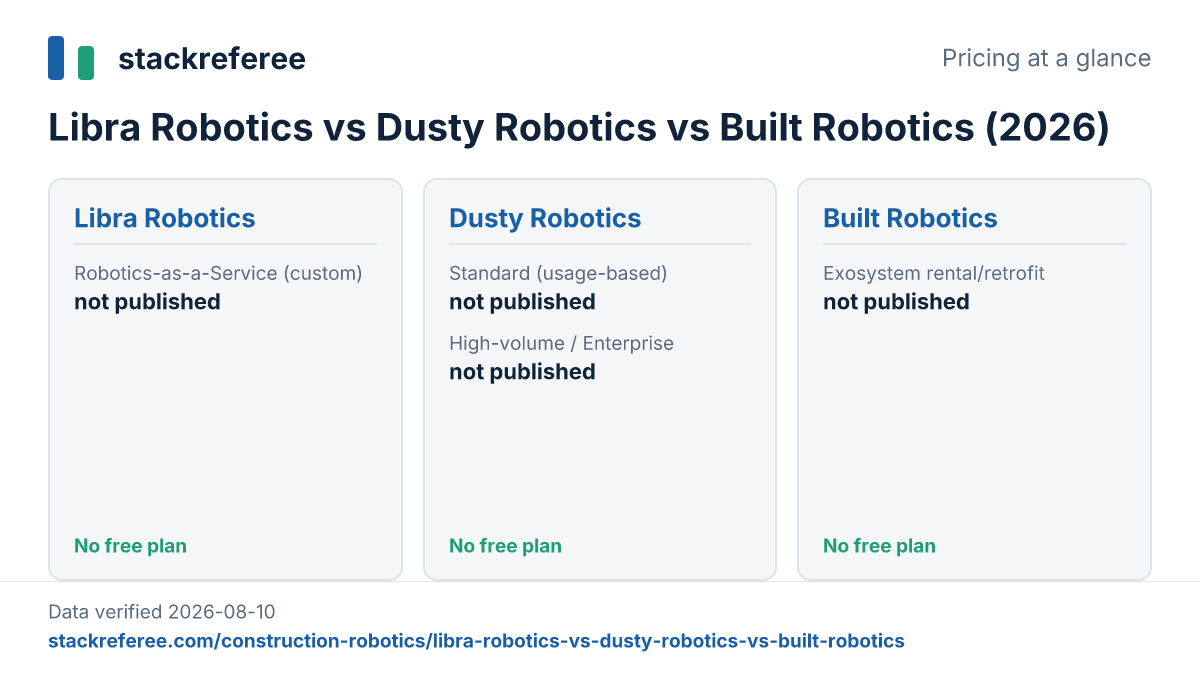
Libra Robotics has not published a pricing page on its own site. Its Y Combinator profile describes a Robotics-as-a-Service model that requires no upfront capital investment from the customer, but exact rates, whether structured per project, per panel, or per month, are not disclosed publicly. Contractors interested in a pilot need to contact Libra Robotics directly for a project quote, and given the company's one-project track record as of early August 2026, it is reasonable to ask for a smaller pilot scope before a farm-wide commitment.
Pricing verified on August 10, 2026.
Dusty Robotics pricing
Dusty Robotics runs a usage-based model billed per day the FieldPrinter is used on a jobsite, scaled to the layout scope, according to its own pricing page. All plans include the Dusty Portal software, the Laser Tracker rated at 1/16-inch accuracy, the FieldPrinter robot itself, an iPad tablet with joystick, and US-based support. High-volume customers can request additional plans, per the same page, but no dollar figures are published for either tier, so budget conversations should start with an estimated day count for your project.
Pricing verified on August 10, 2026.
Built Robotics pricing
Built Robotics does not publish a pricing page, and direct automated attempts to fetch pricing details from builtrobotics.com returned an HTTP 403 response rather than usable content. The company's own materials describe an Exosystem rental or retrofit arrangement priced per machine per month plus usage, but no confirmed dollar amounts are available from the vendor. Third-party outlets cite estimates in the range of $3,000 per machine per month plus hourly usage fees, or $150,000 to $250,000 for an outright retrofit, but these are unverified secondary figures rather than vendor-confirmed pricing. Confirm current rates directly with Built Robotics sales before comparing total cost of ownership to a fleet purchase.
Pricing verified on August 10, 2026.
What users say
No independent review-platform coverage was found for any of the three vendors. As of August 10, 2026, Libra Robotics, Dusty Robotics, and Built Robotics have no listings on G2, Capterra, Trustpilot, GetApp, or ProductHunt, and no quotes from those platforms could be sourced for this comparison. That gap is typical for capital-equipment and direct-enterprise-sales robotics vendors that sell through account teams rather than self-serve trials, and it means you should not expect a star rating or aggregate review score to lean on during procurement.
What does exist is vendor-published case study material: Dusty Robotics has documented deployments with Skanska and with Turner Construction, and Built Robotics has documented work referenced in a case study published by Silicon Valley Bank alongside Mortenson. Those are useful signals that real contractors have used these systems on real jobs, but they are not neutral third-party reviews, and this article does not present them as such. If independent reviews matter to your evaluation, ask each vendor for reference customers you can contact directly, and ask specifically about schedule impact and rework rates rather than general satisfaction.
Verdict per use case
Choose Libra Robotics if your priority is autonomous solar panel installation on a utility-scale farm, you want to test it without a large upfront equipment purchase, and you are comfortable being an early adopter of a Y Combinator Summer 2026 company with a thin public track record so far.
Choose Dusty Robotics if you are a general contractor or trade crew running interior layout from a BIM model across multiple trades, your projects are in North America, and you want a documented history with large GCs like Skanska and Turner Construction.
Choose Built Robotics if you already own excavators and want to add autonomous trenching or grading capability without replacing your fleet, and you are willing to work through a sales conversation to get an actual quote since no rates are published.
Whichever direction fits, treat all three pricing conversations the same way: ask for a written quote scoped to your project before you compare total cost of ownership across vendors, and confirm insurance, safety sign-off, and geographic coverage in writing rather than assuming they match your existing procurement checklist.
Recap table
| Libra Robotics | Dusty Robotics | Built Robotics | |
|---|---|---|---|
| Price | Custom RaaS quote, not published | Usage-based per day, not published | Per machine per month plus usage, not published |
| Best-fit audience | Utility-scale solar EPC contractors | GCs and trade crews doing interior layout | Earthwork and utility contractors with existing fleets |
| Core differentiator | Night-capable autonomous solar install with remote supervision | BIM-accurate FieldPrinter layout at 1/16-inch precision | Exosystem retrofit kit for machines you already own |
For more options in this vertical, see our overview of construction robotics comparisons. Related autonomy categories worth a look include our guides to drone fleet management software and humanoid robots, both of which face similar early-market pricing opacity, and our comparison of firmware simulation software for teams evaluating adjacent hardware-adjacent tooling. To understand how we select and label vendors in comparisons like this one, read our editorial policy.
Frequently asked questions
Is Libra Robotics the same category of company as Dusty Robotics or Built Robotics?
Not exactly. Libra Robotics builds autonomous robots for solar panel installation on utility-scale farms. Dusty Robotics prints BIM-derived layouts on interior slabs. Built Robotics retrofits excavators for autonomous trenching and grading. They sit in the same construction robotics vertical but rarely compete for the same purchase order, so comparing them is closer to comparing three adjacent specialists than three rivals bidding on the same scope of work.
How much does Dusty Robotics cost?
Dusty Robotics does not publish rates. Its pricing page describes a usage-based model billed per day of FieldPrinter utilization on a jobsite, scaled to the layout scope, with separate high-volume enterprise plans available on request. All tiers bundle the Dusty Portal, Laser Tracker, FieldPrinter robot, and an iPad plus joystick. Contact Dusty Robotics sales for a project-specific quote before you budget a multi-floor job.
Does Built Robotics sell equipment or rent it?
Built Robotics' own site does not publish a pricing page, so the rental-versus-purchase split is not vendor-confirmed. Third-party estimates describe a monthly-plus-usage rental model alongside an outright retrofit option priced in the low six figures, but treat those figures as unverified until Built Robotics confirms them directly with a written quote.
Is Libra Robotics a proven vendor or an early-stage startup?
Libra Robotics is early stage. It is part of Y Combinator's Summer 2026 batch, and its own YC profile described one paid project in execution and five in the pipeline as of August 4, 2026. Funding amount and team size are not disclosed publicly. Weigh that maturity gap against the more established Dusty Robotics and Built Robotics before committing a large site to it.
Can Built Robotics work with excavators I already own?
Yes. Built Robotics' Exosystem is designed as a retrofit kit for existing heavy equipment, which is the opposite approach from Libra Robotics and Dusty Robotics, both of which deploy their own purpose-built robots rather than upgrading machines you already operate. That distinction is the single biggest factor in deciding which vendor fits your capital plan.
Does Dusty Robotics work outside North America?
Based on available data, Dusty Robotics is North America only. If your projects run internationally, confirm current availability directly with Dusty Robotics before including it in a global rollout plan, since no public source describes an international expansion timeline.
Which of these three has published GDPR or SOC 2 compliance?
None of them, as of August 10, 2026. Libra Robotics, Dusty Robotics, and Built Robotics are hardware and Robotics-as-a-Service vendors rather than typical multi-tenant SaaS platforms, so standard SaaS compliance badges may not apply the way they would for a cloud app. Ask each vendor directly if compliance documentation matters for your procurement process.
Are there independent reviews of Libra Robotics, Dusty Robotics, or Built Robotics?
None were found on G2, Capterra, Trustpilot, GetApp, or ProductHunt as of August 10, 2026. That is common for capital-equipment and direct-enterprise-sales robotics vendors that sell through account teams rather than self-serve trials. Vendor-published case studies exist for Dusty Robotics and Built Robotics, but they are not neutral third-party reviews.
Comments
No comments yet.